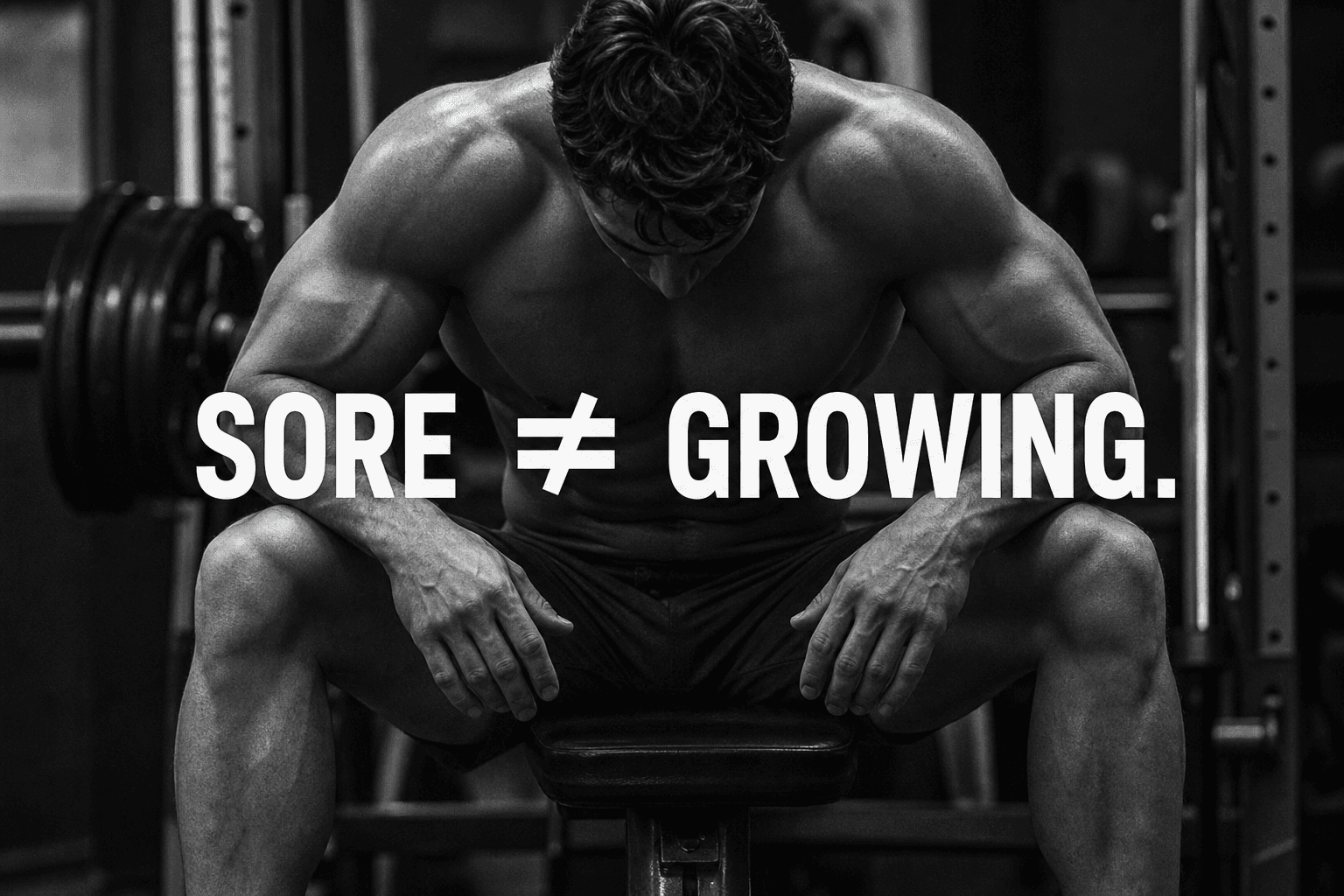
Soreness is not a measure of muscle growth.
3 studies · Zhang 2026 meta-analysis
4 min read
The myth: no pain, no gain
You crushed a workout. The next morning you can barely sit down. That feeling — delayed-onset muscle soreness (DOMS) — gets treated like a receipt: proof that you trained hard enough, that your muscles got the signal to grow.
It's not. Soreness tells you that tissue was stressed and that an inflammatory response is underway. It says almost nothing about how much new muscle protein will be laid down over the next 48–72 hours.
The belief is understandable — DOMS peaks after novel, high-damage workouts, and novel training does drive growth. But correlation isn't causation, and the two signals can be cleanly separated.
Soreness tells you tissue was stressed. It says almost nothing about how much new muscle will be built.
Eccentric training is the perfect test case
Eccentric (lowering) contractions cause significantly more mechanical damage than concentric ones — and therefore more soreness. Accentuated eccentric loading (AEL), where you intentionally overload the lowering phase, is one of the most reliable ways to guarantee you'll be sore tomorrow.
So if soreness drove hypertrophy, AEL should produce noticeably more muscle growth than standard constant-load training. It doesn't.
A 2026 systematic review and meta-analysis of 49 studies (773 participants) found that AEL and constant-load resistance training produce similar hypertrophy outcomes — despite AEL generating substantially greater mechanical disruption and DOMS (Zhang et al., 2026). The training stimulus that causes the most soreness does not produce proportionally more muscle.
That's the clearest controlled signal we have: you can dial soreness up without dialing growth up.
AEL causes more damage and more soreness — yet produces similar hypertrophy to standard training.
— Zhang et al. (2026). Acute and Chronic Effects of Accentuated Eccentric Loading vs. Constant-Load Resistance Training: A Systematic Review and Meta-analysis. Sports Med.
You can kill soreness without killing gains
If soreness were the mechanism behind muscle growth, anything that reliably reduces it should also blunt adaptation. That's not what happens.
Heat therapy is a good example. Applying heat before or after training — via hot water immersion or microwave diathermy — consistently reduces muscle soreness and speeds the restoration of muscle function post-exercise (McGorm et al., 2018). Yet the same review found evidence that heating muscle can actually enhance strength-training adaptations for muscle mass in some contexts — not impair them.
You don't need to feel destroyed to grow. You need a sufficient mechanical and metabolic stimulus, adequate protein, and recovery. Soreness is a side effect of the process, not the engine.
Reducing damage can actually support growth
β-Hydroxy-β-methylbutyrate (HMB) — a leucine metabolite — reduces markers of muscle damage and attenuates soreness after hard training. If soreness equaled growth, HMB would be a gains-killer. It isn't.
The International Society of Sports Nutrition's 2025 position stand concludes that HMB's anti-inflammatory and anti-catabolic actions may actually promote muscle growth and repair by suppressing excessive protein breakdown while maintaining protein synthesis (Rathmacher et al., 2025). Less damage, less soreness — and potentially better net hypertrophy, not worse.
This is a recurring pattern in the literature: interventions that reduce the collateral damage of training don't necessarily reduce adaptation. They can free up resources for actual rebuilding.
HMB reduces soreness and muscle damage — and the ISSN says it may promote muscle growth, not impair it.
— Rathmacher et al. (2025). International society of sports nutrition position stand: β-hydroxy-β-methylbutyrate (HMB). J Int Soc Sports Nutr.
What actually signals muscle growth
Hypertrophy is driven by three primary mechanisms: mechanical tension, metabolic stress, and muscle damage — but damage is the least important of the three, and it doesn't map cleanly onto soreness anyway.
Mechanical tension (progressive overload — lifting heavier or doing more volume over time) is the dominant driver. You can create plenty of tension with exercises that cause minimal soreness, especially once your body has adapted to them. Experienced lifters barely get sore from squats or rows, yet those movements still build muscle effectively.
Soreness also decreases with repeated exposure to the same exercise (the repeated bout effect) — meaning that by the time a movement is truly optimized in your program, it causes almost no DOMS at all. Chasing soreness by constantly rotating exercises is actually one of the fastest ways to slow your progress — you never give your body the repeated stimulus it needs to adapt.
The metrics that actually predict growth: progressive overload over weeks, sufficient weekly volume per muscle group, adequate protein intake (1.6–2.2 g/kg/day), and quality sleep. None of these show up as soreness.
Chasing soreness by rotating exercises constantly is one of the fastest ways to slow your progress.
How Planfit applies this
Planfit's programs are built around progressive overload — not novelty-chasing. The app tracks your loads and volumes across sessions, prompting increases in weight or reps when you're ready, so your training stimulus grows systematically rather than just feeling hard. If you finish a session and you're not particularly sore, that's fine. The log tells the real story.
When you do a new exercise or return from a break, Planfit will flag elevated effort — but it doesn't use soreness as a performance metric. Adaptation is measured in plates added and reps completed, not in how much trouble you have walking down stairs.
How Planfit applies this
Planfit's programs are built around progressive overload — not novelty-chasing. The app tracks your loads and volumes across sessions, prompting increases in weight or reps when you're ready, so your training stimulus grows systematically rather than just feeling hard. If you finish a session and you're not particularly sore, that's fine. The log tells the real story.
When you do a new exercise or return from a break, Planfit will flag elevated effort — but it doesn't use soreness as a performance metric. Adaptation is measured in plates added and reps completed, not in how much trouble you have walking down stairs.
References
- Zhang et al. (2026). Acute and Chronic Effects of Accentuated Eccentric Loading vs. Constant-Load Resistance Training: A Systematic Review and Meta-analysis.. Sports Medicine. 10.1007/s40279-026-02422-7
- McGorm et al. (2018). Turning Up the Heat: An Evaluation of the Evidence for Heating to Promote Exercise Recovery, Muscle Rehabilitation and Adaptation.. Sports Medicine. 10.1007/s40279-018-0876-6
- Rathmacher et al. (2025). International society of sports nutrition position stand: β-hydroxy-β-methylbutyrate (HMB).. Journal of the International Society of Sports Nutrition. 10.1080/15502783.2024.2434734