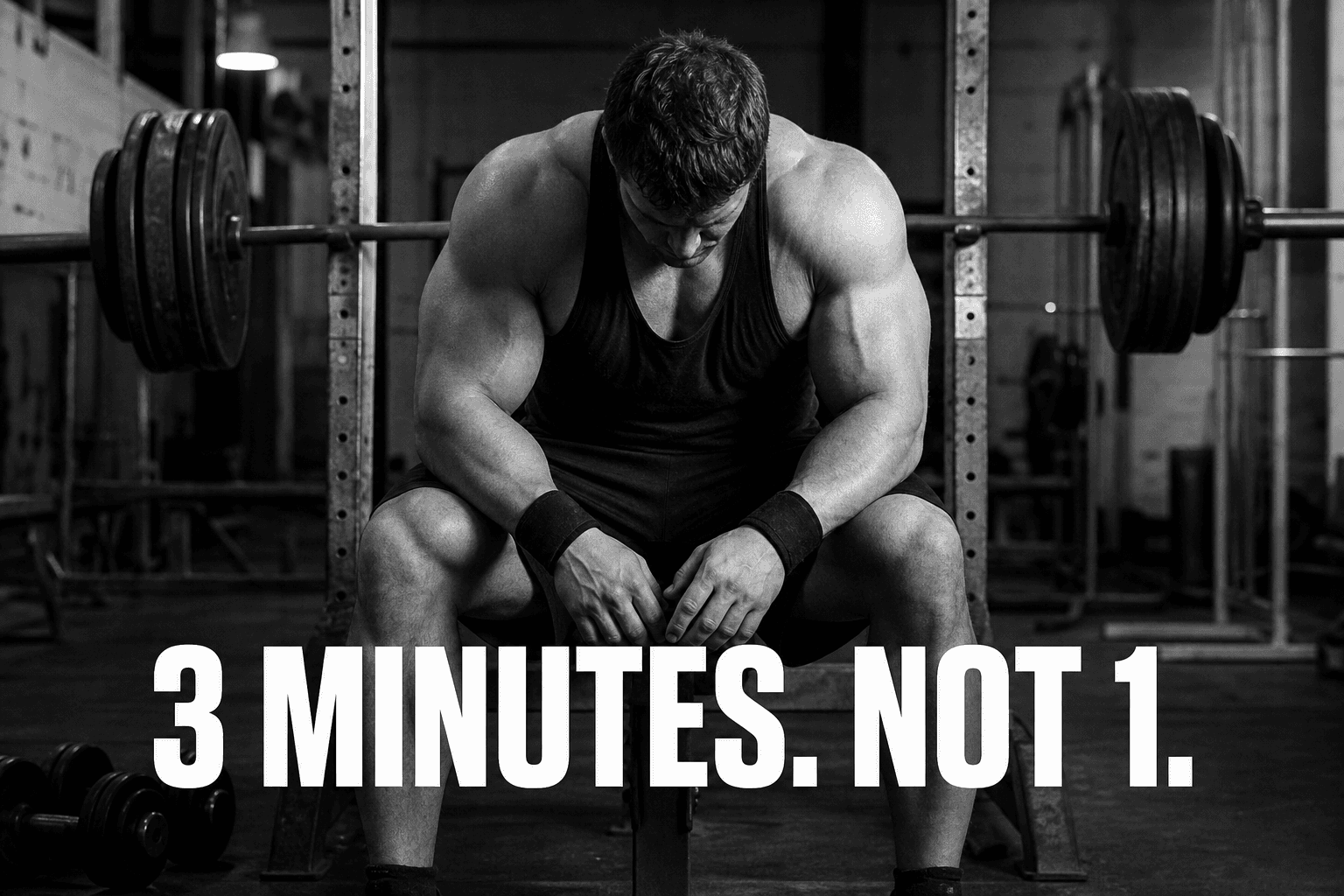
3 minutes beats 1 minute — and the data on rest periods is clearer than you think.
3 studies · Schoenfeld 2016 RCT + 2024 meta-analysis
5 min read
The number everyone gets wrong
Most gym-goers rest about 60–90 seconds between sets. It feels productive — you're staying in that "metabolic zone", keeping your heart rate up, not wasting time. The problem? That logic is mostly wrong.
Resting 3 minutes instead of 1 minute produced significantly greater gains in both strength and muscle thickness over 8 weeks of resistance training (Schoenfeld et al., 2016). The short-rest group didn't catch up. They fell behind — on every measure tested.
The conventional wisdom that short rest = more hypertrophy (because of the hormonal spike and metabolic stress) turns out to be one of the more persistent myths in training.
3-minute rest periods beat 1-minute rest periods on every strength and size measure tested.
— Schoenfeld et al. (2016). Longer Interset Rest Periods Enhance Muscle Strength and Hypertrophy in Resistance-Trained Men. J Strength Cond Res.
What Schoenfeld's RCT actually found
In 2016, Schoenfeld and colleagues ran one of the cleanest head-to-head tests on this question. Twenty-one trained men were split into two groups: one rested 1 minute between sets, the other rested 3 minutes. Everything else — exercises, sets, rep ranges (8–12 RM), weekly frequency — was identical across 8 weeks (Schoenfeld et al., 2016).
Results:
- 1RM squat and bench press: significantly greater in the 3-minute group.
- Muscle thickness (elbow flexors, triceps, quads): significantly greater in the 3-minute group for the anterior thigh, with trends favoring longer rest elsewhere.
- The 1-minute group did get stronger and bigger — just measurably less so.
The mechanism isn't complicated. Longer rest lets you recover more phosphocreatine, clear more lactate, and maintain higher force output on the next set. More force per rep over weeks = more stimulus.
The 2024 meta-analysis: the effect is real but smaller than you'd hope
A 2024 Bayesian meta-analysis pulled together 9 studies and 19 separate muscle measurements to get a cleaner estimate of how much rest interval duration actually matters for hypertrophy (Singer et al., 2024).
The honest answer: longer rest periods tend to win, but the margin is modest and the confidence intervals overlap.
- Short rest (typically ≤1 min): standardized mean difference of 0.48 for muscle growth.
- Longer rest (typically ≥2 min): standardized mean difference of 0.56.
- In controlled pairwise comparisons, the advantage for longer rest was +0.13 SMD for arms and +0.17 SMD for thighs — real, but not dramatic (Singer et al., 2024).
Translation: if you're chronically cutting rest to 45–60 seconds, you're probably leaving muscle on the table. But the difference between 2 minutes and 5 minutes is probably noise.
Longer rest showed +0.17 SMD for thigh hypertrophy vs. short rest — real, but the intervals overlap.
— Singer et al. (2024). Give it a rest: a systematic review with Bayesian meta-analysis on inter-set rest interval duration and muscle hypertrophy. Front Sports Act Living.
What about listening to your body instead of the clock?
Here's an interesting wrinkle. A 2022 RCT by Simão and colleagues compared a fixed 75-second rest interval against a self-selected rest interval (SSRI) — where lifters rested however long they felt they needed — over 8 weeks of upper-body training (Simão et al., 2022).
The SSRI group did significantly more total reps across all four exercises tested:
- Chest press: 26.1 reps vs. 21.5 reps per session on average.
- Shoulder press: 24.0 vs. 17.4 reps.
But here's the punchline: long-term strength gains were nearly identical between groups (SSRI: ~7.3% average gain; FRI: ~6.8%). When you let people rest until they feel ready, they do more volume per session but end up at roughly the same place strength-wise (Simão et al., 2022).
What this suggests: the body is reasonably good at self-regulating rest. If you're naturally taking 2–3 minutes between hard sets, you're probably doing it right. If you're forcing yourself to rush at 60 seconds because a timer told you to, that's the mistake.
So how long should you actually rest?
Here's a practical framework that the evidence supports:
For strength (1–5 rep range, heavy loads): 3–5 minutes.
You need near-complete phosphocreatine recovery to hit max force. Rushing this directly caps your output.
For hypertrophy (6–15 rep range): 2–3 minutes.
This is the Schoenfeld sweet spot. You get enough recovery to maintain rep quality across sets without waiting around so long that the session runs forever.
For muscular endurance / circuit work: 60–90 seconds.
If metabolic conditioning is the goal, short rest is the point — not a mistake.
If you're not sure: use SSRI. Rest until you feel ready to match your previous set's rep count. The Simão et al. (2022) data suggests this is a legitimate, evidence-backed strategy — not just impatience or laziness.
One caveat from the Singer et al. (2024) meta-analysis worth remembering: training to failure vs. stopping short of failure doesn't meaningfully change how rest intervals interact with hypertrophy. So the "rest more" advice applies whether you're grinding to absolute failure or leaving a rep or two in the tank.
What you should stop doing immediately
Two habits the evidence argues against:
1. Timing 60 seconds by default for everything. One minute is too short for compound, heavy sets if your goal is strength or meaningful hypertrophy. The Schoenfeld RCT showed the 1-minute group got measurably less out of 8 identical weeks of training (Schoenfeld et al., 2016). That's an avoidable cost.
2. Assuming more metabolic burn = better results. The short-rest "feel the burn" approach does spike lactate and GH transiently — but those hormonal blips don't translate into measurably better long-term muscle growth vs. resting longer (Singer et al., 2024). You're trading performance for a feeling.
The productive use of 60-second rest is cardio conditioning work — not hypertrophy training.
How Planfit applies this
Every program in Planfit has rest intervals baked in and calibrated to the goal of that specific session — strength, hypertrophy, or endurance. If you're doing a heavy compound day, the app prompts 3-minute rests automatically. Switch to a hypertrophy block, and it drops to 2 minutes. You can also enable the self-selected mode if you prefer to go by feel (consistent with Simão et al., 2022). No manual fiddling. Just train.
References
- Schoenfeld BJ, Pope ZK, Benik FM, et al. (2016). Longer Interset Rest Periods Enhance Muscle Strength and Hypertrophy in Resistance-Trained Men.. Journal of Strength and Conditioning Research. 10.1519/JSC.0000000000001272
- Singer N, Fitzgerald JS, Kline JR, et al. (2024). Give it a rest: a systematic review with Bayesian meta-analysis on the effect of inter-set rest interval duration on muscle hypertrophy.. Frontiers in Sports and Active Living. 10.3389/fspor.2024.1429789
- Simão R, Polito M, de Salles BF, et al. (2022). Acute and Long-Term Comparison of Fixed vs. Self-Selected Rest Interval Between Sets on Upper-Body Strength.. Journal of Strength and Conditioning Research. 10.1519/JSC.0000000000003606