Warm up before lifting: movement-specific wins — 4 studies
4 studies · 2 RCTs · J Sports Sci
6 min read
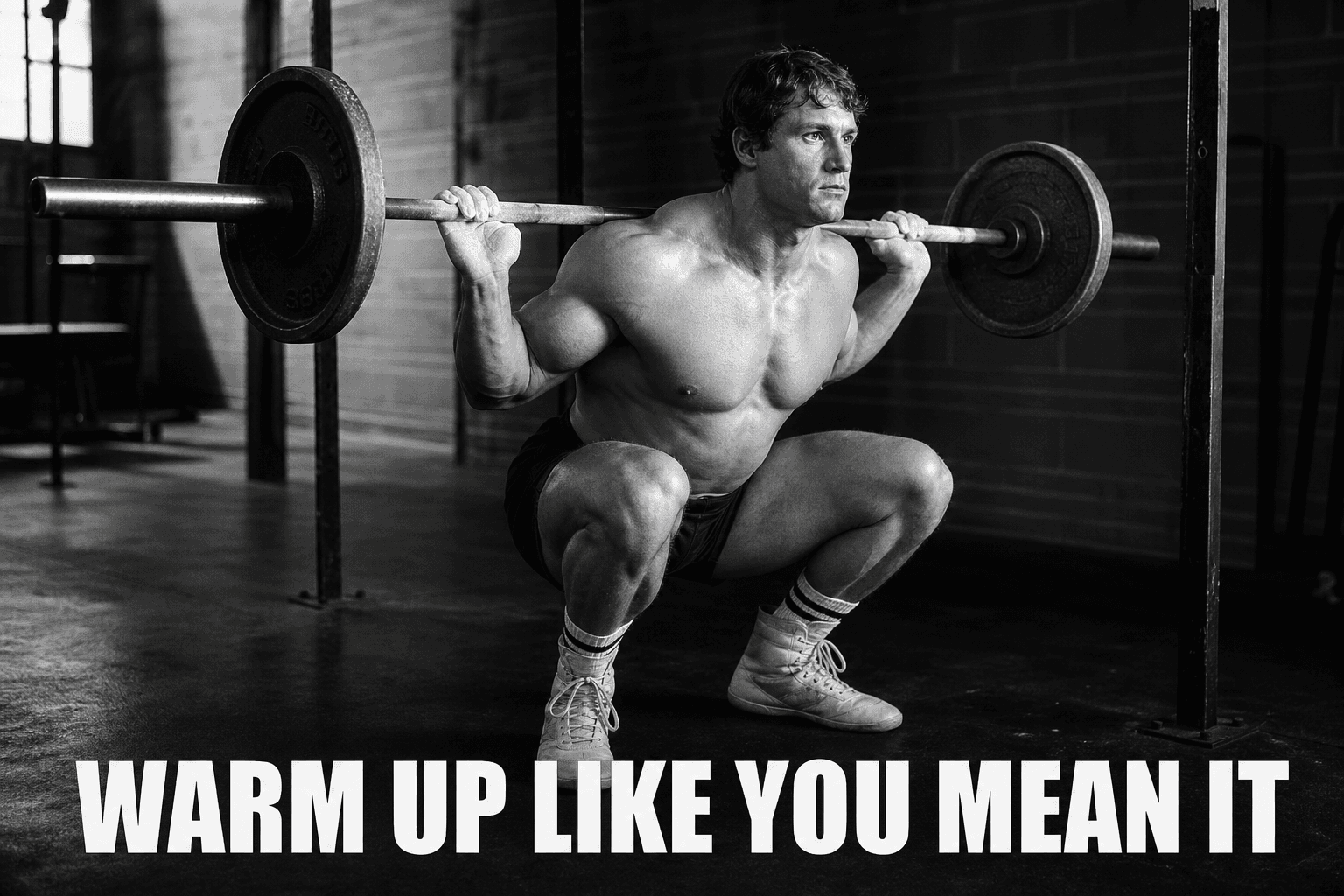
The answer: warm up with the lift you're about to do
Your warm-up doesn't need a treadmill, a foam roller, or ten minutes of static stretching. It needs to look like your workout.
A movement-specific warm-up — doing the same exercise at submaximal weight before your working sets — improves peak power output more than any other warm-up method tested so far. (Barnes et al., 2017)
That's the short answer. Everything below explains why, and what it means for how you structure the first 10–15 minutes of your session.
A movement-specific warm-up improved peak power output more than cycling, whole-body vibration, or a combination of both.
— Barnes et al. (2017). Effects of different warm-up modalities on power output during the high pull. J Sports Sci.
Why muscle temperature alone isn't enough
For years, the logic was simple: raise your body temperature, raise your performance. Cycle for 5 minutes, muscles get warmer, you're ready.
Barnes et al. (2017) tested exactly this. Nine resistance-trained men completed six different warm-ups before the high pull — an explosive barbell movement that is a good proxy for any compound lift you'd do in the gym. Conditions included cycling, whole-body vibration (WBV), a movement-specific high-pull warm-up, and combinations of those.
Cycling and WBV both raised muscle temperature by 2°C. That's a real thermal response. But the biggest jump in peak power output came from the movement-specific warm-up alone: +232.8 W on average. The combined conditions (cycle + specific, WBV + specific) added +158.6 W and +177.3 W respectively — both significantly less than movement-specific alone, and neither statistically different from it.
In plain terms: adding a cardio warm-up to your movement prep didn't help, and doing cardio instead of movement prep actively hurt performance. The mechanism isn't temperature — it's something in the neuromuscular system activating when you practice the exact pattern you're about to train.
What 'post-activation' actually means — and why your warm-up sets trigger it
You may have heard the term "post-activation potentiation" — or the newer term, "post-activation performance enhancement" (PAPE). Strip the jargon: it means that doing a heavy or challenging contraction before your main effort temporarily makes your muscles fire faster and harder.
Think of it as priming a pump. A few submaximal warm-up reps flick a switch in your nervous system that makes the working sets feel sharper.
Mina et al. (2019) tested this in the back squat specifically. Fifteen active men performed warm-up sets with either standard free-weight back squats or variable resistance — that's squats with elastic bands added to the bar, which increases the load at the top of the movement. Both groups completed the same task-specific warm-up before their squat sets.
The free-weight group saw no significant change in jump performance after their warm-up. The variable resistance group saw jump height go up 5.3–6.5%, peak power increase 4.4–5.9%, and rate of force development — how quickly the muscle produces force — jump 12.9–19.1%. All at multiple time points up to 12 minutes later.
The practical takeaway for most lifters: your warm-up sets are doing more than greasing the groove. They are setting up your nervous system to perform. Don't rush them.
Variable resistance squats in the warm-up raised rate of force development by up to 19.1% — and the effect lasted 12 minutes.
— Mina et al. (2019). Variable, but not free-weight, resistance back squat exercise potentiates jump performance. Scand J Med Sci Sports.
Does it matter which exercise you use to prime up?
Here's a question worth asking: if you're training legs, does your upper-body work in the warm-up carry over? Or do you need to squat to prime the squat?
Santos et al. (2024) looked at this directly in female soccer players. Fourteen players performed either half-back squats or bench press at 90% of their 1RM — the maximum weight they can lift for one rep — as a conditioning warm-up before sprinting and jumping tests.
Both protocols produced large positive effects on horizontal jump distance (effect size = 1.68 for both), even though bench press loads the upper body and the jump loads the lower. The effects were non-significant given the small sample, but the effect size was real and exceeded the smallest worthwhile change.
The interpretation isn't "upper-body work is just as good as lower-body work for leg performance." It's more nuanced: when intensity is high enough, the systemic nervous-system response can carry over to non-specific tasks. The prime mover matters, but total arousal of the nervous system matters too.
For most gym lifters, the safest rule is still: warm up with the lift you're training. But if you're doing a push/pull superset structure, the first heavy set of one pattern can prime the second.
What about foam rolling before you lift?
Foam rolling before a session has become almost universal. Roll out the quads, the lats, the thoracic spine — then lift. Is that helping or hurting?
Aragão-Santos et al. (2025) tested foam rollers, standard massage balls, and vibrating massage balls against a control condition in 14 resistance-trained people performing back squats. They measured movement velocity, range of motion, and muscle activation.
The vibrating massage ball increased quadriceps activation during the fastest squat rep. That sounds useful. But all three tools — foam roller, massage ball, and vibrating massage ball — reduced squat velocity on the second and subsequent reps compared to control.
The foam roller specifically reduced mean squat velocity (β = −0.046, p = 0.046) and the speed of the third-fastest rep (β = −0.025, p = 0.027).
In other words: foam rolling before your working sets may be blunting the sharpness you want. If you foam roll, do it before your movement-specific warm-up sets — not immediately before you load the bar. For post-session recovery, it's a different story. (See our article on dynamic vs static stretching for the broader warm-up stretching picture.)
Foam rolling and massage ball work reduced back squat velocity on subsequent reps — all three tools showed this effect versus control.
— Aragão-Santos et al. (2025). Effects of Foam Roller, and Massage Ball with and Without Vibration on Squat Load-Velocity Profile. J Sports Sci Med.
How to build your warm-up in under 15 minutes
Here's what the research actually supports, turned into a practical sequence:
1. General movement (3–5 minutes)
Light cardio, dynamic drills — hip circles, leg swings, arm swings. The goal is to raise heart rate and loosen the joints you're about to load. This is preparation, not the warm-up itself. Keep it short.
2. Foam rolling, if you use it (2–3 minutes)
If you want to roll, do it here — not right before your heavy sets. Aragão-Santos et al. (2025) showed velocity drops when rolling is done immediately before squatting. Put it early, before the movement work.
3. Movement-specific warm-up sets (5–8 minutes)
This is the most important part. For a squat session: 2–3 sets of the barbell squat at progressively heavier loads — perhaps 40%, then 60%, then 75–80% of your working weight. For a press session: the same logic with the press. Same pattern, same joints, same nervous-system demand.
Barnes et al. (2017) showed this is what actually moves the needle on performance. Not the treadmill. Not the vibration plate. The lift itself, at a challenging-but-not-maximal load.
4. One potentiation set, optional (if you're chasing peak output)
If you're squatting heavy that day, one set at 85% 1RM a few minutes before your top set can produce the PAPE effect documented by Mina et al. (2019). Allow 4–8 minutes of rest after it before your working set — the effect peaks then.
Total time: 10–15 minutes. That's enough.
How Planfit applies this
Every session in Planfit includes auto-generated warm-up sets scaled to your working weight. You pick the exercise, set your target load, and the app recommends the warm-up ramp — specific to that movement, at the right percentages. It also tracks your load across sessions and nudges weight up when the current stimulus stops being challenging, so your warm-up stays proportional to your actual strength level.
No guessing on how many ramp sets to do, or at what weight. The research is already baked in.
References
- Barnes MJ et al. (2017). Effects of different warm-up modalities on power output during the high pull.. J Sports Sci. 10.1080/02640414.2016.1206665
- Mina MA et al. (2019). Variable, but not free-weight, resistance back squat exercise potentiates jump performance following a comprehensive task-specific warm-up.. Scand J Med Sci Sports. 10.1111/sms.13341
- Santos da Silva V et al. (2024). Effects of Upper-Body and Lower-Body Conditioning Activities on Postactivation Performance Enhancement During Sprinting and Jumping Tasks in Female Soccer Players.. J Strength Cond Res. 10.1519/JSC.0000000000004562
- Aragão-Santos JC et al. (2025). Effects of Foam Roller, and Massage Ball with and Without Vibration on Squat Load-Velocity Profile of Resistance Trained Adults.. J Sports Sci Med. 10.52082/jssm.2025.485