Progressive Overload Is the Only Variable That Actually Guarantees Muscle Growth.
4 studies · ACSM 2026 overview of reviews
5 min read
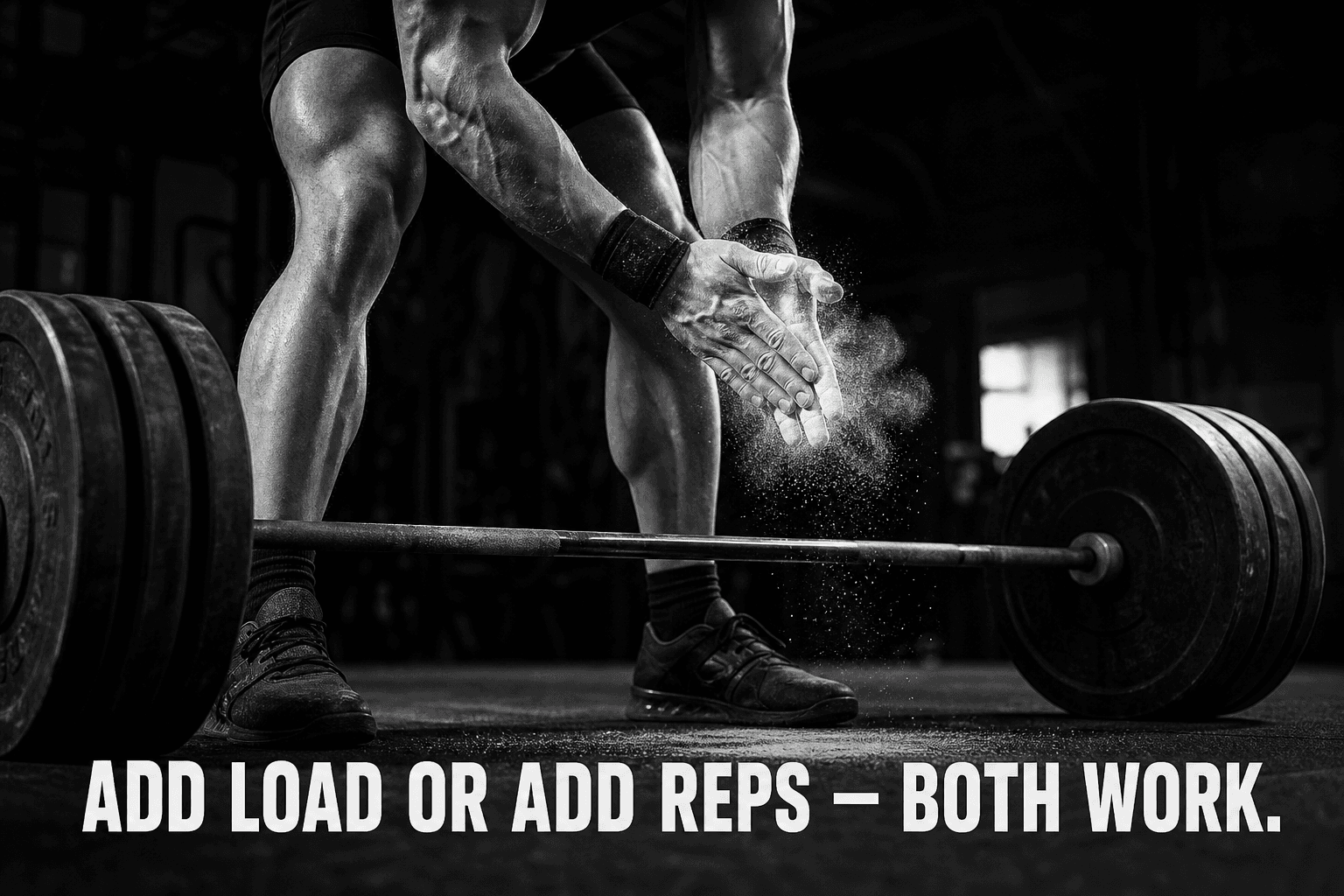
The one principle every training program lives or dies by
Progressive overload isn't a protocol — it's a biological law. Without a progressively increasing demand on muscle tissue, adaptation plateaus. Full stop.
The American College of Sports Medicine's landmark 2026 overview synthesized data from 137 systematic reviews covering more than 30,000 participants and confirmed what exercise scientists have suspected for decades: virtually no single training variable matters as much as ensuring that the stimulus keeps growing over time (Currier et al., 2026).
Everything else — rep ranges, rest periods, exercise order — is secondary noise. Progressive overload is the signal.
137 systematic reviews. One consistent finding: the stimulus must keep growing.
— Currier et al. (2026). ACSM Position Stand. Med Sci Sports Exerc.
Adding weight is not your only option
Most gym-goers assume progressive overload means one thing: slap more plates on the bar. But a well-designed 2024 RCT tested that assumption directly.
39 untrained participants trained one leg using load progression (LOADprog) and the other leg using repetition progression (REPSprog) for 10 weeks. Muscle cross-sectional area of the vastus lateralis grew from ~21.1 cm² to ~23.5 cm² in both legs — no statistically significant difference between methods (Chaves et al., 2024).
Strength followed the same pattern. 1RM on leg extension jumped roughly +16 kg in the load group and +15 kg in the rep group — again, no meaningful gap.
The takeaway: progression is the mechanism; the tool you use to create it is flexible. Stuck on load due to a joint issue? Add a rep. Capped on reps for a set? Bump the weight. Both drive adaptation.
Load up or rep up — the muscle doesn't care which direction you push.
— Chaves et al. (2024). Effects of Resistance Training Overload Progression Protocols. Int J Sports Med.
The minimum effective dose for strength vs. size
Progressive overload works, but the prescription details still matter. The ACSM overview (Currier et al., 2026) breaks down which variables shift the needle for each specific adaptation:
- Maximal strength responded best to loads ≥80% 1RM, full range of motion, 2–3 sets, performed at the start of a session, at least 2 days/week.
- Hypertrophy responded best to higher weekly volumes (≥10 sets per muscle per week) and eccentric overload — not just any progressive stimulus, but one that pushes volume upward over time.
- Power required moderate loads (30–70% 1RM) with fast, intent-driven contractions.
The practical implication: define your goal before you define your progression strategy. A powerlifter progressing via load at ≥80% 1RM is doing the right thing. A bodybuilder who only adds weight but keeps weekly sets below 10 is leaving hypertrophy on the table.
What BFR training reveals about overload at low intensities
Here's a finding that challenges the idea that heavier always means better: blood flow restriction (BFR) training at 20–30% 1RM can produce hypertrophic gains comparable to conventional resistance training at 70–80% 1RM.
Hwang & Willoughby (2019) detail the mechanisms — metabolic stress, mTOR pathway activation, satellite cell recruitment, and hormonal spikes all get triggered when low-load work is combined with venous occlusion. The common thread with heavy training? Both still apply a progressive overload to the muscle, just through different physiological routes.
This matters because it proves the principle is more robust than the method. Whether you're an older adult avoiding heavy joint loading, an athlete rehabbing an injury, or someone simply experimenting with BFR for variety — the overload principle transfers across all of them (Hwang et al., 2019).
How fast should you progress?
There's no universal number, but there are useful boundaries. The ACSM overview (Currier et al., 2026) found meaningful adaptations in programs ranging from 6 to 52 weeks, with the majority of relevant studies running 6–16 weeks.
For beginners, progression can be fast — sometimes weekly jumps in load or reps are sustainable. For intermediate and advanced lifters, the window narrows. A practical framework:
- Beginners (0–6 months): Aim to add load or reps every 1–2 sessions. The nervous system adapts quickly.
- Intermediate (6 months–2 years): Weekly progression on main lifts; biweekly or monthly on accessories.
- Advanced (2+ years): Mesocycle-level planning — overload across 4–8 week blocks, deload, repeat.
The mistake isn't progressing too slowly. It's failing to track whether you're progressing at all. If you've done 3×10 at 60 kg for six straight weeks, you're not training — you're maintaining.
Progressive overload also applies to plyometric and sport training
The principle isn't confined to the weight room. A comprehensive review of plyometric training in soccer found that the most effective jump-training programs were those that applied progressive overload and taper strategies systematically — increasing jump volume or intensity across the program before backing off before competition (Ramirez-Campillo et al., 2022).
Programs that didn't build in structured progression showed weaker performance gains. The optimal dose suggested was roughly 7 weeks at 1–2 sessions per week, ~80 jumps per session, near-maximal intensity, with adequate recovery between sessions (≥24–48 h).
The overload principle scales. Whether you're adding 2.5 kg to a barbell or increasing jumps per session from 60 to 80, the body adapts to what it's forced to do — and stagnates when that force doesn't increase.
How Planfit applies progressive overload
Planfit structures every training plan around the overload principle — tracking your volume, load, and rep totals across sessions to ensure the stimulus keeps climbing. When you log a workout, the app knows whether you're ahead, on pace, or stalling, and adjusts your next session accordingly. It also flags when weekly set volume drops below the ≥10-sets-per-muscle threshold the ACSM overview links to hypertrophy — so you're never accidentally maintaining when you think you're building.
References
- Currier BS et al. (2026). American College of Sports Medicine Position Stand. Resistance Training Prescription for Muscle Function, Hypertrophy, and Physical Performance in Healthy Adults: An Overview of Reviews.. Med Sci Sports Exerc. 10.1249/MSS.0000000000003897
- Chaves TS et al. (2024). Effects of Resistance Training Overload Progression Protocols on Strength and Muscle Mass.. Int J Sports Med. 10.1055/a-2256-5857
- Hwang PS, Willoughby DS. (2019). Mechanisms Behind Blood Flow-Restricted Training and its Effect Toward Muscle Growth.. J Strength Cond Res. 10.1519/JSC.0000000000002384
- Ramirez-Campillo R et al. (2022). Programming Plyometric-Jump Training in Soccer: A Review.. Sports (Basel). 10.3390/sports10060094