Mind-Muscle Connection Matters — But Only Below 60% of Your 1RM
4 studies · 2 RCTs · Schoenfeld 2018
4 min read
The short answer: it's real, but load-dependent
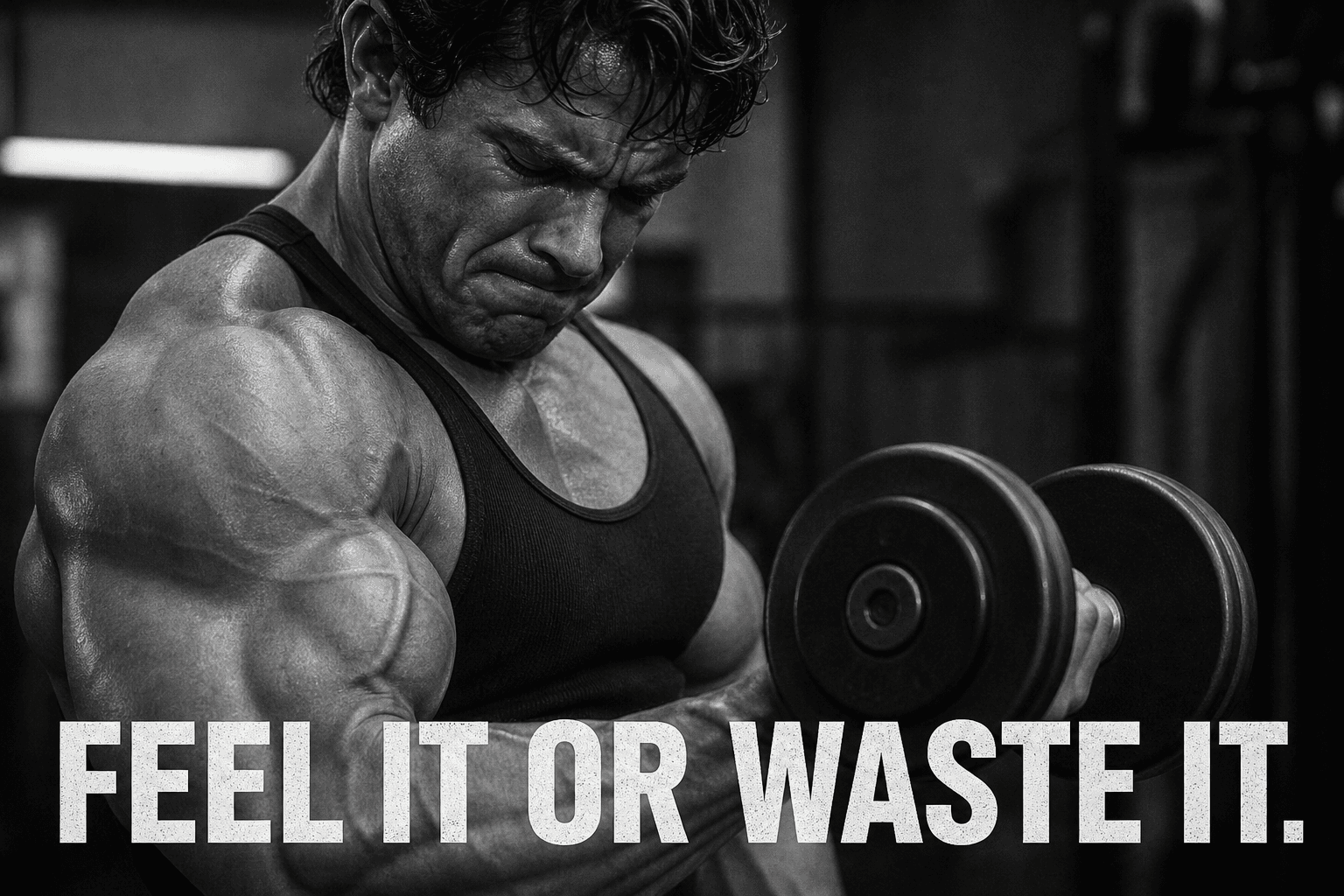
The mind-muscle connection is not gym-bro folklore. Deliberately thinking about the muscle you're training measurably increases activation and — after 8 weeks of consistent practice — produces nearly twice the hypertrophy compared to just moving the weight (Schoenfeld et al., 2018).
The catch? The effect disappears once load climbs above roughly 60% of your one-rep max. At heavy intensities, the nervous system is already recruited to its ceiling and attentional cues can't push it further (Calatayud et al., 2016).
So it's not "always focus internally" or "focus is overrated" — it's when and how you use it that counts.
Internal focus produced 12.4% elbow flexor growth vs. 6.9% with external focus over 8 weeks.
— Schoenfeld et al. (2018). Differential effects of attentional focus strategies during long-term resistance training. Eur J Sport Sci.
What the 8-week hypertrophy trial actually showed
Schoenfeld et al. (2018) ran the cleanest test of this question to date. Thirty untrained men were split into two groups: one focused on contracting the target muscle (internal focus), the other focused on the outcome of the lift — moving the bar — (external focus). Same volume, same exercises, 8 weeks.
The internal group grew their elbow flexors by 12.4%. The external group grew them by 6.9%. That's an 80% relative difference in biceps hypertrophy from a single mental cue.
Quadriceps results trended the same direction, though neither arm reached statistical significance for strength changes. The takeaway is clear: for hypertrophy, especially in isolation movements, where your attention lands changes how your muscles respond.
EMG confirms it — up to a point
Two EMG studies from Calatayud and colleagues fill in the mechanism. In bench press, subjects who focused on their pectoralis major during the lift increased pec activity by a meaningful margin at loads from 20–60% 1RM — but at 80% 1RM, the effect was gone (Calatayud et al., 2016). The threshold sits somewhere between 60 and 80%, not as a gradual fade but as a near cliff-edge.
A follow-up study on push-ups confirmed the direction: focusing on the pectoralis increased its normalized EMG by 9% (95% CI 5–13, Cohen's d = 0.60) compared to a regular push-up (Calatayud et al., 2017). Triceps focus showed a borderline effect — but here's an interesting wrinkle: years of training experience predicted the ability to selectively activate the triceps (β = 0.41, p = 0.04). Beginners can feel the chest. Feeling a smaller, less dominant muscle takes practice.
The practical read: internal focus is a high-rep, moderate-load tool. It's not what you reach for on a heavy deadlift single.
Motor imagery takes it one step further
A 2025 RCT by Piveteau et al. extended the concept beyond attention into motor imagery — mentally simulating the movement while physically performing it. One hundred national-level CrossFit athletes completed a 5-week back squat program. Two groups added kinesthetic motor imagery of either the concentric or eccentric phase during each rep; a control group just trained.
Both imagery groups outperformed the control on 5RM strength and power (RP² = 0.60, both p < 0.001). The eccentric-imagery group even outperformed the concentric-imagery group for 5RM load (RP² = 0.27, p < 0.001).
Visualizing the eccentric phase — the part most lifters mentally check out on — produced the biggest strength gains. That's a significant finding. Slowing down mentally during the lowering phase isn't just technique advice; it's a performance strategy backed by data.
How to actually use this in your training
Here's what the research stack supports, translated into practice:
For hypertrophy sets (50–70% 1RM, 8–15 reps): Use internal focus. Think about the muscle shortening and lengthening, not the weight moving. The Schoenfeld (2018) data shows this is where the gains gap opens up.
For strength sets (>80% 1RM, 1–5 reps): Switch to external focus — think about driving the floor away, pushing the bar through the ceiling, or hitting a target. At this load, motor units are maxed out and technique cues matter more than squeeze cues (Calatayud et al., 2016).
During the eccentric (lowering) phase: Add mental imagery of the muscle lengthening under tension. The Piveteau et al. (2025) eccentric-imagery group outgained the concentric group — most people are leaving strength on the table by zoning out on the way down.
If you're a beginner: Start with bigger, dominant muscles (chest, quads). The Calatayud (2017) data shows selectively feeling smaller muscles — like the triceps — correlates with training experience. You'll develop this skill over months, not sessions.
If you're advanced: You probably already use internal focus intuitively during isolation work. The novel lever to pull is eccentric imagery during compound lifts.
How Planfit applies this
Planfit tracks the load you're lifting relative to your logged 1RM and adjusts in-rep coaching cues to match — internal focus prompts on hypertrophy sets, external focus cues on heavy work. It also programs eccentric-emphasis sets informed by the Piveteau et al. (2025) findings, with tempo guidance to keep your attention on the lowering phase where the strength gains are hiding.
You don't have to remember the research. Just follow the cues.
References
- Schoenfeld BJ et al. (2018). Differential effects of attentional focus strategies during long-term resistance training.. European Journal of Sport Science. 10.1080/17461391.2018.1447020
- Calatayud J et al. (2016). Importance of mind-muscle connection during progressive resistance training.. European Journal of Applied Physiology. 10.1007/s00421-015-3305-7
- Calatayud J et al. (2017). Mind-muscle connection training principle: influence of muscle strength and training experience during a pushing movement.. European Journal of Applied Physiology. 10.1007/s00421-017-3637-6
- Piveteau A et al. (2025). New insights on mind-muscle connection: Motor imagery concomitant to actual resistance training enhances force performance.. Journal of Science and Medicine in Sport. 10.1016/j.jsams.2025.03.005