Foam rolling does reduce soreness and improve range of motion — what 6 studies actually found
6 studies · 2 reviews, 1 meta, 2 RCTs
6 min read
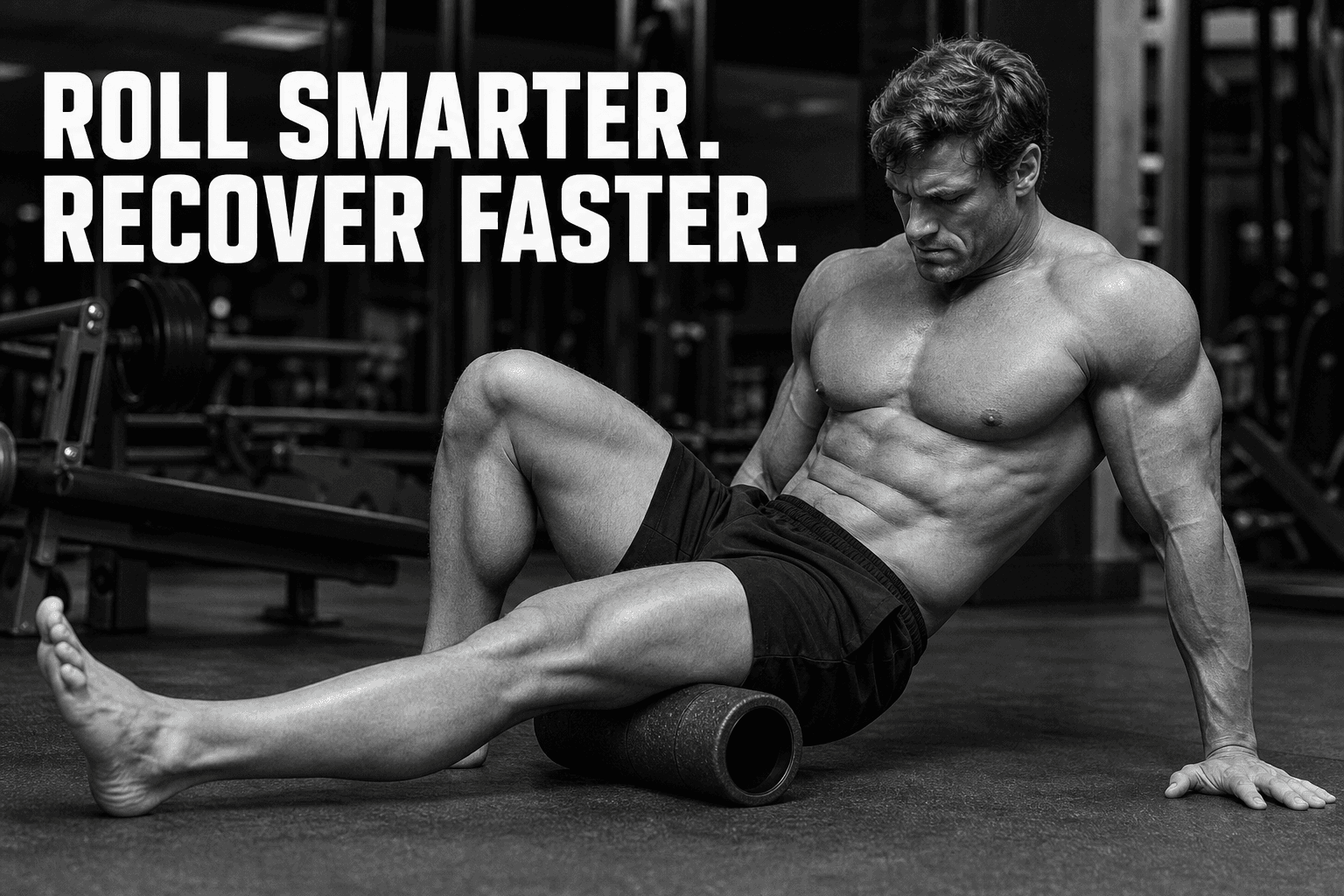
Foam rolling works — but not for every reason you've heard
Foam rolling is one of those things almost everyone does and almost no one fully understands. You've probably heard it 'breaks up scar tissue' or 'releases fascia' — the connective tissue that wraps around your muscles. Both claims are marketing, not physiology.
What foam rolling actually does is measurable: it reduces post-workout soreness, temporarily increases range of motion — how far a joint moves freely — and can improve dynamic balance after hard sessions.
The evidence for those three things is solid enough to act on. The mechanism behind them is still being worked out. That's worth knowing before you spend 20 minutes on a roller expecting it to fix everything.
It genuinely eases soreness — if the dose is right
DOMS — delayed-onset muscle soreness, the ache that peaks 24–48 hours after a hard session — is the most-studied target for foam rolling, and the results are reasonably consistent.
A 2020 systematic review that pulled together 49 studies found foam rolling reduced DOMS and increased pressure pain threshold — pressure pain threshold is how much force you can take on a muscle before it hurts, a standard lab proxy for soreness level (Hendricks et al., 2020). The same review pinned the optimal dose at 90–120 seconds of rolling per muscle group to see those flexibility and soreness benefits. Less than that and the signal weakens.
A 2024 systematic review of 6 randomized clinical trials — trials where people were randomly assigned to foam rolling or a comparison group — found a more mixed picture for chronic pain: only 2 of the 6 trials showed a statistically significant pain reduction (Santos et al., 2024). So for general gym soreness after a hard workout? Evidence is in your favour. For managing ongoing pain conditions? Less clear.
The takeaway: foam rolling is a recovery tool, not a therapy. Use it for post-session soreness. Don't expect it to fix a nagging injury.
Optimal dosage for flexibility and soreness benefits: 90–120 seconds of foam rolling per muscle group.
— Hendricks et al. (2020). Effects of foam rolling on performance and recovery. J Bodyw Mov Ther.
Range of motion improves — but it's temporary
Range of motion is the distance a joint can move through its full arc. Tighter muscles and connective tissue restrict that arc; foam rolling seems to loosen it — at least in the short term.
The 2020 review found foam rolling reduces muscle stiffness and increases range of motion, and recommended using it in combination with dynamic stretching before training rather than relying on it alone (Hendricks et al., 2020). If you want to know exactly where dynamic stretching fits in your warm-up, dynamic vs static stretching breaks down the sequence clearly.
The 2025 systematic review of 8 studies on vibrating foam rollers — rollers with a built-in motor that oscillates as you roll — found increased range of motion in the hip and knee specifically, though results weren't consistent across every study (Park et al., 2025).
What this means practically: rolling before your session can give you a slightly better starting position for squats, lunges, and hip-dominant movements. Don't expect it to last all day — the mobility window is real but short.
Balance and movement quality get a short-term boost too
This one surprises people. A 2023 randomised controlled trial — 47 amateur athletes split into a foam rolling group, a manual therapy group, and a passive recovery group — found that the foam rolling group improved dynamic balance scores on both legs immediately after rolling, and those scores were still higher one week later (Espí-López et al., 2023). Dynamic balance here means the ability to control your body weight while moving, measured with a standard sports-science test.
The foam rolling group actually outperformed the manual therapy group on balance at the post-intervention measurement. Manual therapy means hands-on treatment from a therapist — the same type of work a physiotherapist or sports massage therapist does.
That's a meaningful result. It suggests foam rolling does something to how your nervous system coordinates movement, not just how a muscle feels to the touch. The exact mechanism isn't confirmed yet, but better balance post-rolling is a real, measurable effect.
Foam rolling group outperformed manual therapy on dynamic balance — immediately and at 1-week follow-up.
— Espí-López et al. (2023). Effectiveness of Foam Rolling vs. Manual Therapy. J Strength Cond Res.
Vibrating rollers: worth the upgrade?
Vibrating foam rollers add an oscillating motor — typically running at around 28 Hz, roughly 28 vibrations per second — on top of the standard rolling pressure. The question is whether that extra vibration actually adds anything.
A 2019 RCT on 38 healthy adults found the vibrating roller produced 30.2% greater pain reduction (measured on a standard 0–10 pain scale) compared to a non-vibrating roller after eccentric squat-induced muscle damage (Romero-Moraleda et al., 2019). Eccentric here means the lowering phase of a movement — the part where the muscle lengthens under load, which causes more muscle damage than the lift itself. The vibrating group also showed greater improvement in hip extension range of motion.
But a more recent 2026 clinical trial on 18 experienced runners found no significant difference between vibrating rolling, non-vibrating rolling, and static stretching on soreness, inflammatory markers, or jump performance at 24 and 48 hours post-exercise (Wu et al., 2026).
The honest answer: vibrating rollers may give you a modest edge on immediate pain relief. For longer-term recovery outcomes, standard rollers appear to do the same job. If you already have one, use it. If you're deciding whether to buy one, a standard roller at a quarter of the price does most of the work.
How to actually use a foam roller (the protocol that works)
Based on what the research supports, here's a simple approach:
Before training — mobility focus:
- Roll each target muscle group for 90–120 seconds total
- Follow immediately with dynamic movement (leg swings, hip circles, bodyweight squats)
- Focus on areas that feel restricted for the session you're about to do
After training — recovery focus:
- Same 90–120 seconds per group, slower pace
- Pair with the how to warm up before lifting approach in reverse: active cool-down first, then rolling
- You don't need to roll every muscle — prioritise whatever worked hardest that session
What to skip:
- Rolling directly over a joint (knee, hip bone, spine) — pressure belongs on muscle, not bone
- Rolling a recently injured area — foam rolling is for fatigued muscle, not damaged tissue
- Spending more than 2 minutes on one spot — longer isn't better, it's just more time
The 2020 review is clear that combining foam rolling with dynamic stretching beats either one alone (Hendricks et al., 2020). Rolling by itself is a warm-up accessory, not a complete warm-up.
How Planfit applies this
Foam rolling is prep work — and prep work only pays off if the training that follows it is structured well. Planfit builds your session with auto-suggested warm-up sets before heavy movements, tracks your working sets and progressive overload across sessions, and monitors your per-muscle volume so you know exactly which muscle groups need recovery priority (and therefore where to focus the roller). It's the difference between rolling randomly and rolling with a plan.
References
- Hendricks S et al. (2020). Effects of foam rolling on performance and recovery: A systematic review of the literature to guide practitioners on the use of foam rolling.. J Bodyw Mov Ther. 10.1016/j.jbmt.2019.10.019
- Santos et al. (2024). Effects of foam roller on pain intensity in individuals with chronic and acute musculoskeletal pain: a systematic review of randomized trials.. BMC Musculoskelet Disord. 10.1186/s12891-024-07276-6
- Espí-López GV et al. (2023). Effectiveness of Foam Rolling vs. Manual Therapy in Postexercise Recovery Interventions for Athletes: A Randomized Controlled Trial.. J Strength Cond Res. 10.1519/JSC.0000000000004383
- Romero-Moraleda B et al. (2019). Effects of Vibration and Non-Vibration Foam Rolling on Recovery after Exercise with Induced Muscle Damage.. J Sports Sci Med
- Wu et al. (2026). Vibration Rolling, Non-Vibration Rolling, and Static Stretching for Delayed-Onset Muscle Soreness on Physiological Changes and Recovery of Athletic Performance in Runners.. J Sports Sci Med. 10.52082/jssm.2026.149
- Park et al. (2025). Effects of Vibration Foam Rolling on Pain, Fatigue, and Range of Motion in Individuals with Muscle Fatigue: A Systematic Review.. Healthcare (Basel). 10.3390/healthcare13121391