Full-body vs. split training: muscle and strength gains are the same — per a 2024 meta-analysis
4 studies · 2024 meta-analysis (14 studies, 392 subjects)
5 min read
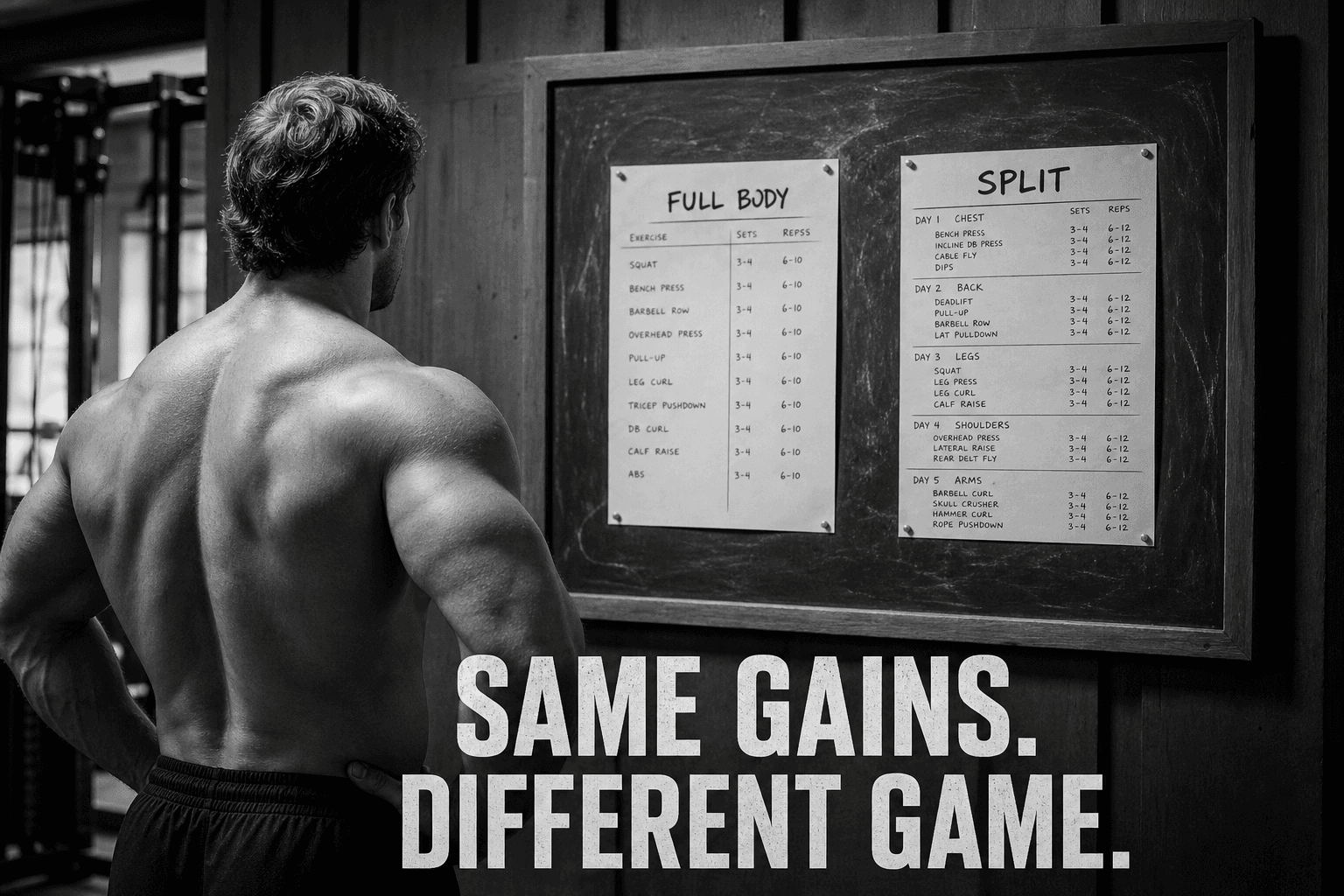
The honest answer: it doesn't matter — for muscle or strength
Stop stressing over this one. The split vs. full-body debate has a definitive answer, and it's a draw.
A 2024 systematic review — the first to formally pool all the research on this question — analyzed 14 studies and 392 healthy adults. Muscle growth in the biceps, triceps, and quads was statistically identical between split and full-body programs. Strength gains on the bench press and lower-body lifts were identical too (Ramos-Campo et al., 2024).
The mean difference in bench press strength was 1.19 kg in favor of split training — a gap so small it didn't reach statistical significance (p = 0.34). For quad size, the difference was literally –0.08 cm². Neither routine wins on the outcomes that most lifters actually care about (Ramos-Campo et al., 2024).
14 studies, 392 lifters, zero meaningful difference in muscle growth or strength.
— Ramos-Campo et al. (2024). Efficacy of Split Versus Full-Body Resistance Training on Strength and Muscle Growth. J Strength Cond Res.
Why the tie makes biological sense
Here's the thing — the body doesn't care what day of the week you trained your chest. It cares about total weekly volume per muscle group: how many hard sets you hit each muscle over 7 days.
Both split and full-body programs can deliver the same weekly volume. A classic bro split might give your chest 4 sets on Monday. A full-body program might give it 1–2 sets Monday, Wednesday, and Friday. Same total sets. Same growth signal.
If you want to go deeper on why volume is the number that actually drives growth, the How Many Sets Per Muscle Group Per Week? 10 Is Enough article breaks it down with the research. The short version: hitting your weekly set target is the job. How you distribute those sets across days is a scheduling choice, not a biology choice.
The routine is the vehicle. Volume is the fuel.
One place full-body actually wins: fat loss
Here's where the split gets edged out — if losing fat is part of your goal.
An RCT published in the European Journal of Sport Science assigned 23 well-trained men to either full-body or split-body training for 8 weeks. Both groups did the exact same weekly volume: 75 sets per week at 70–80% of 1RM. The only difference was how those sets were spread across days.
Full-body training produced –0.78 kg of fat loss. Split training added +0.32 kg of fat. That's a ~1.1 kg swing in body composition from the same total work (Carneiro et al., 2024).
Why? Full-body sessions recruit more total muscle mass per workout — every session works legs, push, and pull. That drives a larger metabolic response per session: higher lactate, more calories burned, greater hormonal disruption. If you train 3–5 days per week, full-body stacks that metabolic hit every single session instead of concentrating it on one muscle group.
Same 75 sets/week. Full-body lost 0.78 kg of fat. Split gained 0.32 kg.
— Carneiro et al. (2024). Full-body resistance training promotes greater fat mass loss than a split-body routine. Eur J Sport Sci.
Full-body also suppresses appetite more
That same full-body metabolic hit carries a bonus you probably didn't expect: you feel less hungry after the session.
An RCT with 12 trained men compared hunger responses after full-body, upper-body, and lower-body sessions — all matched for 18 total sets. Full-body training produced significantly lower subjective hunger ratings one hour post-workout, and the area-under-the-curve hunger score was lower than upper-body training (p = 0.041) (Freitas et al., 2021).
The likely driver is lactate. Full-body sessions spike blood lactate higher than isolated split sessions — and elevated lactate is associated with appetite suppression. For someone in a fat-loss phase, that's a real practical edge: train full-body, feel less hungry, eat less without fighting your cravings.
For muscle and strength? No edge. For managing a cut? Full-body has a clear advantage.
So when does a split actually make sense?
If full-body has the fat-loss edge, why would anyone run a split? Plenty of good reasons.
Training frequency per muscle group. Full-body works best at 3–4 days per week. If you want to train 5–6 days, a split lets you recover each muscle properly between sessions without overlap.
Session length. Full-body workouts covering 6+ muscle groups take time. A split lets you go deeper on fewer muscles per session — useful for advanced lifters who need high intra-session volume on specific weak points.
Injury and fatigue management. Hitting every muscle group in every session is metabolically demanding. Beginners often underestimate that cumulative fatigue. A split spreads the recovery load more evenly.
Scheduling reality. Miss a full-body session and you've skipped everything. Miss a leg day in a split and your upper body still got trained. For people with unpredictable schedules, splits can be more robust.
The research is clear that neither approach is superior for growth. Pick the one you'll actually execute consistently — because the best program is the one you complete (Ramos-Campo et al., 2024). And if you're unsure how many days a week to train, the 3 days a week is enough — and a J Strength Cond Res RCT of 32 athletes proves it works article has the numbers.
The one variable that actually decides this
Whether you run full-body or split, the thing that drives progress is Progressive Overload Is the Only Variable That Actually Guarantees Muscle Growth.: adding load, reps, or sets over time.
Neither routine guarantees growth on its own. A split where you lift the same weights for months goes nowhere. A full-body program that keeps adding load every few weeks will build muscle and strength regardless of the schedule.
Volume and progressive overload are the inputs. The split-vs-full-body question is just logistics — when and how you distribute those inputs across your week. Get the logistics right for your life, then make sure you're progressing. That's the whole formula.
How Planfit applies this
Planfit reads your goal (muscle gain, fat loss, or both), your available training days, and your experience level — then picks the routine structure that the research actually supports for your situation. If you're cutting, it leans full-body to maximize the metabolic hit per session. If you're bulking on a 5-day schedule, it builds a split that keeps your weekly volume on target without burying your recovery. You don't have to debate it. The app does the routing.
References
- Ramos-Campo DJ, Benito-Peinado PJ, Caravaca LA, Rojo-Tirado MA, Rubio-Arias JÁ (2024). Efficacy of Split Versus Full-Body Resistance Training on Strength and Muscle Growth: A Systematic Review With Meta-Analysis. Journal of Strength and Conditioning Research. 10.1519/JSC.0000000000004774
- Carneiro MAS, et al. (2024). Full-body resistance training promotes greater fat mass loss than a split-body routine in well-trained males: A randomized trial. European Journal of Sport Science. 10.1002/ejsc.12104
- Conrado de Freitas M, Ricci-Vitor AL, de Oliveira JVNS, et al. (2021). Appetite Is Suppressed After Full-Body Resistance Exercise Compared With Split-Body Resistance Exercise: The Potential Influence of Lactate and Autonomic Modulation. Journal of Strength and Conditioning Research. 10.1519/JSC.0000000000003192
- Lira FS, Conrado de Freitas M, Gerosa-Neto J, Cholewa JM, Rossi FE (2020). Comparison Between Full-Body vs. Split-Body Resistance Exercise on the Brain-Derived Neurotrophic Factor and Immunometabolic Response. Journal of Strength and Conditioning Research. 10.1519/JSC.0000000000002653