The goblet squat isn't a beginner move — it fixes your squat form, then cuts blood-sugar spikes 22%
2 studies · RCT + meta-analysis
6 min read
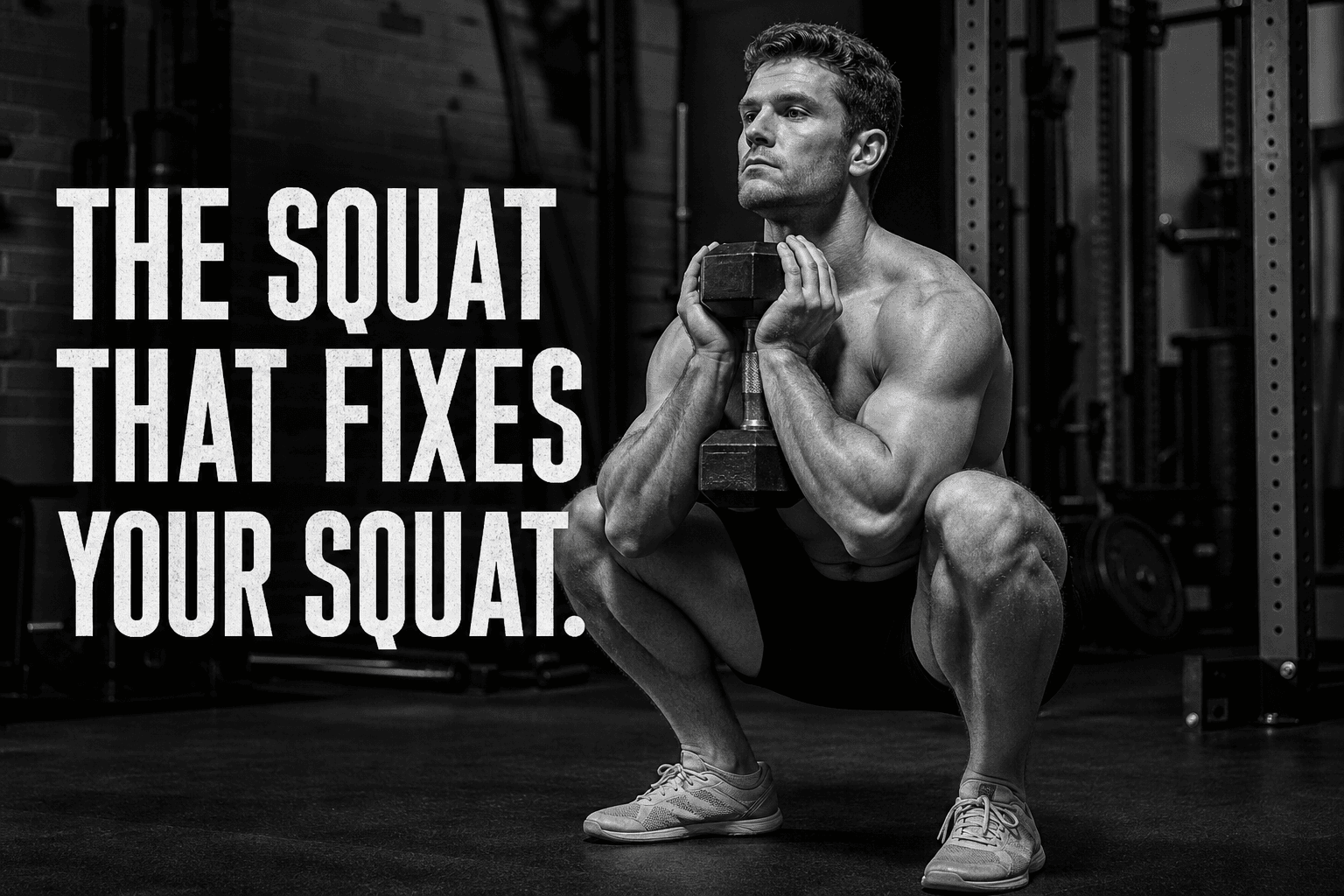
The goblet squat does something no other squat variation does quite as well
Most people pick up the goblet squat as a warm-up drill and drop it the moment they feel ready for a barbell. That's a mistake.
The goblet squat isn't a beginner move you graduate from. It's a loaded movement that teaches — and reinforces — the exact mechanics that carry over to every squat variation you'll ever do.
Hold a dumbbell or kettlebell at your chest, sit your hips back and down, and your torso has no choice but to stay upright. The counterbalance in front of you corrects forward lean automatically. No coaching cue does that as reliably.
And beyond mechanics, the research has surfaced a metabolic benefit of squatting that most gym-goers have never heard of.
It forces an upright torso — and that's the whole game for beginners
The number one squat problem coaches see is forward lean. When your torso tips forward, the load shifts off your quads and onto your lower back. It feels fine until it doesn't.
The goblet squat fixes this structurally. The weight sits in front of your centre of mass, pulling you upright. Your elbows drop inside your knees at the bottom, which physically cues hip external rotation and depth.
You can't goblet squat with bad form and not feel it immediately. The position self-corrects.
This is why coaches use it as a teaching tool before introducing the back squat or front squat — not because it's easier, but because the feedback loop is instant. Once the pattern is grooved, the carryover to barbell work is direct.
If you want to see what the goblet squat looks like with correct depth and positioning, the Planfit exercise library has a full breakdown.
The counterbalance in front of you corrects forward lean automatically. No coaching cue does that as reliably.
It loads your quads, glutes, and hamstrings — not just as a warm-up
Let's be clear: the goblet squat is a loaded squat. Done with a challenging weight for 3–4 sets, it trains the same prime movers as a barbell back squat — quads, glutes, and hamstrings.
Eccentric and heavy squat-pattern work increases concentric hamstring strength, a finding that showed up across randomized controlled trials (RCTs — studies where people are randomly split into groups and compared directly) included in a 2023 systematic review of 108 trials (Rudisill et al., 2023). Squatting under load contributes to the same hamstring adaptation that injury-prevention programs target.
That matters because hamstring weakness relative to quad strength is one of the most consistent injury-risk markers in athletes. The goblet squat, loaded progressively, addresses that balance while keeping your spine in a safe position.
For the lower body, it pairs well with a romanian deadlift if you want full posterior-chain coverage in the same session.
Here's the benefit nobody talks about: it cuts your post-meal blood sugar spike
This one surprised researchers too.
A 2024 RCT put 18 overweight men through four different conditions over an 8.5-hour day (Gao et al., 2024). One group sat uninterrupted. The others broke up their sitting every 45 minutes — with walking, or with squatting.
Uninterrupted sitting produced a glucose net area under the curve of 10.2 mmol/L/h. Squatting breaks brought that down to 7.9 mmol/L/h — a 22% reduction. Walking breaks did the same.
What drove the effect? Quadriceps muscle activation. Higher average quadriceps EMG amplitude during breaks was directly predictive of lower blood glucose response. The quads are the largest muscle group in your legs. When they contract repeatedly — even in bodyweight squats — they act as a glucose sink, pulling sugar out of your bloodstream and into working muscle.
The goblet squat activates those same quadriceps under load. If bodyweight squats cut blood sugar spikes by 22%, loaded goblet squats are doing at least as much work on that mechanism.
Squatting breaks cut post-meal blood sugar from 10.2 to 7.9 mmol/L/h — a 22% drop.
— Gao et al. (2024). Enhanced muscle activity during interrupted sitting improves glycemic control in overweight and obese men. Scand J Med Sci Sports.
It's accessible at any fitness level — and that's a real advantage
The goblet squat has no barbell setup. No rack, no safety arms, no spotter required. You pick up a dumbbell or kettlebell, and you squat.
That low barrier means you can run it as:
- A warm-up drill with light load to prime hip and ankle mobility before heavy work
- A working set exercise with a challenging weight (aim for 3–4 sets of 8–12 reps at a load that makes the last 2 reps genuinely hard)
- A between-task reset on long sitting days — even a few bodyweight goblet squats every 45 minutes carries a measurable metabolic benefit, per Gao et al. (2024)
Progressive overload applies here the same as any other lift. Add weight when the current load stops being challenging at your target rep range. If you want a deeper look at how to apply that principle across all your lifts, progressive overload training covers the mechanism directly.
One practical cue: hold the weight at sternum height, not chin or belly. That position keeps your torso most upright and reduces wrist strain.
How to programme it — the short version
You don't need a complicated plan. Here's what the research and practice support:
For muscle and strength: 3–4 sets of 8–12 reps, 2–3 times per week. Pick a weight where the last 2 reps are hard but your form doesn't break. Rest 2–3 minutes between sets — how long should you rest between sets explains why longer rest produces better strength and size outcomes.
For metabolic health and blood sugar control: 10 squats every 45 minutes during long periods of sitting. Bodyweight is enough for this purpose (Gao et al., 2024).
For squat mechanics: Use it at the start of every lower-body session with a moderate load (50–60% of what you'd use for a working set). Three sets of 5–8 slow reps, pausing 2 seconds at the bottom.
The bottom line: the goblet squat is one of the few exercises that earns its place at every training level — not because it's easy, but because it does multiple jobs well at the same time.
How Planfit applies this
Planfit programmes the goblet squat as both a primary lower-body movement and a warm-up drill, depending on your training level. For each working set it recommends a target weight and rep range, and warm-up sets are auto-suggested before your heavier barbell work. As you log sessions, the app tracks your load progression so you're always nudged toward a harder stimulus — not repeating the same weight week after week. The built-in rest timer keeps your recovery between sets honest, too.
Try Planfit free →
How Planfit applies this
Planfit programmes the goblet squat as both a primary lower-body movement and a warm-up drill, depending on your training level. For each working set it recommends a target weight and rep range, and warm-up sets are auto-suggested before your heavier barbell work. As you log sessions, the app tracks your load progression so you're always nudged toward a harder stimulus — not repeating the same weight week after week. The built-in rest timer keeps your recovery between sets honest, too.
References
- Gao Y et al. (2024). Enhanced muscle activity during interrupted sitting improves glycemic control in overweight and obese men.. Scand J Med Sci Sports. 10.1111/sms.14628
- Rudisill SS et al. (2023). Evidence-Based Hamstring Injury Prevention and Risk Factor Management: A Systematic Review and Meta-analysis of Randomized Controlled Trials.. Am J Sports Med. 10.1177/03635465221083998