How Many Reps for Muscle Growth? Hard Sets Matter More
4 studies · 3 RCTs · 2 priority journals
5 min read
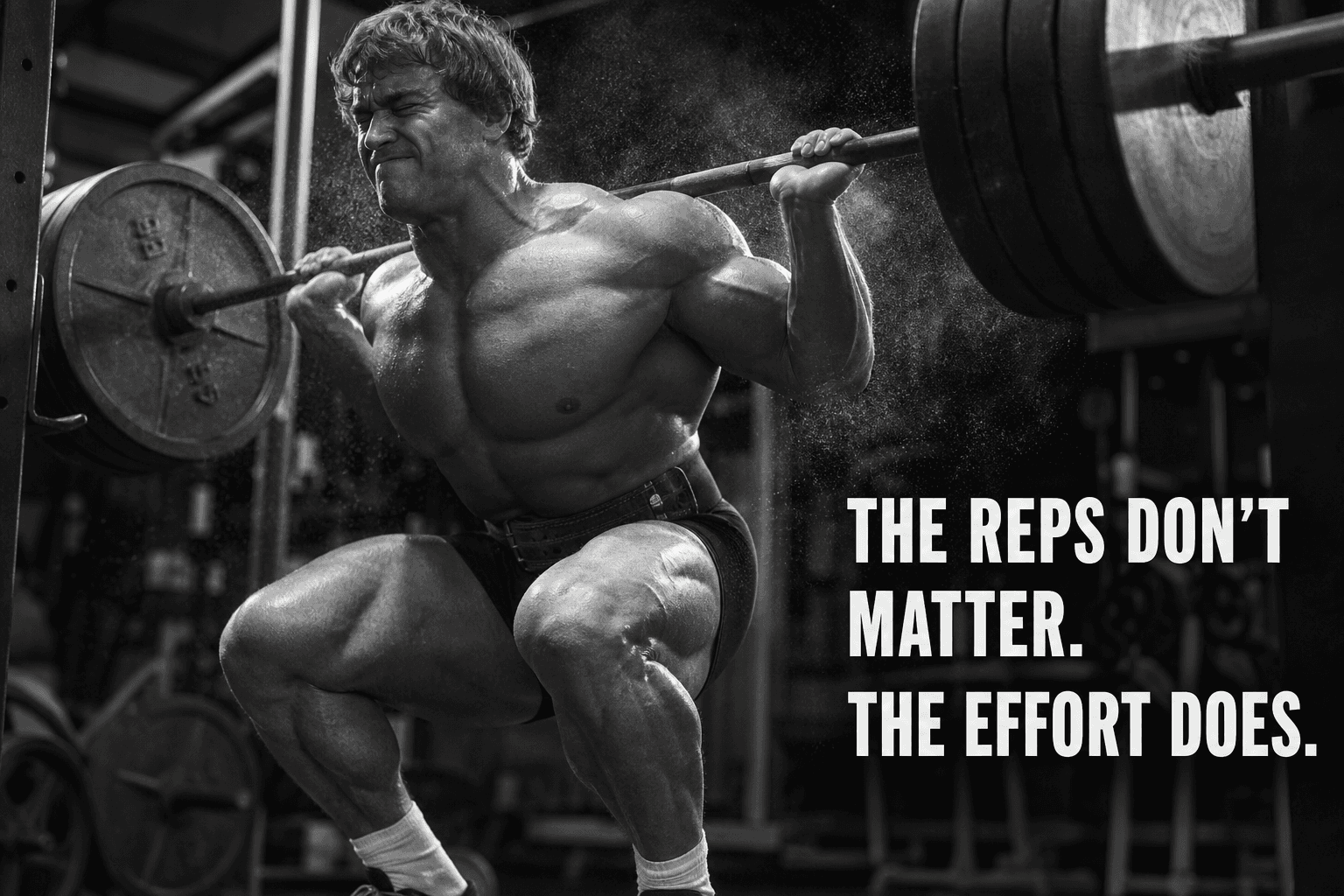
The rep range question has one honest answer
You can build muscle with 5 reps per set. You can build muscle with 30 reps per set. The difference in hypertrophy between those two extremes, when effort is matched, is close to zero.
That's not a coach's opinion. It's what the research keeps showing. The rep count you obsess over is one of the least important variables in your training — and yet it's the one most lifters argue about the longest.
Here's what actually determines whether your muscles grow, and where rep range fits into that picture.
Loading vs adding reps: same muscle growth, full stop
Plotkin et al. (2022) ran an 8-week RCT with 43 resistance-trained participants to answer a direct question: does it matter how you progressively overload — by adding weight, or by adding reps?
One group kept reps constant and increased load each week. The other kept load constant and added reps. At the end of 8 weeks, quadriceps and calf muscle thickness increased by almost identical amounts in both groups. Neither approach beat the other for hypertrophy.
Both methods grew muscle equally well. The key ingredient wasn't the rep count — it was the progressive overload itself.
If you want to dig deeper into why progressive overload is the real driver here, progressive overload training breaks down exactly how that mechanism works.
Progressive overload via reps grew muscle just as effectively as progressive overload via load — over 8 weeks in trained individuals.
— Plotkin et al. (2022). Progressive overload without progressing load? PeerJ.
Low-load training (30% 1RM) still builds muscle — when you push hard enough
Here's the number that surprises most people: 30% of your one-rep max — a weight you could lift 40–50 times fresh — can still produce meaningful muscle growth.
Kataoka et al. (2026) tested exactly this in a large RCT of 144 participants. One group trained at 30% 1RM to failure (LL-Failure). Another trained at 30% 1RM but stopped short of failure (LL submaximal). A third used 30% 1RM with blood flow restriction — a technique that amplifies the muscle stimulus at low loads by partially limiting blood return.
Muscle thickness gains after 6 weeks:
- LL-Failure (low load, to failure): +0.17 cm
- LL + BFR (low load + restriction): +0.14 cm
- LL submaximal (low load, not to failure): +0.06 cm
The group that trained at 30% 1RM but stopped well short of failure grew muscle at less than a third the rate of the group that went to failure. The load was identical. The rep count was the variable — but only because more reps meant closer to failure.
The load wasn't the driver. Proximity to failure was. (Kataoka et al., 2026)
A practical rep range does exist — here's what it is
None of this means rep ranges are completely irrelevant. There's a window that makes training practical and sustainable without sacrificing results.
Kinoshita et al. (2026) used 10 reps per set at 70% 1RM across a 12-week training study and produced clear, measurable quadriceps hypertrophy in all four heads — whole-quad volume grew by +4.9% to +7.1% depending on the exercise (Kinoshita et al., 2026). That's a well-established training zone: moderate load, moderate reps, high enough effort to drive growth.
The practical sweet spot most evidence lands on: roughly 5–30 reps per set, with load set somewhere between 30–85% of your 1RM. Inside that range, the rep count you choose barely moves the needle on muscle size.
What does move the needle:
- Getting within 0–4 reps of failure on most sets
- Adding reps or load over time (progressive overload)
- Accumulating enough weekly sets per muscle group — see how many sets per muscle group per week for the breakdown on that number
5–30 reps per set, 30–85% 1RM — inside this window, rep count barely affects hypertrophy. What you do at the end of the set is what counts.
— Kinoshita et al. (2026). Hypertrophic Effects of Single- versus Multi-Joint Exercise. Med Sci Sports Exerc.
Higher reps aren't easier — they're just a different kind of hard
One reason lifters default to 8–12 reps is that high-rep sets feel manageable. But sets of 20–30 reps taken close to failure are genuinely brutal — heart rate climbs, the burn is intense, and most people bail before they actually reach failure.
The Kataoka et al. (2026) data makes this visible: the submaximal low-load group was doing the same exercise with the same weight as the failure group — just stopping earlier. Same load, far less growth.
Stopping 6–8 reps short of failure at low loads is not a shortcut. It's wasted volume.
If you prefer lower reps and heavier weights because you actually push those sets hard, that's a perfectly valid choice — not because heavy is magic, but because it's easier to gauge effort and stay close to failure when the weight is substantial.
What this means for how you train right now
Here's the short version you can apply today:
Pick a rep range you can actually execute well. For compound lifts like squats and barbell squat, heavier sets of 5–8 reps are easier to push hard and track. For isolation work, 10–20 reps is fine and easier on your joints.
End your sets close to failure. Leave 0–3 reps in the tank, not 6–8. This matters more than the number on the bar.
Add reps or weight over time. Plotkin et al. (2022) showed that rep progression works just as well as load progression for hypertrophy — so if the weight feels stuck, add a rep or two per set. Both count.
Don't switch rep ranges constantly hoping one will unlock faster growth. Consistency with progressive overload across any rep range is what drives results. The lifters who keep obsessing over the perfect rep count are usually the ones avoiding the actual hard part: showing up and pushing their sets.
For context on how many sets to pair with whatever rep range you choose, how many sets per workout covers the per-session volume side of the equation.
How Planfit applies this
Planfit builds your program around progressive overload across whatever rep range fits your goals and equipment — not a one-size-fits-all scheme. It tracks reps, load, and proximity to failure across every session, so you can see whether you're actually getting closer to the threshold that drives muscle growth, not just logging numbers. The research is clear: the rep range is secondary. The effort and the progression are primary. Planfit is built around that order of priority.
References
- Plotkin DL et al. (2022). Progressive overload without progressing load? The effects of load or repetition progression on muscular adaptations.. PeerJ. 10.7717/peerj.14142
- Kataoka R et al. (2026). Submaximal low-load resistance exercise with blood flow restriction produces similar results to low-load exercise to failure for muscle size and strength, but not endurance.. Eur J Appl Physiol. 10.1007/s00421-025-05949-1
- Kinoshita R et al. (2026). Hypertrophic Effects of Single- versus Multi-Joint Exercise: A Direct Comparison Between Knee Extension and Leg Press.. Med Sci Sports Exerc. 10.1249/MSS.0000000000003957
- Barsuhn A et al. (2025). Training volume increases or maintenance based on previous volume: the effects on muscular adaptations in trained males.. J Appl Physiol (1985). 10.1152/japplphysiol.00476.2024