How many sets of push-ups? 3 sets to failure, 3×/week
3 studies · Int J Sports Med, J Strength Cond Res
6 min read
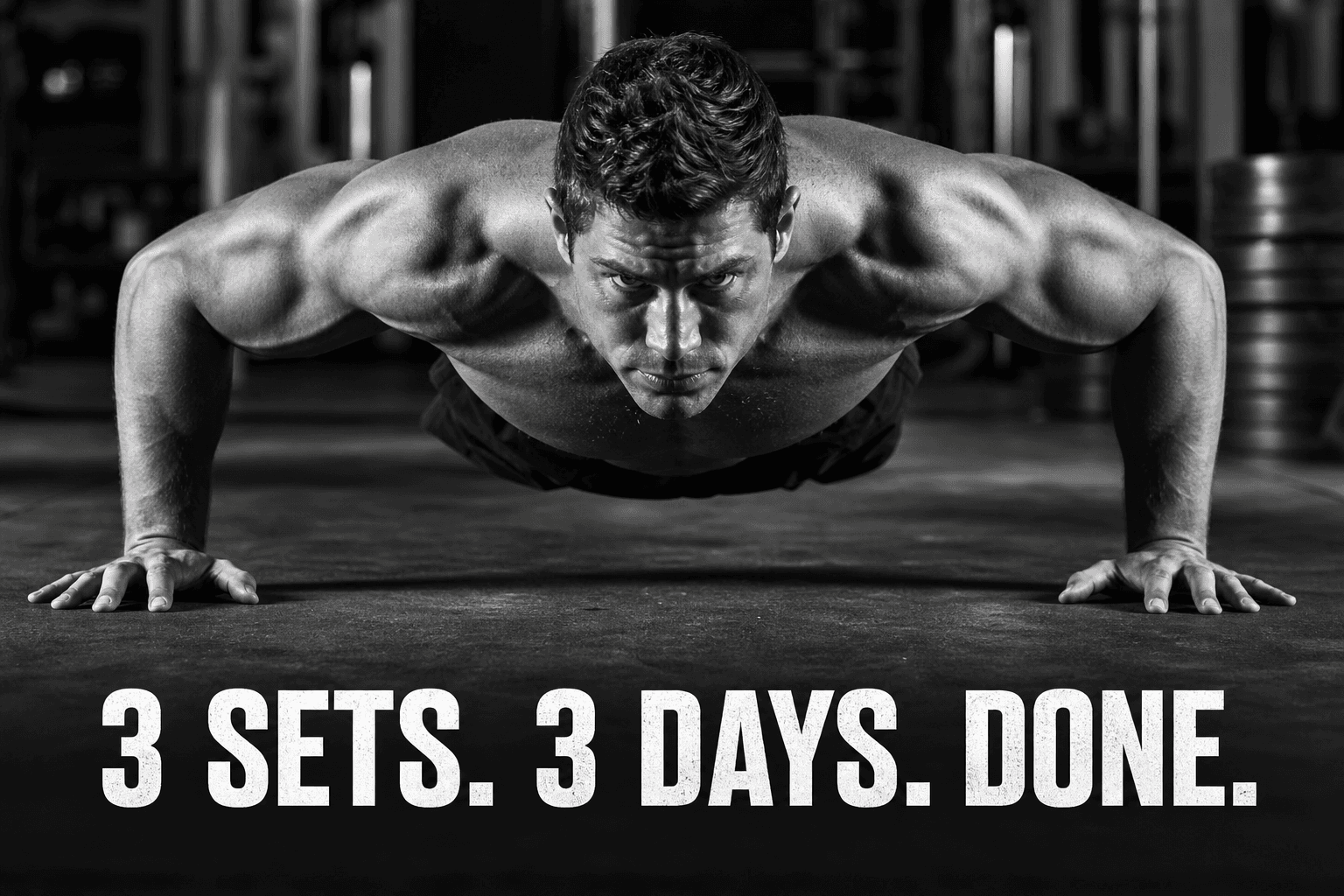
The answer: 3 sets, 3 times a week
3 sets of push-ups per session, done 3 times a week, is enough to build real muscle.
That's not an estimate. Researchers put eight men through exactly that set structure — 3 sets to failure, 3 sessions a week, 8 weeks — using suspended (sling) push-ups, and measured what happened. Elbow extensor (triceps) thickness grew 16%. Rectus abdominis — your main abs muscle — grew 27%. External oblique grew 14% (Kohiruimaki et al., 2019).
So before you wonder whether you need 5 sets, or 10, or some elaborate push-up ladder: 3 sets taken to failure, three days a week, already moves the needle on your arms and your core.
Two caveats that study is explicit about: it trained a harder, suspended variation, and it found no change in maximum strength — elbow extension, elbow flexion or 1RM bench press. Size went up; max force didn't. The transferable part is the set structure.
3 sets of suspended push-ups to failure, 3×/week: +16% triceps size, +27% abs size in 8 weeks.
— Kohiruimaki et al. (2019). Suspended Push-up Training Augments Size of not only Upper Limb but also Abdominal Muscles. Int J Sports Med.
Why 'to failure' matters more than a fixed rep count
The Kohiruimaki study didn't prescribe 10 reps or 15 reps. It prescribed sets taken to failure — meaning you go until you physically can't do another clean rep.
Why? Because the hardest reps at the end of a set are where most of the growth signal comes from. EMG activity — a measure of how hard your muscles are actually firing — rose from 46% to 88% of max in the abs, and from 32% to 50% in the external oblique, as participants approached failure in suspended push-ups (Kohiruimaki et al., 2019). The last few reps recruit the most muscle fibers.
A set of 8 reps where you stop comfortably doesn't give you the same stimulus as a set of 8 where rep 8 nearly kills you. If you can crank out 20 easy push-ups, you need to go further — or make the movement harder. More on that in a moment.
For more on how hard to push per set, see training to failure.
What muscles push-ups actually train
Push-ups are a chest exercise that also trains your triceps, front shoulder (anterior deltoid), and core — all at once.
A cross-sectional study — one where researchers measured muscle activity across different push-up versions in the same session — confirmed that pectoralis major (your chest) activates at similar levels across the three variations tested — floor, hands-on-ball, feet-on-ball (Bezerra et al., 2020). The variation changes which secondary muscles take on more load, but the chest stays consistently involved.
Your core gets more work than most people expect. In the Kohiruimaki suspended push-up study, abdominal growth (27% in the rectus abdominis) actually outpaced arm growth (16%). If you're skipping core work and doing push-ups, you may already be training your abs more than you think.
The muscle anatomy can show you exactly where each of these muscles sit if you want a visual.
How many sets of pull-ups should you do — and how push-ups compare
Pull-ups and push-ups are the opposite sides of the same coin. Push-ups push — chest, triceps, front shoulder. Pull-ups pull — lats, biceps, rear shoulder.
The set prescription is the same: 3 sets to failure, 3 times a week is a solid starting structure for both. The logic is identical — get close enough to failure that you're recruiting the hardest-to-reach muscle fibers, then recover and repeat.
One practical difference: most people can't do 10 pull-ups on day one. If that's you, start with 2 sets and add a third when you can hit at least 5 clean reps per set. For push-ups, the opposite problem often applies — once standard push-ups get easy, you need to load them differently (feet elevated, weighted vest, or a suspension trainer) to keep the stimulus high enough.
For a deeper look at weekly volume by muscle group, how many sets per muscle group per week is worth reading alongside this.
Which push-up variation should you use?
The standard floor push-up is the right default. But the variation you pick changes which muscles get the most work.
Feet on a Swiss ball: more triceps and abs. Bezerra et al. (2020) measured that triceps activity was significantly higher when feet were elevated on an unstable surface than on the stable floor. Abs activation was also significantly higher compared to the standard version.
Hands on a Swiss ball: the most triceps and abs — but less front shoulder. Anterior deltoid (front shoulder) activity dropped significantly when hands were on the ball versus the stable floor (Bezerra et al., 2020). If shoulder development matters to you, hands-on-ball is not your best pick.
Suspension or sling push-ups: more strength and endurance. Lima et al. (2018) ran an 8-week progressive push-up programme comparing a sling-based unstable system against stable floor push-ups. The unstable group produced 9.2% greater isometric chest press strength gains, and by the end the stable group performed 33.8% fewer reps on the stable floor than the unstable group — meaning the harder variation built more general capacity, not just skill at the wobble. (That study measured strength and endurance, not muscle size.)
Chest activation was similar across the three variations Bezerra measured. If chest is your priority, the standard push-up works fine. Add complexity only when you need more challenge or want to emphasise a specific secondary muscle.
How to progress when push-ups get easy
The moment 3 sets to failure becomes 3 sets of 30 comfortable reps, the growth signal is gone. You need a harder stimulus — not more sets.
Here's a simple progression ladder:
1. Standard push-up — master this first. If you can't do 5 clean reps, start with your knees on the floor.
2. Feet-elevated push-up — feet on a bench or step shifts more load to your upper chest and increases total muscle demand.
3. Weighted push-up — a plate on your back or a weighted vest adds load without changing the movement.
4. Suspension push-up — hands or feet in straps. Unstable conditions demand more triceps and core activation and, as Lima et al. (2018) showed, produce better long-term strength gains than always staying on the floor.
The principle here is progressive overload — making the movement harder session by session so your body keeps adapting. It's the same rule that applies to every lift. progressive overload training goes deep on exactly how to apply it.
Don't add sets just because you feel like you should be doing more. Add difficulty instead.
Suspension beat the stable floor: the unstable group gained 9.2% more isometric chest press strength over 8 weeks.
— Lima et al. (2018). Superior Training-Specific Adaptations With an 8-Week Yoak Push-up Training Program. J Strength Cond Res.
How Planfit applies this
Planfit programmes push-ups as either a primary movement or a warm-up drill depending on your training level and goal. It logs your sets and reps each session and tracks whether you're progressing — so when you stop moving forward on standard push-ups, it nudges you toward a harder variation or a higher load. The rest timer tells you exactly how long to recover between sets so you're not cutting rest short and blunting the growth signal.
References
- Kohiruimaki M et al. (2019). Suspended Push-up Training Augments Size of not only Upper Limb but also Abdominal Muscles.. Int J Sports Med. 10.1055/a-0989-2482
- Bezerra ES et al. (2020). Effect of push-up variations performed with Swiss ball on muscle electromyographic amplitude in trained men: A cross-sectional study.. J Bodyw Mov Ther. 10.1016/j.jbmt.2019.09.004
- Lima C et al. (2018). Superior Training-Specific Adaptations With an 8-Week Yoak Push-up Training Program.. J Strength Cond Res. 10.1519/JSC.0000000000002735