Magnesium won't stop your muscle cramps — unless you're deficient, per a 2020 Cochrane review
4 studies · Cochrane 2020 meta-analysis
5 min read
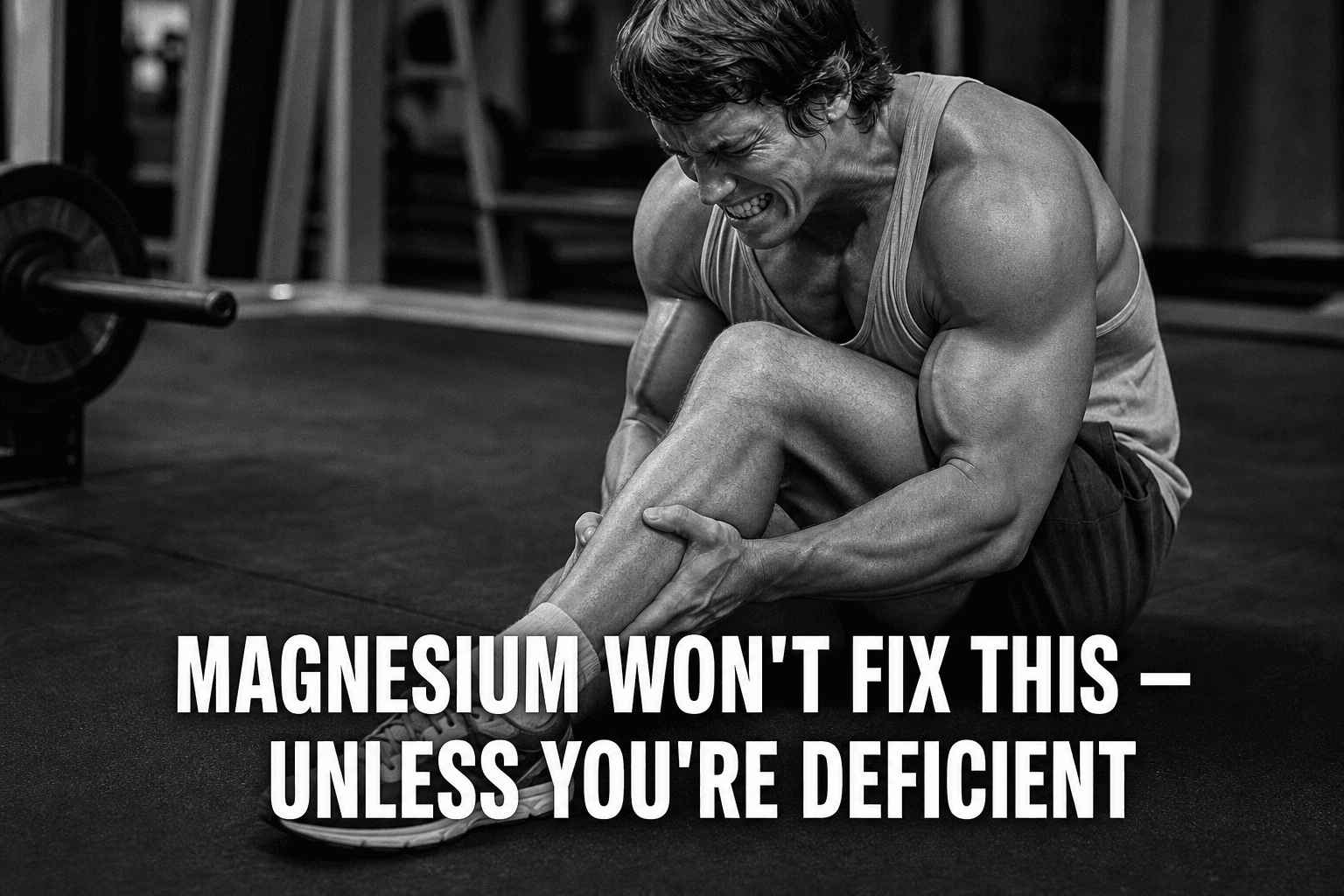
The popular belief vs. what the data says
Magnesium is one of the best-selling sports supplements on the planet, and "it stops cramps" is basically on the label.
The problem: a 2020 Cochrane review — a review that pools many studies to find the clearest answer — looked at all the randomised trials (studies where people are randomly split into groups and compared) of magnesium supplementation for skeletal muscle cramps. The conclusion was blunt. Magnesium does not reliably reduce cramp frequency, intensity, or duration in most people (Garrison et al., 2020).
That's not a fringe finding. Cochrane is widely considered the gold standard in medical evidence. If magnesium worked broadly, it would have shown up here.
Magnesium supplementation does not reliably prevent skeletal muscle cramps in most people.
— Garrison et al. (2020). Magnesium for skeletal muscle cramps. Cochrane Database Syst Rev.
Exercise cramps specifically: still no clear benefit
People often assume exercise-associated cramps are a special case — you sweat out electrolytes, magnesium drops, cramp hits. Makes intuitive sense.
But the Cochrane review covered multiple populations, including people with exercise-induced cramps, and found no significant benefit there either (Garrison et al., 2020). The same held for older adults who cramp at night — another group heavily marketed to by magnesium brands.
The cramp-sweat-magnesium chain sounds logical. The evidence just doesn't support it for people who aren't genuinely low in the mineral to begin with.
That's the key distinction, and it changes the whole conversation.
Deficiency is real — and it does cause cramps
Here's where it gets more nuanced. Magnesium isn't useless. It's essential.
Magnesium plays a core role in nerve signalling and muscle contraction — it helps regulate the electrical activity that tells a muscle to fire and, crucially, to stop firing. When magnesium levels drop too low (a state called hypomagnesemia — meaning "low blood magnesium"), one of the textbook consequences is muscle cramps, along with fatigue and, in severe cases, irregular heartbeat (Bosman et al., 2021).
The issue isn't that magnesium doesn't matter. It's that most people taking magnesium supplements aren't actually deficient.
If your levels are already in the normal range, adding more doesn't fix anything — because there's nothing to fix on that front.
Low magnesium is a real cause of cramps. But most people supplementing aren't actually low.
— Bosman et al. (2021). Genetic and drug-induced hypomagnesemia. Proc Nutr Soc.
Who actually runs low on magnesium?
Genuine magnesium deficiency isn't rare, but it's not universal either. Several real risk factors can deplete your levels:
- Poor dietary intake — magnesium is found in leafy greens, nuts, seeds, and whole grains. If your diet is light on those, your intake is probably light too.
- Certain medications — proton pump inhibitors (acid reflux drugs) and high-dose diuretics (water pills) are well-documented causes of magnesium loss (Varghese et al., 2020).
- High sweat output over time — not a single session, but chronic heavy training with consistently low dietary intake.
- Kidney or absorption issues — conditions that disrupt how the gut or kidney handles magnesium (Bosman et al., 2021).
In people on dialysis — who are studied closely for this — hypomagnesemia (serum magnesium below 0.7 mmol/L) affects 10–20% of patients (Varghese et al., 2020). That's a specific clinical group, but it illustrates that deficiency is real and consequential when it occurs.
If any of those risk factors apply to you, a blood test is the right first move — not a supplement.
Even in pregnancy — where cramps are common — it didn't work
Leg cramps hit 30–50% of pregnant women at least twice a week (Liu et al., 2021). Magnesium is routinely recommended for them. It also seems like a logical fit: pregnancy increases mineral demand.
But a 2021 meta-analysis — a review pooling 4 randomised controlled trials (RCTs — people randomly split into groups and compared) covering 332 pregnant women — found that oral magnesium supplementation did not significantly reduce cramp frequency (weighted mean difference: −0.47, 95% CI: −1.14 to 0.20, p = 0.167). It also did not improve the rate of full recovery from cramps compared to placebo (Liu et al., 2021).
That's a null result in the population most commonly told to take magnesium for cramps.
The one good news item: no significant side effects either. So it's not dangerous — it's just not doing the job most people think it's doing.
4 RCTs, 332 pregnant women: oral magnesium did not significantly reduce leg cramp frequency.
— Liu et al. (2021). Effect of oral magnesium supplementation for relieving leg cramps during pregnancy. Taiwan J Obstet Gynecol.
What actually causes exercise cramps — and what to do instead
The current thinking in sports science has shifted away from electrolyte depletion as the primary driver of exercise-associated cramps. Neuromuscular fatigue — your motor nerves becoming over-excitable when a muscle is pushed past its conditioning level — is now seen as the more likely explanation for cramps that hit during or right after hard training.
What that means practically:
- Train for it. If you cramp in a specific movement or at a specific intensity, the fix is progressive conditioning — gradually building tolerance in that range (see progressive overload training for how that principle works).
- Check your diet before you check a supplement label. If you're eating a varied diet with vegetables, legumes, nuts, and whole grains, you are probably getting enough magnesium.
- If you're on acid-reflux medication or diuretics long-term, talk to your doctor about getting your magnesium levels tested.
- Hydration and sodium matter more for sweat-driven cramps than magnesium does in most exercisers.
Magnesium supplementation is low-risk and might help if you're genuinely deficient. But taking it because you cramped after leg day is almost certainly not addressing the real cause.
How Planfit applies this
Cramps from training are almost always a conditioning issue, not a mineral issue. Planfit tracks your load and volume session by session, applies progressive overload automatically, and shows your per-exercise history so you can see exactly where your conditioning is building. If you're cramping in a specific lift, the fix is in the programming — and that's what Planfit does.
References
- Garrison SR et al. (2020). Magnesium for skeletal muscle cramps.. Cochrane Database Syst Rev. 10.1002/14651858.CD009402.pub3
- Liu M et al. (2021). Effect of oral magnesium supplementation for relieving leg cramps during pregnancy: A meta-analysis of randomized controlled trials.. Taiwan J Obstet Gynecol. 10.1016/j.tjog.2021.05.006
- Bosman CB et al. (2021). Genetic and drug-induced hypomagnesemia: different cause, same mechanism.. Proc Nutr Soc. 10.1017/S0029665121000926
- Varghese Z et al. (2020). A Higher Concentration of Dialysate Magnesium to Reduce the Frequency of Muscle Cramps: A Narrative Review.. Can J Kidney Health Dis. 10.1177/2054358120964078