Mechanical Tension: The Main Driver of Muscle Growth
5 reviews · Sports Med, Eur J Appl Physiol
6 min read
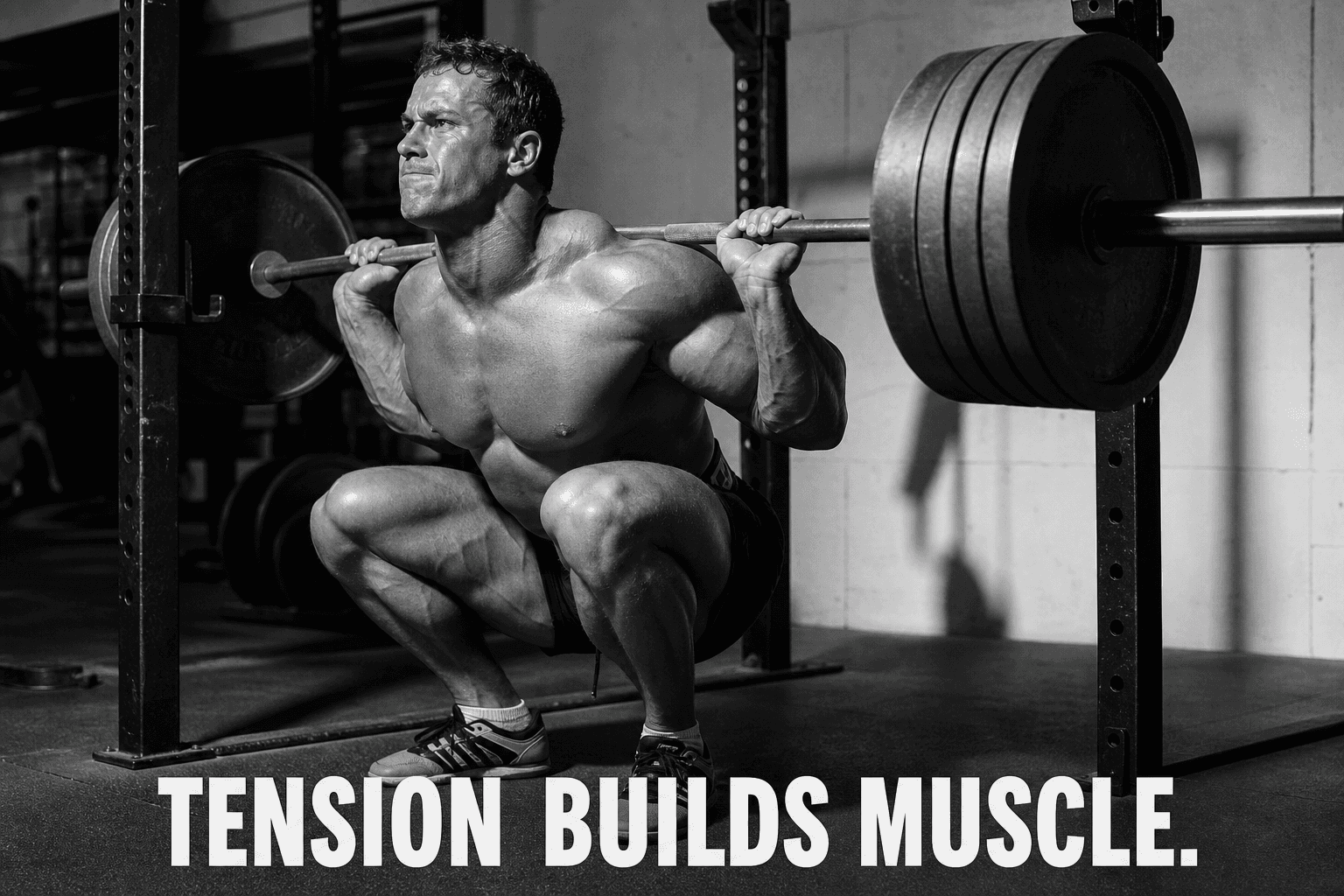
The real driver of muscle growth isn't the pump — it's tension
Every rep you do sends a mechanical signal into your muscle fibers. That signal — mechanical tension — is what tells your body to build more muscle. Not the burn. Not the soreness. Not how much you sweat.
Mechanical tension is the primary stimulus for muscle hypertrophy. When a loaded muscle is stretched and contracted under resistance, the fibers physically deform. That deformation triggers a chain of molecular events that ends with your muscle adding new protein and getting bigger (Warneke et al., 2023).
The burn and the pump are side effects of metabolic stress — a real but secondary factor. Soreness is a sign of tissue damage, which also contributes a little. But if you had to pick one thing to optimize? Tension is it. And if you've ever wondered whether soreness means you're growing, the short answer is no — check out does soreness mean muscle growth for the full breakdown.
Mechanical tension is the signal. Everything else is noise.
— Warneke et al. (2023). Physiology of Stretch-Mediated Hypertrophy and Strength Increases. Sports Med.
What actually happens inside your muscle when tension hits
Here's the process, without the textbook language.
When a muscle fiber is loaded — say, during the lowering phase of a squat — tiny structural proteins inside the fiber sense that it's being pulled and compressed. This sensing process is called mechanotransduction. Think of it as your muscle's alarm system: load detected, growth signal sent.
That signal activates mTORC1 — a molecular switch that controls muscle protein synthesis, which is the process of building new muscle tissue. More tension, more activation, more protein built (Gonzalez et al., 2016).
No tension, no signal. No signal, no growth. That's the chain.
This is also why progressive overload works — you're not just lifting more weight for the sake of it. You're creating enough tension to keep that alarm system firing as your muscle adapts. If you want a deeper look at why progressive overload is non-negotiable, progressive overload training covers it directly.
mTORC1 is the molecular switch. Tension is what flips it.
— Gonzalez et al. (2016). Intramuscular Anabolic Signaling and Endocrine Response Following Resistance Exercise. Sports Med.
Motor unit recruitment: why going heavy matters
Your muscle isn't one big unit — it's made up of hundreds of smaller motor units, each controlling a bundle of fibers. Your nervous system recruits these units from smallest to largest as a set gets harder.
Light loads recruit only the small, slow-twitch units. Heavy loads — or lighter loads taken close to failure — recruit the large, fast-twitch units too. And it's those large motor units that produce the most mechanical tension (Alix-Fages et al., 2022).
This is why load and proximity to failure both matter. A set of 15 reps done with 2 reps left in the tank recruits most of the same fibers as a heavy set of 6. A set of 15 stopped at rep 10 does not.
The takeaway: you don't have to always go heavy. But you do have to push hard enough that the high-threshold motor units — the ones responsible for the strongest tension signal — get involved.
High-threshold motor units produce the most tension. You have to recruit them.
— Alix-Fages et al. (2022). The role of the neural stimulus in regulating skeletal muscle hypertrophy. Eur J Appl Physiol.
Full range of motion: tension at length is the sweet spot
Not all tension is equal. Research on stretch-mediated hypertrophy — growth triggered by tension applied to a muscle in a lengthened position — suggests that loading a muscle through a full range of motion produces a stronger growth signal than partial reps (Warneke et al., 2023).
Animal studies show that prolonged mechanical tension at long muscle lengths drives more hypertrophy than the same tension applied at shorter lengths. Human data is still catching up, but the mechanistic case is solid: a deeper stretch under load means more tension on more sarcomeres — the individual contractile units inside each fiber.
Practically, this means: the bottom of a squat matters. The stretched position of a Romanian deadlift matters. Half-reps limit the tension stimulus, especially in the range where the muscle is most lengthened.
The same review also notes that mechanical tension at greater muscle lengths may drive structural changes like serial sarcomerogenesis (adding new sarcomeres in series), which improves both strength and range of motion over time.
Tension at length is a stronger growth signal than tension at short.
— Warneke et al. (2023). Physiology of Stretch-Mediated Hypertrophy. Sports Med.
Volume as the amplifier of tension
Mechanical tension per set is the quality of the stimulus. Volume — total sets per week — is how many times you deliver it.
A review integrating molecular mechanisms with practical training variables found that 10–20 sets per muscle group per week is the range that maximizes hypertrophy, with near-failure effort (roughly 0–2 reps left in reserve) as the quality standard for each set (Vergara et al., 2026).
Think of it this way: one hard set creates one round of mTORC1 activation. Ten hard sets across a week create ten rounds. Up to a point, more rounds mean more cumulative protein synthesis.
But volume only amplifies tension if the tension is actually there. Ten sloppy, partial-range sets well short of failure deliver far less stimulus than six hard sets through full range. Quality of tension comes first. Then volume.
For a practical look at how many sets actually moves the needle, how many sets per muscle group per week has the full breakdown.
10–20 hard sets per week, near failure, full range. That's the formula.
— Vergara et al. (2026). Molecular Basis and Practical Applications of Training. Sports Health.
Time under tension: does slowing down your reps help?
You've probably heard that slower reps = more time under tension = more growth. It's partially true, but the picture is more nuanced.
A review on time under tension found that high-volume, slower-tempo training does produce hypertrophy — but mainly because more total mechanical work is done, not because slow reps are inherently superior (Mang et al., 2022). The same review noted that slow-tempo work also increases aerobic adaptations inside the muscle, like mitochondrial development, which can improve muscle endurance.
The key variable is still total mechanical tension over a set — not tempo for its own sake. A 4-second eccentric (lowering) phase that keeps the muscle under load longer can help, especially on compound movements. But artificially slow concentric (lifting) phases that reduce the load you can use may actually reduce the tension stimulus.
Practical rule: control the eccentric, don't rush it. Aim for 2–3 seconds down. Explode up. That gives you time under tension without sacrificing load.
Control the eccentric. Don't slow the concentric to the point of reducing load.
— Mang et al. (2022). Aerobic Adaptations to Resistance Training: The Role of Time under Tension. Int J Sports Med.
How to actually apply this in your training
Here's what the research adds up to, in plain language:
1. Load hard enough to recruit your biggest motor units. That means either heavy loads (70–85% of your max) or lighter loads taken within 2 reps of failure. Pick your range — both work.
2. Train through a full range of motion. The stretched position under load is where a lot of the tension signal lives. Partial reps cut that signal short.
3. Control the lowering phase. A 2–3 second eccentric keeps the muscle under tension longer and makes full-range reps harder — in a good way.
4. Hit 10–20 sets per muscle per week, spread across 2–3 sessions. Quality first: every set should reach near-failure (Vergara et al., 2026).
5. Add weight over time. Progressive overload isn't optional — it's how you keep the tension signal above your muscle's adaptation threshold. A muscle that's adapted to 60 kg needs 65 kg to feel the same mechanical stress.
That's it. Tension, range, volume, progression. Everything else — supplements, fancy techniques, training time of day — is secondary to getting these four right.
How Planfit applies this
Planfit builds mechanical tension principles directly into your program. Every workout is structured around near-failure sets, full range of motion cues, and progressive overload — the three levers that actually drive the tension signal. The app tracks your weekly volume per muscle group and flags when you're above or below the 10–20 set window that the research supports. You don't have to think about the science. You just follow the plan.
References
- Warneke K et al. (2023). Physiology of Stretch-Mediated Hypertrophy and Strength Increases: A Narrative Review.. Sports Med. 10.1007/s40279-023-01898-x
- Gonzalez AM et al. (2016). Intramuscular Anabolic Signaling and Endocrine Response Following Resistance Exercise: Implications for Muscle Hypertrophy.. Sports Med. 10.1007/s40279-015-0450-4
- Alix-Fages C et al. (2022). The role of the neural stimulus in regulating skeletal muscle hypertrophy.. Eur J Appl Physiol. 10.1007/s00421-022-04906-6
- Vergara N et al. (2026). Molecular Basis and Practical Applications of Training, Nutrition and Recovery for Maximum Gains in Lean Muscle Mass: A Narrative Review for Optimizing Muscular Hypertrophy.. Sports Health. 10.1177/19417381261438760
- Mang ZA et al. (2022). Aerobic Adaptations to Resistance Training: The Role of Time under Tension.. Int J Sports Med. 10.1055/a-1664-8701