Knee Pain When Squatting? It's Usually the Kneecap
5 studies · 2 meta-analyses · JAMA + Br J Sports Med
6 min read
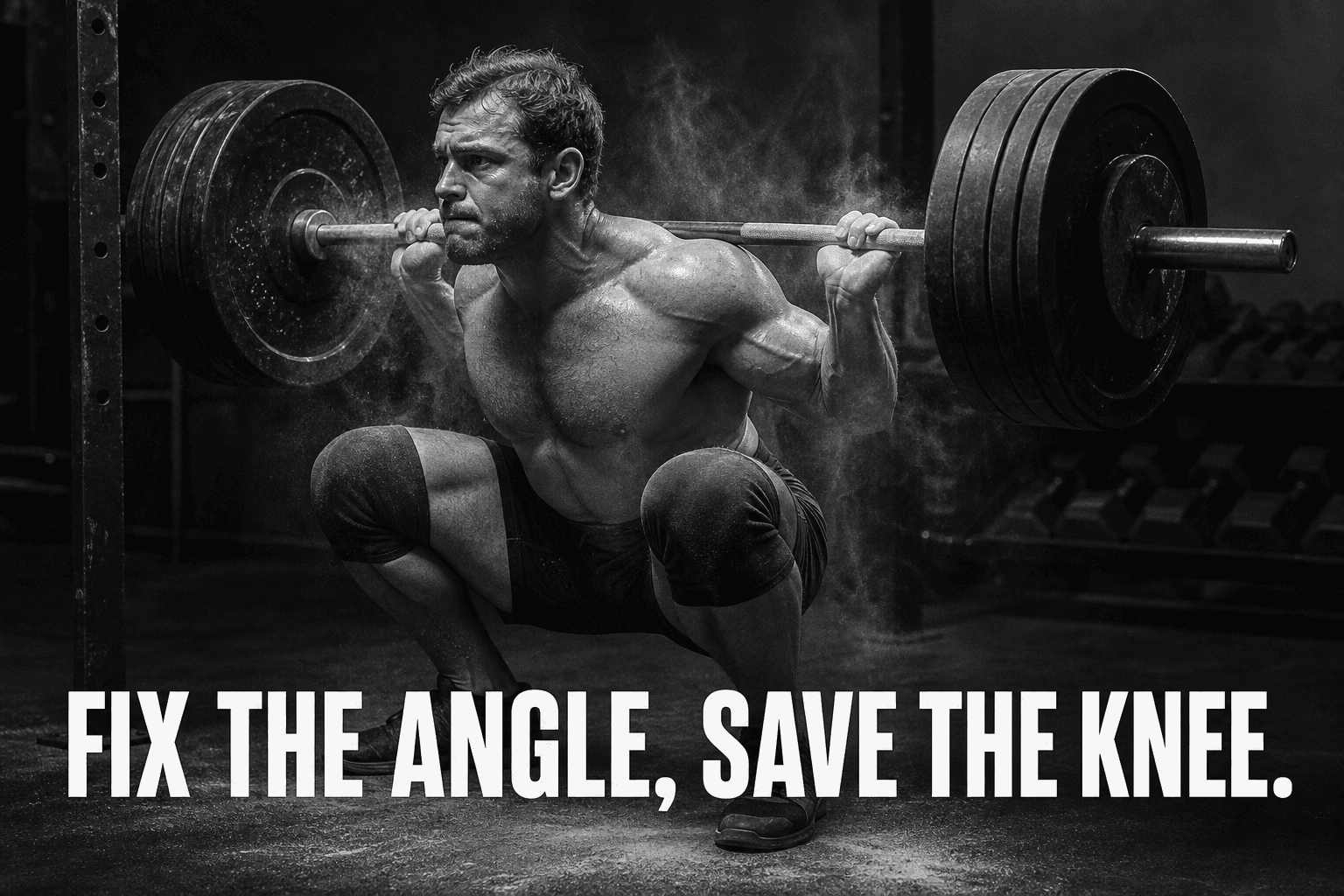
What's actually hurting — and why squats get the blame
The pain you feel under or around your kneecap during a squat has a name: patellofemoral pain — discomfort where the kneecap (patella) meets the thigh bone (femur) below it. It affects roughly 1 in 4 physically active people over their lifetime (Duong et al., 2023).
Squats don't cause this pain. Deep knee flexion — bending the knee far past 90° — increases the load on that joint. That distinction matters, because the fix is almost never "stop squatting." It's understanding how much load the joint is under and where that load is coming from.
For anterior knee pain, the presence of pain during a squat is 91% sensitive for patellofemoral pain — meaning if squats hurt at the front of your knee, that's almost certainly the structure involved (Duong et al., 2023). Everything that follows is about managing and reducing the force on that joint so you can keep training.
Squats don't cause patellofemoral pain. Deep knee flexion drives the load — and that's the variable you can control.
— Duong et al. (2023). Evaluation and Treatment of Knee Pain: A Review. JAMA.
How much force is actually on your kneecap
A 2022 systematic review and meta-analysis in the British Journal of Sports Medicine quantified the load on the patellofemoral joint — measured as a multiple of your body weight (BW) — across everyday activities and exercises (Hart et al., 2022).
Here's what that looks like in practice:
- Walking: ~0.9× your body weight on the joint
- Stair climbing: ~3.2× body weight
- Running: ~5.2× body weight
- Deep squatting: higher still, increasing with knee flexion angle
The deeper you squat, the more force stacks up on the kneecap. This isn't a reason to squat shallow forever — it's a reason to build into depth gradually and earn it with good mechanics first.
Critically, the review found that people with patellofemoral pain already show lower forces than pain-free people during the same activities — their bodies naturally offload the joint. That offloading, however, also means they're building less strength in the surrounding muscles (Hart et al., 2022).
The real culprit: your knee caving inward
The single most common mechanical cause of squat-related knee pain isn't depth, isn't bar weight, and isn't your squat frequency. It's dynamic valgus — your knee collapsing inward during the movement.
Dynamic valgus means your knee tracks toward the midline of your body instead of staying in line with your toes. When that happens, the kneecap is pulled off its natural groove, loading the outer edge unevenly (Petersen et al., 2017).
What causes it? Two things, mostly:
1. Weak hip abductors and external rotators — the muscles on the outside of your hip that hold the knee out. When they can't do their job, the knee caves.
2. Foot pronation — the arch of your foot collapsing inward, which chains up the leg and pulls the knee in.
A 2025 meta-analysis of 7,518 military personnel confirmed this directly: a larger inward knee angle during a single-leg squat — a measure of this valgus — was a significant predictor of patellofemoral pain, with a standardized effect size of 0.55 (Rocha et al., 2025). That's a meaningful signal, not noise.
A knee caving inward during a squat is a significant predictor of patellofemoral pain — the data is clear on this.
— Rocha et al. (2025). Risk Factors for Patellofemoral Pain in the Military. J Athl Train.
Weak quads make it worse — here's what the rehab data says
The same 2025 meta-analysis identified isokinetic knee-extensor weakness — meaning weak quads when tested at speed — as a moderate predictor of patellofemoral pain (SMD = −0.69) (Rocha et al., 2025). Weak quads means the joint has less muscular support during loading.
So you're in this situation: the knee hurts, you avoid squatting, your quads get weaker, the knee becomes even less protected. That's the cycle.
A 2025 systematic review of 79 studies on knee-extensor training for patellofemoral pain found that the most commonly prescribed exercises were straight-leg raises, squats, and open-chain knee extensions — typically 3 sets of 10 reps at bodyweight (Gunhamn et al., 2025). Low load, moderate volume.
The takeaway: you don't rehab a painful knee by resting it indefinitely. You rehab it by loading it carefully, starting lighter than you think you need to, and building back up.
Fix the hip to fix the knee: valgus control training
This is where things get practical. A 2019 RCT — a study where 64 female volleyball players with patellofemoral pain were randomly split into two groups and compared — put valgus control instruction (VCI) exercises to the test (Emamvirdi et al., 2019).
VCI exercises are movements designed to train the hip abductors and external rotators to stop the knee from caving. Things like clamshells, side-lying hip abduction, and hip-hinge drills — the muscles that hold the knee out, not in.
The results after the training program:
- Pain dropped 49.18% in the VCI group
- Knee dynamic valgus angle decreased 59.48% — more than half
- Hip external rotation strength improved 59.73%
- Single-leg hop performance improved 24.62%
All of those numbers were statistically significant (P = 0.000). That's a large effect for an exercise intervention — and the mechanism makes sense. Stronger hip muscles mean the knee stays where it belongs during a squat (Emamvirdi et al., 2019).
For the how to warm up before lifting article on Planfit, this connects directly: movement-specific warm-up work — including hip activation drills — is the right prep before loading a squat.
Pain dropped 49% and knee valgus dropped 59% after hip-focused valgus control training — in an RCT of 64 women with patellofemoral pain.
— Emamvirdi et al. (2019). The Effect of Valgus Control Instruction Exercises on Pain, Strength, and Functionality. Sports Health.
What to actually change in your squat right now
Here's what the evidence points to, translated into things you can adjust today:
1. Reduce depth temporarily.
Squat to where your knee tracks cleanly and pain-free. For most people with patellofemoral pain, that's a quarter squat or box squat to start. You're not giving up — you're managing load (Hart et al., 2022).
2. Add hip activation before every set.
Banded clamshells, side-lying abduction, or a glute bridge. 2–3 sets of 10–15 reps. These wake up the muscles that stop valgus before you load the bar (Emamvirdi et al., 2019).
3. Watch your knee tracking during every rep.
Your knee should follow the line of your second and third toe — not cave inward. If it's caving, reduce the weight and practice the cue "spread the floor" with your feet.
4. Train your quads directly, not just through squats.
Straight-leg raises and leg extensions — even at light load — help maintain quad strength without putting heavy force through the patellofemoral joint (Gunhamn et al., 2025).
5. Consider your footwear.
Foot pronation — the arch collapsing inward — is a documented driver of dynamic valgus. A foot orthotic or a shoe with more arch support can interrupt that chain (Petersen et al., 2017).
6. Keep moving.
Patellofemoral pain is best managed with continued exercise therapy, not rest (Duong et al., 2023). The goal is to find the load level that keeps you training without flaring the pain, then build from there.
When to see someone
Most squat-related knee pain resolves with load management and hip strengthening. But some presentations need a clinician.
See a physiotherapist or sports medicine doctor if:
- Pain is sharp, sudden, or came on after a specific incident (twisting, fall, collision)
- There is swelling, locking, or the knee gives way
- Pain is on the inside or outside of the knee, not at the front
- Pain doesn't improve after 4–6 weeks of modified training
The JAMA review notes that meniscal tears — which feel different from patellofemoral pain — affect roughly 12% of adults and often require different management (Duong et al., 2023). A clinician can tell the difference quickly.
How Planfit applies this
Patellofemoral pain is a load-management problem. Planfit tracks your squat weight and reps across every session, flags your progression trends, and recommends working weights — so you can systematically reduce load, rebuild, and avoid the guesswork of "did I do too much today?"
It also programmes warm-up sets before heavy squats and logs per-body-part volume so you can see whether your quads and hips are getting enough work each week — the two variables that matter most for keeping your knees healthy long-term.
References
- Hart HF et al. (2022). May the force be with you: understanding how patellofemoral joint reaction force compares across different activities and physical interventions — a systematic review and meta-analysis.. Br J Sports Med. 10.1136/bjsports-2021-104686
- Rocha ESB et al. (2025). Risk Factors for Patellofemoral Pain in the Military: Systematic Review With Meta-Analysis.. J Athl Train. 10.4085/1062-6050-0526.23
- Emamvirdi M et al. (2019). The Effect of Valgus Control Instruction Exercises on Pain, Strength, and Functionality in Active Females With Patellofemoral Pain Syndrome.. Sports Health. 10.1177/1941738119837622
- Gunhamn F et al. (2025). Knee extensor training in patients with patellofemoral pain: a systematic review and synthesis.. Front Rehabil Sci. 10.3389/fresc.2025.1641054
- Duong V et al. (2023). Evaluation and Treatment of Knee Pain: A Review.. JAMA. 10.1001/jama.2023.19675
- Petersen W et al. (2017). Patellofemoral pain in athletes.. Open Access J Sports Med. 10.2147/OAJSM.S133406