The trap bar deadlift isn't a shortcut — it's the smarter pull, backed by posterior-chain research
4 studies · Sports Med Open review + 2 RCTs
6 min read
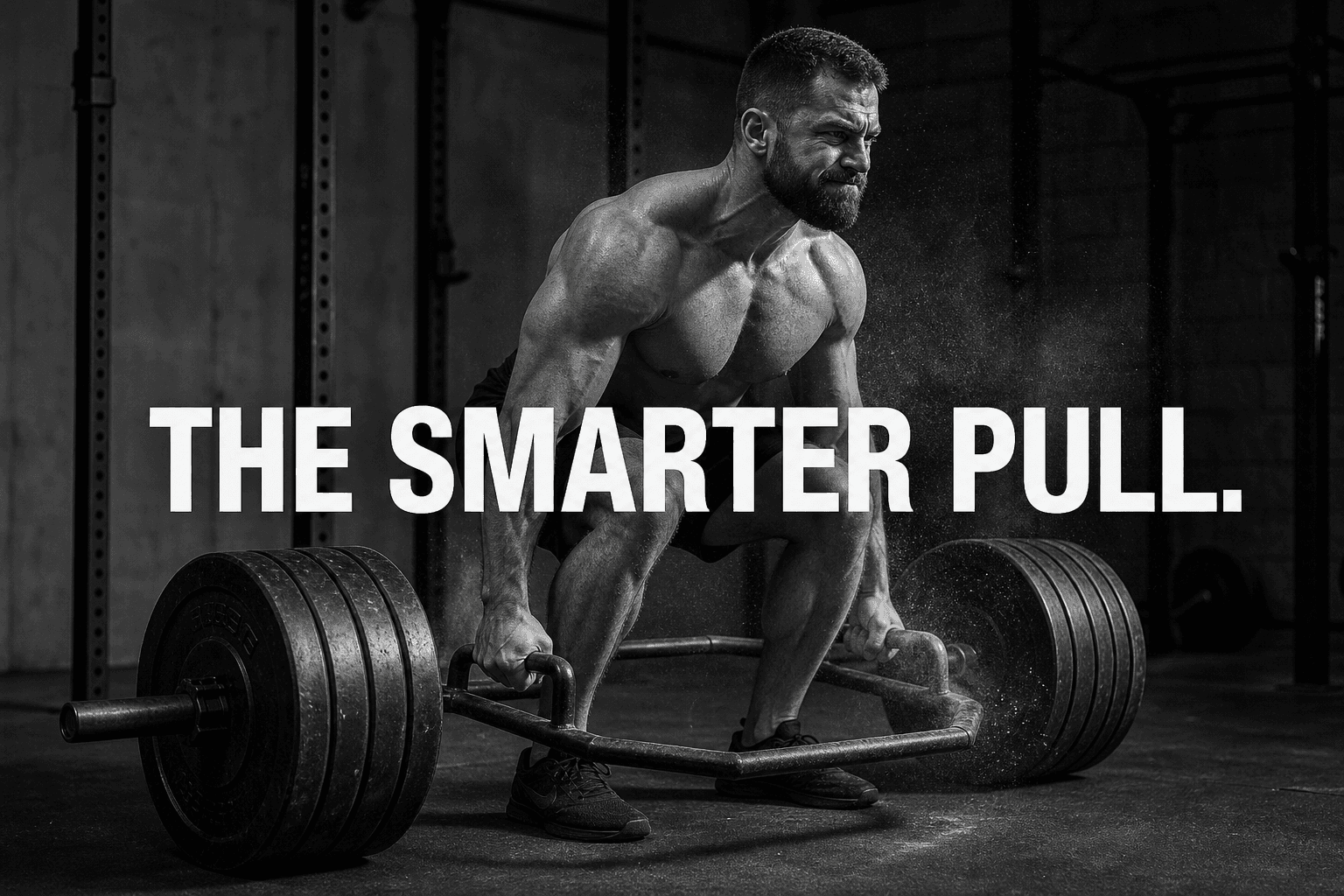
The trap bar is not the easy version
Most lifters treat the trap bar like training wheels. Something you use until you're 'ready' for the real deadlift.
That's backwards.
The trap bar deadlift is a legitimate strength tool with a mechanical profile that suits the majority of people — especially anyone who trains for general health, athletic performance, or longevity. It isn't a compromise. It's a choice.
Here's what the research actually supports about why that choice often makes sense.
It loads your posterior chain — which is exactly what your back needs
The posterior chain is the group of muscles running down the back of your body: glutes, hamstrings, spinal erectors, and the muscles along your thoracic and lumbar spine. Training these muscles directly is one of the most effective things you can do for chronic low back pain.
A systematic review in Sports Med Open — pooling 8 randomised controlled trials (RCTs) across 408 participants — found that posterior-chain resistance training (PCRT) produced significantly greater reductions in pain and disability than general exercise programmes. Longer programmes (12–16 weeks) showed the clearest advantages (Tataryn et al., 2021).
The trap bar deadlift is a posterior-chain exercise. Every rep trains the exact musculature that review is talking about: glutes, hamstrings, and spinal extensors, loaded through a full hip-hinge pattern.
General exercise — walking, bodyweight circuits, machines — doesn't come close to the same stimulus.
Posterior-chain resistance training produced significantly greater pain and disability reductions than general exercise across 8 RCTs and 408 participants.
— Tataryn et al. (2021). Posterior-Chain Resistance Training Compared to General Exercise and Walking Programmes for the Treatment of Chronic Low Back Pain. Sports Med Open.
The neutral grip shifts the mechanics in your favour
Here's the mechanical difference that matters: in a conventional deadlift, the bar sits in front of your body. Your centre of mass is forward of the bar path, which increases the torque — the rotational force — on your lumbar spine throughout the lift.
In a trap bar deadlift, you stand inside the bar. The load is distributed around your body, not in front of it. Your torso stays more upright, your hips sit lower, and the moment arm on your lower back is shorter.
A review of weightlifting injuries and biomechanics in Seminars in Musculoskeletal Radiology confirms that spinal loading in the deadlift is closely tied to bar position relative to the lifter's centre of mass — and that variations reducing forward lean reduce lumbar shear forces (Igbinoba et al., 2025).
Less lumbar shear doesn't mean 'easier.' It means more of the load goes where you want it: into your legs and glutes.
For most recreational lifters, that's the better trade-off.
It still builds real deadlift strength
Some lifters worry the trap bar doesn't carry over to 'real' strength. The data on deadlift strength gains says otherwise.
An RCT in the Journal of Strength and Conditioning Research put 28 resistance-trained men through 6 weeks of structured deadlift training. Deadlift 1RM — the maximum weight a person can lift for one rep — improved by +19 kg in the 3×/week group and +21 kg in the 6×/week group (Colquhoun et al., 2018). The mechanism driving those gains is the same whether you're using a straight bar or a trap bar: progressive overload on the hip-hinge pattern.
The trap bar lets you load that pattern heavier, sooner, because the mechanics are more forgiving. More load, more often, with better form = more strength over time.
If you want to dig into how progressive overload drives those gains at a deeper level, progressive overload training covers exactly that.
It carries over to athletic power — jumps, sprints, and sport
A machine-learning meta-analysis pooling data from 124 studies across 16 meta-analyses found that including deadlift-pattern exercises in a training programme was one of the top predictors of countermovement jump (CMJ) improvement — a standard measure of explosive leg power (Ho et al., 2023).
The countermovement jump is basically a standing vertical leap. It reflects how well your nervous system and posterior-chain muscles work together under fast, ballistic conditions. That transfers directly to sprinting, cutting, and sport.
The trap bar deadlift trains the same hip-hinge and triple-extension pattern — hips, knees, and ankles all extending together — that underlies most athletic movements. Because lifters can typically move more weight and maintain better posture with the trap bar, the power-training stimulus is often higher, not lower.
For athletes who also squat heavily, the trap bar provides a lower-back-sparing alternative that still trains the same explosive chain. That's volume management without sacrificing stimulus.
Deadlift-pattern training was among the top predictors of countermovement jump improvement across 124 studies and 16 meta-analyses.
— Ho et al. (2023). Using Machine Learning Algorithms to Pool Data from Meta-Analysis for the Prediction of Countermovement Jump Improvement. Int J Environ Res Public Health.
Who it suits best — and one honest caveat
The trap bar deadlift is a strong default choice for:
- Beginners learning the hip-hinge pattern for the first time
- Anyone with a history of low back sensitivity
- Athletes training for power and speed who need high load without excessive spinal stress
- Lifters who want to deadlift frequently without accumulating too much lumbar fatigue
The honest caveat: if your goal is specifically to compete in powerlifting, you need the conventional (or sumo) deadlift — that's what's judged on the platform. The trap bar won't prepare your technique for competition.
For everyone else, the conventional deadlift isn't a higher rung on the ladder. It's a different tool — with a different mechanical cost. And for most people, the trap bar's mechanics make it the smarter long-term choice.
If you're wondering how many sets to actually do each session, how many sets of deadlifts should i do breaks down exactly that.
How to actually do it well
The trap bar deadlift rewards good setup. Here's what matters:
Foot position. Stand in the centre of the bar, feet hip-width apart. You should be equidistant from the front and back rails.
Hip height. Before you pull, set your hips at a height where your shins are roughly vertical and your back is at roughly 45 degrees — not horizontal like a Romanian deadlift, not vertical like a squat. This is the position that loads both your posterior chain and your quads evenly.
Brace before you pull. Take a deep breath into your belly, brace your core like you're about to take a punch, then initiate the pull. This intra-abdominal pressure is your spine's natural support system.
Push the floor away. Think 'leg press' not 'lift the bar'. Drive through your feet. The bar follows.
Lock out with your glutes. At the top, squeeze your glutes to reach full hip extension. Don't hyperextend your lower back to finish the rep.
For the trap bar deadlift specifically, Planfit sets your starting weight and rep target based on your training level — so you're not guessing where to begin.
How Planfit applies this
Planfit programmes the trap bar deadlift as a primary posterior-chain movement, recommends your working weight and rep range based on your training level, and tracks your progression so the stimulus keeps getting harder. It also logs your volume by body part — so you can see exactly how much posterior-chain work you're actually accumulating each week.
If you're adding the trap bar deadlift to your training for the first time, Planfit slots it into your session and tells you where to start.
References
- Tataryn N et al. (2021). Posterior-Chain Resistance Training Compared to General Exercise and Walking Programmes for the Treatment of Chronic Low Back Pain in the General Population: A Systematic Review and Meta-Analysis.. Sports Med Open. 10.1186/s40798-021-00306-w
- Colquhoun RJ et al. (2018). Training Volume, Not Frequency, Indicative of Maximal Strength Adaptations to Resistance Training.. J Strength Cond Res. 10.1519/JSC.0000000000002414
- Ho et al. (2023). Using Machine Learning Algorithms to Pool Data from Meta-Analysis for the Prediction of Countermovement Jump Improvement.. Int J Environ Res Public Health. 10.3390/ijerph20105881
- Igbinoba et al. (2025). Weight-lifting Injuries: A Review of Imaging and Biomechanics.. Semin Musculoskelet Radiol. 10.1055/s-0045-1809399