Can You Work Abs Every Day? How Often to Train Abs
By Planfit Editorial Team · 4 min read
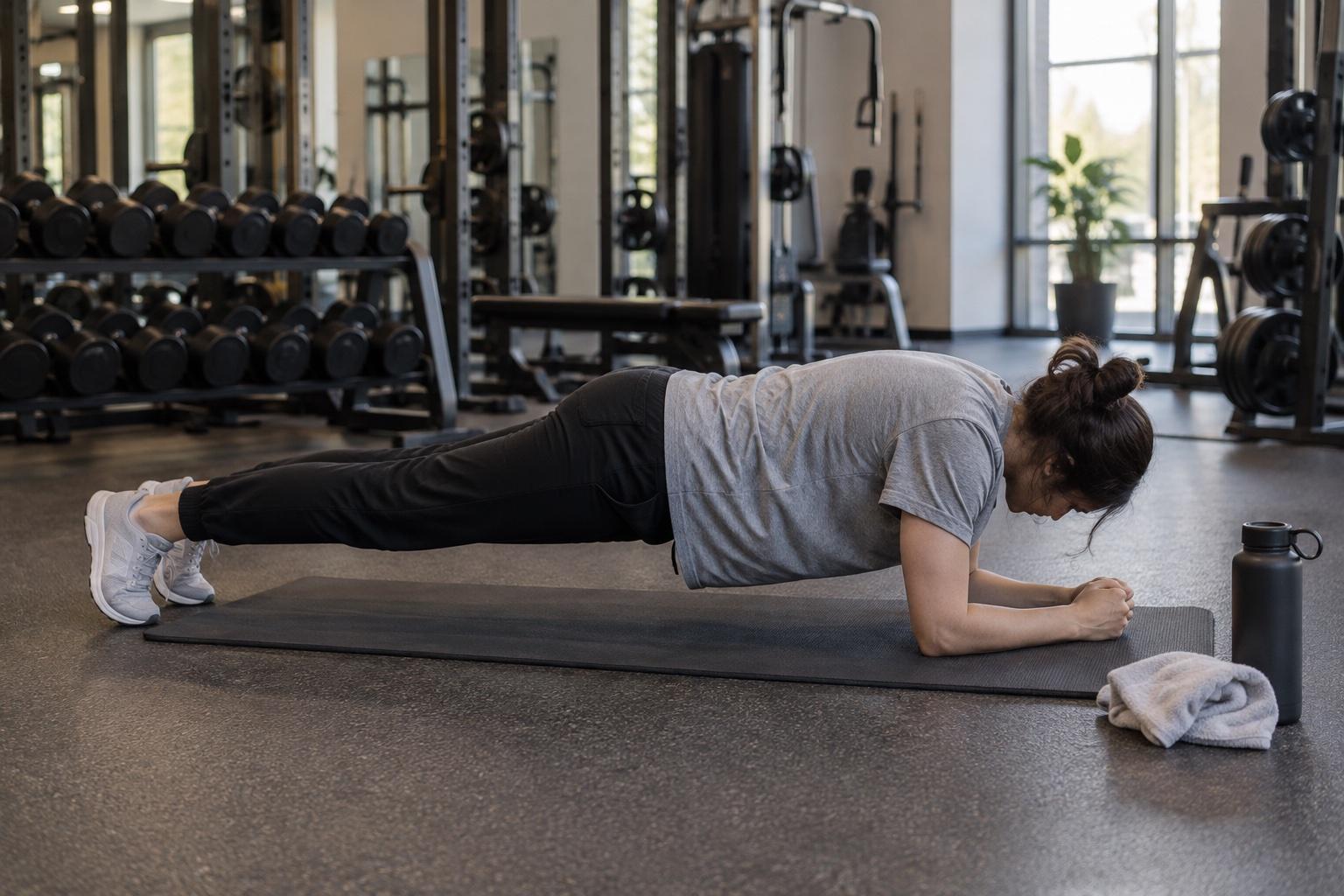
1. Can you work abs every day, or how many times a week?
Yes, you can work abs every day. Light ab work won't hurt you. But training abs every day won't build them any faster. What matters is how many hard sets you do in a week, not how many days you spread them over.
A review of 25 studies found that when people did the same number of sets per week, splitting those sets across more days didn't build more muscle (Schoenfeld et al., 2019). So before choosing every day or a few days a week, decide how many sets you'll do in a week.
If you're new, start with 10–15 sets a week. Then spread those sets over whatever days fit your week.
If you're new, 2–3 times a week is the easiest place to start. Women who hadn't been exercising did Pilates twice a week for 9 months, and the front ab muscle (the "six-pack" muscle) grew 21% in volume (Dorado et al., 2012). If you like the daily habit, keep it to 2 sets a day. Doing 6 sets every day adds up to 36 sets a week. The extra sets won't add much, and your abs get less time to recover.
2. Can you work abs 2 days in a row?
It depends on what you did yesterday.
- Go ahead if yesterday was light, like 2 sets of planks.
- Take the day off if your stomach still feels sore when you sit up out of bed or cough. If you did 6 hard sets yesterday, skip a day.
3. Can ab exercises alone give you a six-pack?
Doing abs every day won't burn belly fat. In one study, 24 adults who hadn't been exercising did 7 ab exercises, 2 sets each, 5 days a week for 6 weeks. Their belly fat, waist size, and body fat didn't change. What did change: they could do more curl-ups than people who didn't train (47 vs 32) (Vispute et al., 2011).
To see a six-pack, the fat covering your abs has to come off, and fat comes off your whole body, not from the spot you train. That's why your overall training and your diet matter more than ab work for a flatter stomach. If you want more detail, read Spot reduction is (mostly) a myth.
4. A simple 10-minute ab routine for beginners
Do 3 exercises, 2 sets each, twice a week. That's 12 sets a week. Rest 1 minute between sets. Do it at the very end of your strength workout. If your abs are tired first, it's harder to keep your body steady during squats or deadlifts.
Make each set hard enough that you only just reach the numbers in the table below. For example, reverse crunches should start to feel tough around rep 10.
When to make it harder: once you hit the top of the range (40 sec, 8 per side, 12 reps) on both sets, move up one step next time.
- Plank: add 10 seconds, up to 60.
- Dead Bug: add 2 reps per side, up to 12.
- Reverse Crunch: take 3–4 seconds to lower. When 15 slow reps feel easy, switch to the gym routine in the next section.
5. Ab machines for beginners at the gym
If bodyweight moves feel too easy or too hard, you can use machines instead. Machines make it easier to adjust the difficulty with weight or position. Do 3 sets of each of the two machines: 6 sets a day, the same as the bodyweight routine.
- Abdominal Machine: start with a weight where you only just reach 10–12 reps. When you get 12 on all three sets, move the pin down one plate.
- Captains Chair Leg Raise: start by bringing your knees up toward your chest with your knees bent. When 12 reps get easy, straighten your legs a little more.
6. Do ab workouts hurt your lower back?
Your lower back can hurt if it lifts off the floor or sags toward it while you move. Try these changes for each exercise.
- Reverse Crunch: the closer your legs get to the floor, the easier it is for your back to lift. Don't lower your feet as far, and stop just before your back comes off the floor.
- Plank: if your hips sag, your lower back bends down. Keep your hips level with your shoulders, and if that's still too hard, rest your knees on the floor.
- Dead Bug: slide a hand under your lower back. If you feel a gap, don't reach your arms and legs out as far.
- Captains Chair Leg Raise: keep your back against the pad, lift with your knees bent, and don't swing your legs up.
If it still hurts after these changes, or your back hurts at other times too, stop ab work and see a doctor.
Frequently asked questions
Should I do abs on upper or lower day?
Either is fine. What matters is 2–3 days a week with a day between them.
Is a 20-minute ab workout enough?
You don't need 20 minutes. Count hard sets, not minutes. Six hard sets take under 10 minutes.
Build a plan around the days you can train
Choose your goal, your experience level, and how many days a week you can train, and Planfit will build a workout plan that fits you.
References
- Schoenfeld BJ, Grgic J, Krieger J. (2019). How many times per week should a muscle be trained to maximize muscle hypertrophy? A systematic review and meta-analysis of studies examining the effects of resistance training frequency.. J Sports Sci. 10.1080/02640414.2018.1555906
- Dorado C, Calbet JA, Lopez-Gordillo A, Alayon S, Sanchis-Moysi J. (2012). Marked effects of Pilates on the abdominal muscles: a longitudinal magnetic resonance imaging study.. Med Sci Sports Exerc. 10.1249/MSS.0b013e31824fb6ae
- Vispute SS, Smith JD, LeCheminant JD, Hurley KS. (2011). The effect of abdominal exercise on abdominal fat.. J Strength Cond Res. 10.1519/JSC.0b013e3181fb4a46