Close Grip vs Regular Bench Press: Which Grip to Use?
By Planfit Editorial Team · 4 min read
1. Close grip bench press muscles worked: what changes?
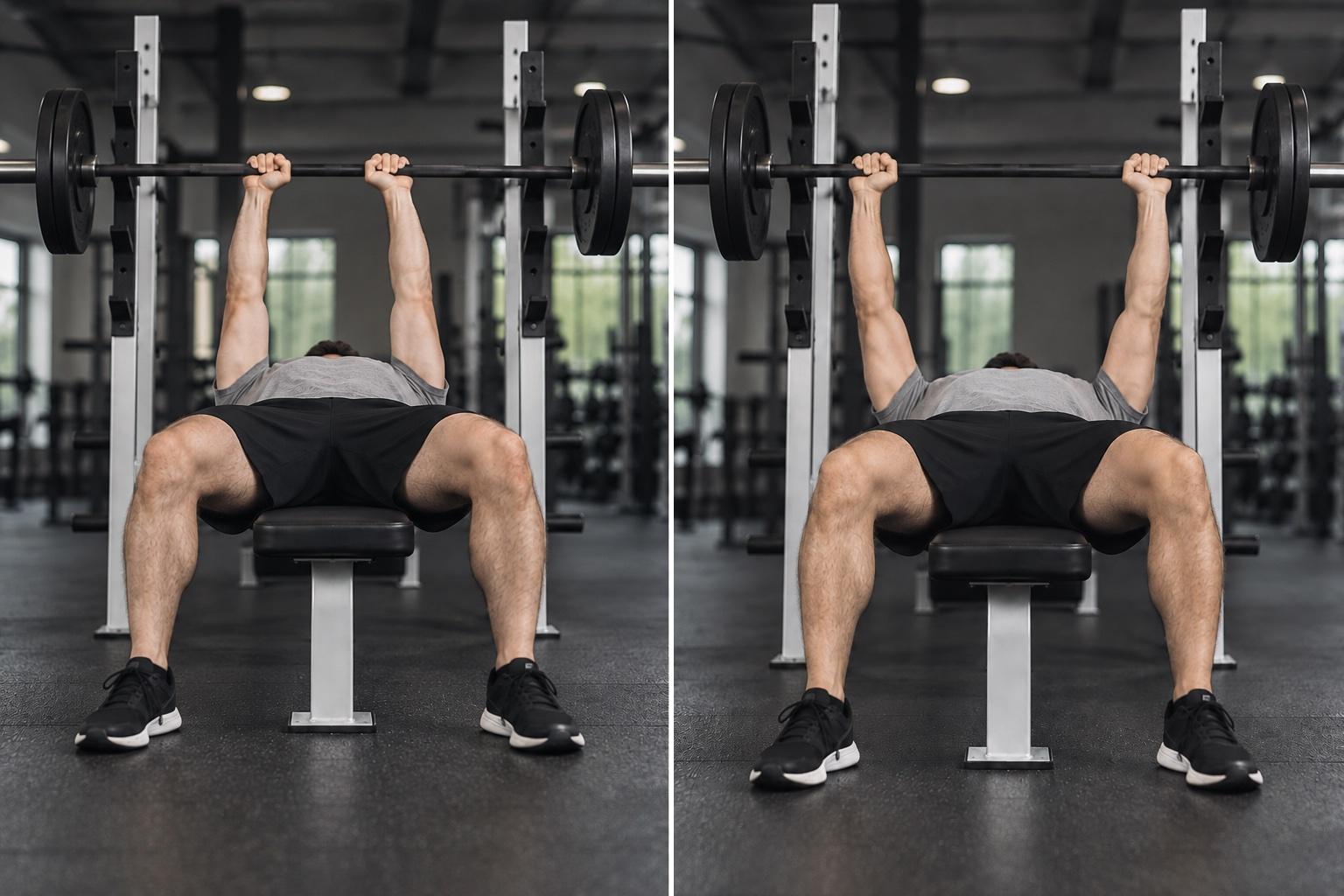
A close grip bench press is a bench press with your hands closer together, about shoulder width apart. You still lie on the bench and lower the bar to your chest the same way. Only where your hands go changes.
Your chest works about the same with any grip. Studies that compared close, regular and wide grips on the bench press found that your chest worked about the same with all three (Saeterbakken et al., 2021; Muyor et al., 2023).
What changes is your triceps (the muscle on the back of your upper arm). Your triceps worked harder with a regular or close grip than with a wide grip (Saeterbakken et al., 2021; Larsen et al., 2021).
So use a regular grip for your main bench press.
2. What changes with grip width, and which to pick
Your chest gets about the same work with any grip, but a few other things change.
How to pick:
- It's your first time: use a regular grip. You can lift more with it than with a close grip.
- You want a little more triceps work: after your regular grip sets, move your hands in and do one more set. A close grip puts less load on your shoulders, so it works well as a last set.
- Your shoulders feel uncomfortable: move your hands in a little. A close grip put less load on the shoulder joint than wider grips in one study (Larsen et al., 2021). If it still hurts, your form may be the problem. Read Shoulder Pain During Bench Press.
- You feel it all in your arms, not your chest: your form is more likely the problem than your grip width. Read Why Can't I Feel My Chest When Benching?.
- A wide grip feels best to you: you can keep using it. You can lift about the same weight as with a regular grip, and your chest gets about the same work (Larsen et al., 2021).
3. Proper bench press form for each grip width
Use your shoulders as the guide for where to put your hands.
- Regular grip: grip the bar with each hand one fist's width outside your shoulder. When the bar touches your chest, your forearms should point straight up at the ceiling.
- Close grip: from your regular grip, move each hand in by one fist's width, so your hands are about shoulder width apart. Keep your elbows close to your sides as you lower the bar.
- Wide grip: from your regular grip, move each hand out by one fist's width.
With any grip, wrap your thumbs all the way around the bar and lower it to your lower chest, just above the bottom of your breastbone. If your wrists hurt with a close grip, move your hands out a little. If your shoulders feel uncomfortable with a wide grip, go back to your regular grip.
4. Learn more: What if you flip your grip?
So far this has been about how far apart your hands are. You can also flip your hands so your palms face you. This is called a reverse grip bench press.
A reverse grip puts more work on your upper chest and biceps.
A reverse grip is harder to handle. The bar can roll toward your face or out of your hands. If you try it:
- Use an empty bar or a light weight.
- Have someone spot you, or use a Smith machine, where the bar is fixed to a track.
- Wrap your thumbs all the way around the bar.
If a reverse grip bench press feels hard to control, try an Incline Bench Press instead. Both work your upper chest, but in different ways. A reverse grip bench press flips your hands on a flat bench. An incline bench press keeps your normal grip and raises the back of the bench to about 30 to 45 degrees. Since only the bench angle changes, you can use the same grip and form as your regular bench press, without worrying about the bar slipping out of your hands.
Frequently asked questions
How much less weight should I use with a close grip?
A little less. In one study, people lifted about 5% less with a close grip than with a regular grip (Larsen et al., 2021). Start about 10 lb lighter and add weight once you finish all your reps.
Should my wrists bend back when I grip the bar?
No. If your wrists bend back, the weight of the bar pulls on them and they can start to hurt. Don't hold the bar up in your fingers. Set it low in your palm, on the thick part just above your wrist. That keeps your wrists from bending back as much.
Can I do a close grip bench press with dumbbells?
Yes. Press with the dumbbells close together over the middle of your chest. This is the Close Grip Dumbbell Bench Press. It's a good option if you don't have a spotter for the barbell, because you can set the dumbbells down to your sides. Wondering how a barbell and a dumbbell bench press compare? See Bench Press vs Dumbbell Bench Press.
Get a routine that fits you
If it's hard to decide which chest exercises to do and how many sets, let Planfit handle it. Answer a few questions and Planfit builds a routine with chest and arm exercises, matched to your goal and experience.
References
- Saeterbakken AH, Stien N, Pedersen H, et al. (2021). The Effect of Grip Width on Muscle Strength and Electromyographic Activity in Bench Press among Novice- and Resistance-Trained Men.. Int J Environ Res Public Health. 10.3390/ijerph18126444
- Larsen S, Gomo O, van den Tillaar R. (2021). A Biomechanical Analysis of Wide, Medium, and Narrow Grip Width Effects on Kinematics, Horizontal Kinetics, and Muscle Activity on the Sticking Region in Recreationally Trained Males During 1-RM Bench Pressing.. Front Sports Act Living. 10.3389/fspor.2020.637066
- Muyor JM, Rodríguez-Ridao D, Oliva-Lozano JM. (2023). Comparison of Muscle Activity between the Horizontal Bench Press and the Seated Chest Press Exercises Using Several Grips.. J Hum Kinet. 10.5114/jhk/161468