Why Can't I Feel My Chest When Benching? 6 Fixes
6 min read
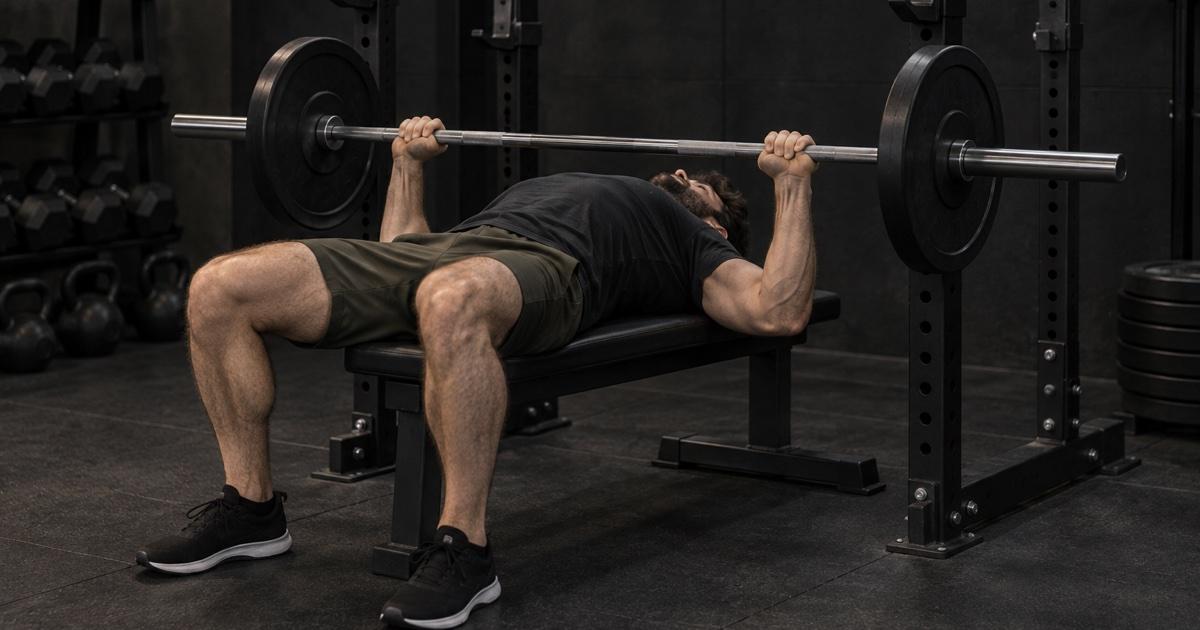
Is it normal not to feel your chest when benching?
If you can't feel your chest when benching, you are not alone, and it does not mean your chest is doing nothing. The Bench Press is a pressing movement shared by three muscles: your chest, the front of your shoulders, and your triceps. Whichever of them gets tired first is the one you feel, and for many lifters, especially beginners, that is the shoulders or the arms.
Feeling a muscle burn is not the same as training it. Plenty of lifters rarely feel their chest on the bench and still build one. What you can change is how much of the work your chest gets:
- Shoulders take over: your shoulder blades are not pressed into the bench, or your elbows flare out. Fixes 1 and 3.
- Arms give out first: your grip is too narrow or your triceps are the weak link. Fix 2.
- You feel nothing much at all: the bar stops short of your chest, or the weight is too heavy to control. Fixes 4 and 5.
Fix your setup first, then judge by your training log over a few months, not by the burn. If you lift more reps at the same weight, or more weight for the same reps, it is working.
1. Shoulders taking over? Press your shoulder blades into the bench
This is the most common reason. When your shoulders roll forward or shrug up toward your ears, the front of your shoulders takes on work your chest should be doing.
Set up in this order before you lift the bar:
- Lie on the bench and, before you grab the bar, pull your shoulders back and press both shoulder blades into the bench.
- Then pull your shoulders down toward your feet. Your chest will rise on its own.
- Brace your stomach so your lower back doesn't arch too much, the way you would right before a cough. Keep your hips on the bench and your feet flat on the floor.
- Grab the bar without losing that position.
- Keep your shoulder blades pressed into the bench as you lower and press the bar. If your shoulders roll forward as you press up, the weight is too heavy for now.
If benching also makes the front of your shoulder ache, see how to fix shoulder pain on the bench.
2. Arms giving out first? Check your grip width
If your triceps burn out before your chest feels anything, look at your grip. A narrow grip shifts more of the work to your triceps. Two studies that compared grip widths both measured more triceps activity with a narrow grip than with a wider one (Saeterbakken et al., 2021; Muyor et al., 2023).
Going very wide, though, does not add much for your chest. In the same studies, chest activity changed little between grip widths. Aim for a medium grip. Put your ring finger or pinky on the smooth rings marked on the bar (where the rough grip texture changes); for most people that is the right width.
If you are new to lifting, it is normal for your triceps to be the weakest of the three muscles, so feeling your arms first is expected.
3. Watch your elbows and where the bar touches
Two small things change how the bench feels:
- Don't flare your elbows straight out to the sides. Tuck them in a little, so that from above your arms make an arrow shape with your body rather than a T. Elbows flared to the sides tend to put more stress on the front of your shoulders.
- Touch the bar just below your nipples, not up near your collarbone. Lowering it too high usually comes with flared elbows and rolled-forward shoulders.
At the top of the rep, the bar should end up roughly over your shoulders.
4. Lower the bar all the way to your chest
Stopping a few inches above your chest cuts out the bottom of the rep, which is exactly where your chest is most stretched. Let the bar touch your chest lightly on every rep, without bouncing it.
Full range of motion also builds more strength than partial reps (Pallarés et al., 2021). If you cannot reach your chest with your current weight, take some weight off.
To learn the bottom position, practice with an empty bar: lower it slowly until it touches your chest, then press it back up, for a few reps.
5. Go lighter and slower
If the bar wobbles and you are busy balancing it, it is hard to focus on your chest. With a weight you can lift for 10 or more reps, thinking about your chest really can make it work harder (Calatayud et al., 2016).
So for sets where you want to feel your chest:
- Use a weight you can lift for 10 or more reps.
- Lower the bar slowly, over 2-3 seconds.
- Think about squeezing your upper arms toward each other as you press, rather than pushing the bar away.
See how to focus on a muscle with lighter weights for more.
6. Still nothing? Swap the exercise
If you have fixed your setup and still only feel your shoulders or triceps, switch the bench press for one of the exercises below. Barbell bench press is not required for a bigger chest.
Quick checklist: fix it in this order
- Press your shoulder blades into the bench and pull your shoulders down before you unrack the bar.
- Put your ring finger or pinky on the rings marked on the bar.
- Tuck your elbows slightly and touch the bar just below your nipples.
- Lower the bar all the way to your chest.
- Use a weight you can lift for 10 or more reps and lower it slowly.
- Still nothing? Switch to one of the exercises above.
Don't try to fix everything at once. Work down the list one step at a time. On dumbbell bench presses and chest press machines too, keep your shoulders back and down and don't flare your elbows out to the sides.
Frequently asked questions
Where should I feel the bench press?
Mostly across your chest, with some work in the front of your shoulders and your triceps. Feeling all three is normal. Feeling only your shoulders, especially as an ache in the front of the joint, usually points to your setup.
Should I arch my back on the bench?
A small arch in your upper back helps you keep your shoulder blades pressed into the bench, and that keeps your chest in the lift. Keep your butt on the bench and your feet flat on the floor. You don't need an extreme arch to feel your chest.
My chest isn't sore after benching. Is it not working?
No. Soreness is not a measure of muscle growth. It fades as you repeat the same workout, but the training still works. See why soreness doesn't track growth.
I don't feel my chest on push-ups either. Is it the same problem?
Usually, yes. Keep your shoulder blades back and down, tuck your elbows a little, and lower until your chest nearly touches the floor. See Push Up for the full movement.
Learn your bench press setup by voice
Each exercise in Planfit comes with a guide. With voice coaching, you can learn the starting position, the movement, and your breathing step by step and practice 3 reps, and you hear form tips during your sets too.
References
- Calatayud J, Vinstrup J, Jakobsen MD, et al. (2016). Importance of mind-muscle connection during progressive resistance training.. Eur J Appl Physiol. 10.1007/s00421-015-3305-7
- Saeterbakken AH, Stien N, Pedersen H, et al. (2021). The Effect of Grip Width on Muscle Strength and Electromyographic Activity in Bench Press among Novice- and Resistance-Trained Men.. Int J Environ Res Public Health. 10.3390/ijerph18126444
- Pallarés JG, Hernández-Belmonte A, Martínez-Cava A, et al. (2021). Effects of range of motion on resistance training adaptations: A systematic review and meta-analysis.. Scand J Med Sci Sports. 10.1111/sms.14006
- Muyor JM, Rodríguez-Ridao D, Oliva-Lozano JM. (2023). Comparison of Muscle Activity between the Horizontal Bench Press and the Seated Chest Press Exercises Using Several Grips.. J Hum Kinet. 10.5114/jhk/161468