Coffee before or after a workout? Two different jobs, per 21 meta-analyses
5 studies · Grgic 2020 umbrella review
5 min read
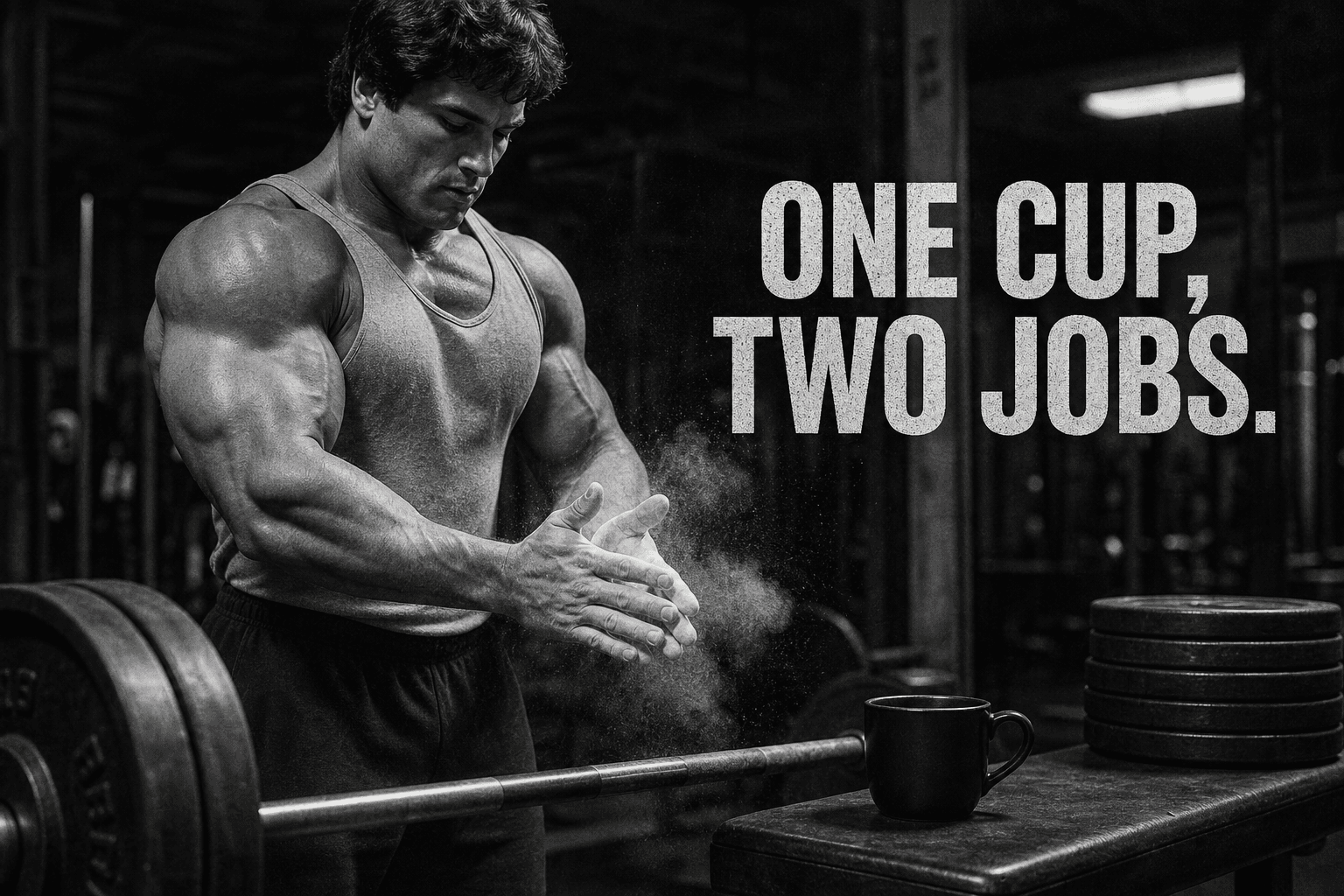
Two timings, two different biological jobs
Caffeine doesn't do one thing to your body — it does several, and they don't happen on the same clock.
Before you lift, caffeine blocks adenosine receptors in your brain and nerves. Adenosine is the molecule that builds up and makes you feel tired; blocking it is a big part of why you feel sharper and can push harder (Grgic J, 2021). That's a performance effect, and it's centered on your nervous system.
After you lift, coffee does something else entirely: it changes how your muscles handle carbohydrate. In a trial where trained cyclists drank coffee mixed with milk during recovery, their muscles refilled with more than double the stored fuel compared to milk alone (Loureiro et al., 2021). That's not an alertness effect — it's a fuel-storage effect.
Same drink, two separate jobs, at two separate times. Treating 'coffee and exercise' as one single question is where most advice goes wrong.
Before training: caffeine is a real performance boost, not a placebo
The pre-workout effect is one of the best-supported findings in sports nutrition.
An umbrella review — a review built entirely out of other reviews, in this case pooling 21 separate meta-analyses — found caffeine improves aerobic endurance, muscle strength, muscular endurance, power, jumping performance, and exercise speed (Grgic et al., 2020). The quality of evidence behind strength, endurance, and power specifically was rated moderate, which in research terms means reliable, not just 'might help.'
Zoom into weight training specifically and the picture holds. Caffeine improves 1-rep max strength, isometric strength (force against something that doesn't move, like pushing on a fixed bar) and isokinetic strength (force tested at a constant speed on a machine), plus muscular endurance, bar speed, and power across different loads and rep schemes (Grgic J, 2021). It works about as well for women as it does for men, and effects show up whether the caffeine comes from a pill, a gel, chewing gum, or brewed coffee itself (Grgic J, 2021). For a deeper look at exactly how to time and dose it before a session, see is coffee good before a workout.
Caffeine reliably boosts strength, endurance, and power — that's moderate-quality evidence across 21 pooled meta-analyses, not a maybe.
— Grgic et al. (2020). Br J Sports Med.
The effective dose is smaller than most people think
You don't need a triple espresso to get the benefit.
The minimum dose that reliably moves performance sits around 1.5 mg of caffeine per kilogram of bodyweight (Grgic J, 2021). For a 70 kg (154 lb) lifter, that's about 105 mg — roughly one regular cup of brewed coffee. Going bigger doesn't buy much more: low doses (2-3 mg/kg) perform about as well as high doses (6 mg/kg) head-to-head (Grgic J, 2021).
There's a separate floor worth knowing if you're relying on a sports drink or energy drink instead of brewed coffee: a review of caffeinated beverages found you need at least 3 mg/kg from a drink to reliably see a performance change (Jiménez et al., 2021). Coffee itself skews toward the smaller end of that range being enough.
Two more things worth knowing. Your genetics — variations in the CYP1A2 and ADORA2A genes, which control how fast your body clears caffeine — don't seem to blunt the effect. Neither does drinking coffee every day (Grgic J, 2021). You don't need to cycle off caffeine for it to keep working.
1.5 mg/kg is the minimum effective dose — about one cup of coffee. More than that barely moves the needle.
— Grgic J. (2021). Sports Med.
After training: coffee nearly doubles how fast you refuel
This is the part almost nobody talks about — and it has nothing to do with feeling alert.
In a randomized, crossover trial — a study design where every participant tries both conditions, so each person is compared against themselves — trained cyclists drained their muscle glycogen (the stored carbohydrate your muscles burn for fuel) with an exhausting ride. Afterward, they had either coffee mixed with milk, or milk alone, alongside a normal breakfast. Four hours later, muscle biopsies showed the coffee group had refilled glycogen to 102.6 mmol per kg of dry muscle, versus 40.5 mmol/kg in the milk-only group — a large difference (Loureiro et al., 2021). The coffee group also showed a bigger rise in blood glucose and insulin, which is likely part of the mechanism: coffee appears to help push more carbohydrate into the muscle during recovery.
One caveat worth flagging: this was coffee added to a carb-and-protein recovery meal, not caffeine on an empty stomach. The effect on record is coffee plus food — not coffee alone.
Why one molecule does two different things
Caffeine's performance effect and its refueling effect run through different pathways — that's why they don't blend into one single 'caffeine effect.'
Before exercise, caffeine works mainly through your central nervous system: it raises alertness, triggers the release of catecholamines (adrenaline-type hormones), and changes how fatigued you feel during effort (Barcelos et al., 2020). That's the mechanism behind the strength and endurance boost.
After exercise, the relevant pathway is metabolic, not neurological. Caffeine appears to influence how your body handles glucose and insulin in ways that help shuttle more carbohydrate into muscle for storage (Loureiro et al., 2021), consistent with its broader effects on systemic metabolism (Barcelos et al., 2020). Same molecule, two different doors, depending on when you walk through with it.
How to actually time it
Before training: aim for 1.5-3 mg/kg, about 30-60 minutes before you lift, especially on your heaviest compound-lift days — that's where the strength and power research is strongest (Grgic J, 2021).
After training: don't skip coffee just because your pre-workout window already closed. Pair it with your normal post-workout meal — the trial that found the glycogen benefit used coffee alongside food, not on an empty stomach (Loureiro et al., 2021).
Either way, coffee isn't a one-shot tool you use once and move on from. The performance boost and the refueling boost are two separate wins from the same habit — you can get both without it costing you anything extra.
How Planfit applies this
Planfit won't tell you when to drink your coffee, but it will show you which sessions are worth timing it around. Your programmed workout marks which sets are your primary heavy lifts versus warm-up work, and per-set intensity recommendations flag exactly which sets deserve your best effort. Log your sessions and Planfit tracks your progression trends over time, so you can see for yourself whether your pre-workout routine — coffee included — is actually moving your numbers.
References
- Grgic J, Grgic I, Pickering C, Schoenfeld BJ, Bishop DJ, Pedisic Z (2020). Wake up and smell the coffee: caffeine supplementation and exercise performance-an umbrella review of 21 published meta-analyses. Br J Sports Med. 10.1136/bjsports-2018-100278
- Grgic J (2021). Effects of Caffeine on Resistance Exercise: A Review of Recent Research. Sports Med. 10.1007/s40279-021-01521-x
- Jiménez SL, Díaz-Lara J, Pareja-Galeano H, Del Coso J (2021). Caffeinated Drinks and Physical Performance in Sport: A Systematic Review. Nutrients. 10.3390/nu13092944
- Loureiro LMR, Reis CEG, da Costa THM (2021). Coffee Increases Post-Exercise Muscle Glycogen Recovery in Endurance Athletes: A Randomized Clinical Trial. Nutrients. 10.3390/nu13103335
- Barcelos RP, Lima FD, Carvalho NR, Bresciani G, Royes LFF (2020). Caffeine effects on systemic metabolism, oxidative-inflammatory pathways, and exercise performance. Nutr Res. 10.1016/j.nutres.2020.05.005