Coffee before a workout does help — but only if you time it right, per a 24-study meta-analysis
3 studies · Gardiner 2023 meta-analysis
6 min read
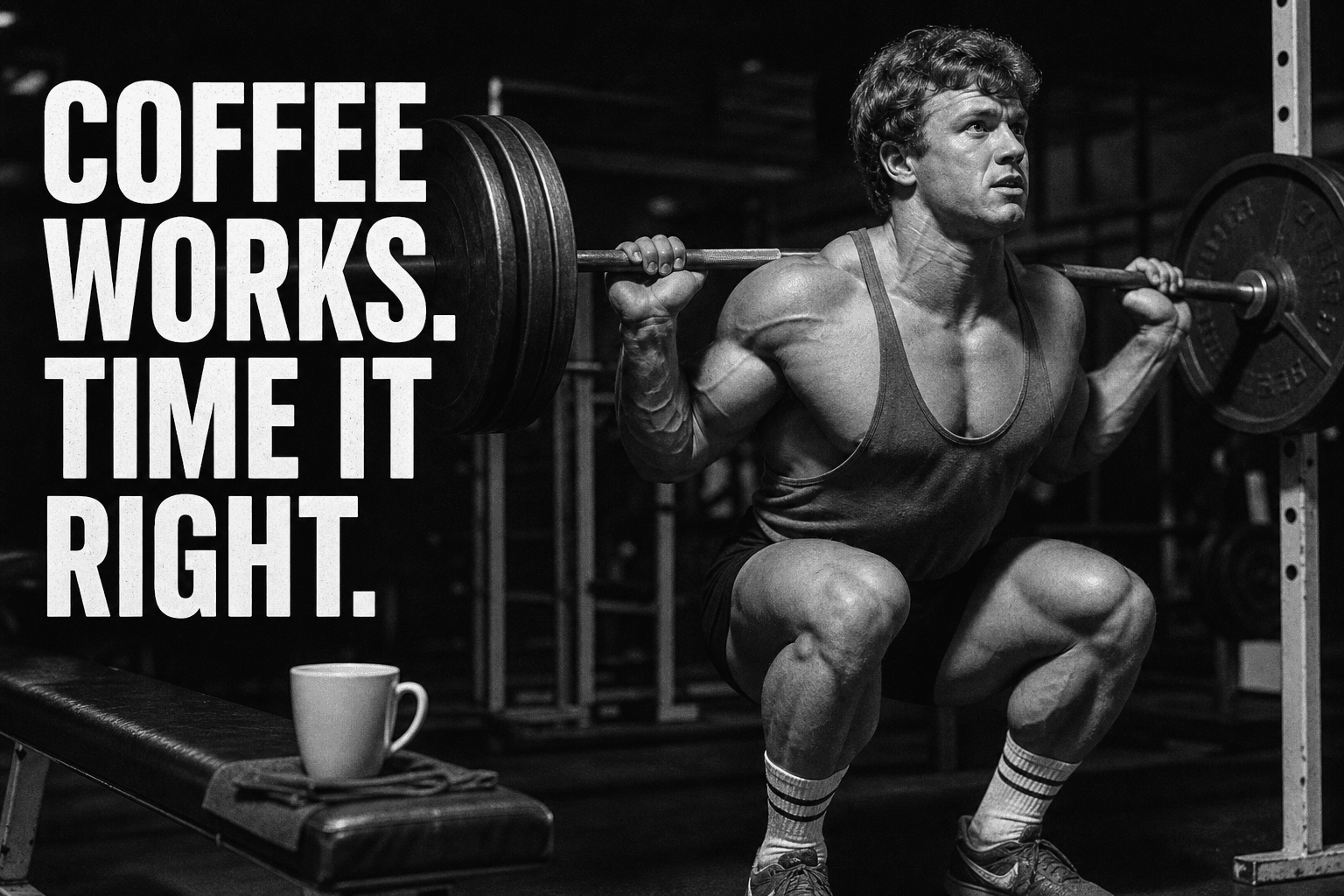
Yes, coffee works — with a catch
Coffee before a workout isn't hype. Caffeine is the most researched performance compound in sports nutrition, and the evidence is consistent: it sharpens focus, reduces how hard the effort feels, and can improve both endurance and strength output (Antonio et al., 2024).
But here's the catch nobody talks about: if you time it wrong, that same cup of coffee cuts your total sleep by 45 minutes and delays how long it takes you to fall asleep by 9 minutes (Gardiner et al., 2023).
The question isn't whether coffee helps. It's whether you're using it in a way that doesn't cost you recovery.
Caffeine reduces perceived effort and improves performance — but mistimed, it costs you 45 minutes of sleep.
— Gardiner et al. (2023). The effect of caffeine on subsequent sleep. Sleep Med Rev.
What caffeine actually does in your body
Caffeine works by blocking adenosine receptors — adenosine is the chemical that builds up over the day and makes you feel tired. Block those receptors, and effort feels lighter, reaction time improves, and you can push harder before hitting perceived failure.
For aerobic work — running, cycling, rowing — the evidence is strong. Energy drink reviews consistently show caffeine improves aerobic performance time and reduces the effort rating on any given pace (Antonio et al., 2024).
For strength training, the effect is real but smaller. The main benefit isn't raw force production — it's that caffeine helps you push closer to your actual limit by making the work feel less punishing. That translates to slightly more reps, slightly more volume, and over time, more growth.
The dose that works: 3–6 mg per kilogram of bodyweight. For a 75 kg person, that's roughly 225–450 mg — about 2–4 standard cups of coffee, or a typical pre-workout supplement.
The 1600m reality check — caffeine isn't magic
Here's where it gets honest. A randomized, placebo-controlled crossover trial — where people are randomly assigned to different conditions and each person tries every condition — had 13 recreational runners complete a 1600m time trial after taking caffeine (Borba et al., 2019).
Result: no difference. Caffeine group ran 7.61 min on average. Placebo group ran 7.64 min. The difference was 0.03 minutes — statistically meaningless (Borba et al., 2019).
Perceived exertion scores were identical too: 6.0 with caffeine, 6.15 with placebo.
What does that tell you? Caffeine isn't a magic performance switch. The benefits are clearest in longer-duration efforts and in trained athletes who are already pushing near their ceiling. For a recreational 10-minute run or a casual gym session, you may not notice much.
That doesn't mean skip the coffee. It means don't expect it to transform a mediocre session into a great one. It helps you extract a bit more from an already solid effort.
Caffeine vs placebo for a 1600m run: 7.61 min vs 7.64 min. Statistically meaningless.
— Borba et al. (2019). Acute Caffeine and Coconut Oil Intake. Nutrients.
The sleep tax — the number most people ignore
This is the one that changes the calculation for a lot of people.
Gardiner et al. (2023) pooled 24 studies into a meta-analysis — a review that combines data across dozens of trials — on caffeine and sleep. The findings:
- Total sleep time dropped by 45 minutes
- Sleep onset latency — how long it takes to fall asleep — increased by 9 minutes
- Wake after sleep onset — time spent awake during the night — increased by 12 minutes
- Deep sleep (N3/N4) dropped by 11.4 minutes
Deep sleep is where most of your physical recovery happens. It's when growth hormone peaks, tissue repairs, and the adaptations from today's training get consolidated. Cutting 11 minutes of deep sleep isn't catastrophic — but if you're doing it every day because you're having a pre-workout coffee at 5pm, it adds up fast.
The guideline from the same study: to avoid meaningfully cutting total sleep time, drink your regular coffee at least 8.8 hours before bed. A standard pre-workout supplement (at a higher caffeine dose) needs 13.2 hours of clearance (Gardiner et al., 2023).
Train at 6am? Have your coffee at 7am. You're fine. Train at 7pm? That 6pm espresso may be costing you sleep quality even if you fall asleep at your normal time.
When to drink it — the practical timing guide
Caffeine peaks in your bloodstream about 30–60 minutes after you drink it. So the sweet spot is 30–60 minutes before your session starts.
Morning sessions (6–9am): Coffee before training is almost risk-free for sleep. Have it, time it 30–60 minutes out, train well.
Lunchtime sessions (12–2pm): Still fine. A cup at 11am clears well before any evening sleep impact.
Evening sessions (5–8pm): This is where you need to make a call. A cup at 4:30pm for a 5:30pm session? You're likely still above the 8.8-hour safe window before a 11pm bedtime. Consider a half-dose — one cup instead of two — or switch to a lower-caffeine source.
Night sessions (8pm+): Caffeine before a 9pm workout will almost certainly interfere with sleep quality even if you don't feel wired. If training late is your only option, either skip the pre-workout coffee or accept the trade-off consciously.
For more on how your workout timing interacts with recovery, cardio before or after weights covers the sequencing side of things.
Coffee vs pre-workout supplements — is there a difference?
A standard 250 mL cup of coffee has roughly 80–100 mg of caffeine. A typical pre-workout supplement packs 200–300 mg or more.
The Gardiner et al. (2023) meta-analysis specifically modelled both: regular coffee needs 8.8 hours of clearance before bed, while a standard pre-workout (at ~217.5 mg caffeine) needs 13.2 hours. That's a big difference.
From a performance standpoint, the evidence suggests that caffeine alone — at the right dose — drives most of the benefit. Energy drink studies show no clear advantage of the full supplement blend over an equivalent caffeine dose alone (Antonio et al., 2024).
Bottom line: a strong cup of coffee 45–60 minutes before training gives you most of what an expensive pre-workout supplement does, at a fraction of the price and with a shorter clearance time. If you train in the afternoon or evening, regular coffee is the safer choice for sleep.
A pre-workout supplement needs 13.2 hours to clear without hitting your sleep — nearly 5 hours longer than regular coffee.
— Gardiner et al. (2023). The effect of caffeine on subsequent sleep. Sleep Med Rev.
The bottom line: coffee is a tool, not a ritual
Coffee before a workout can genuinely help — it reduces perceived effort, sharpens focus, and may squeeze a few more reps out of a hard set. The effect is real, even if it isn't transformative for every session (Borba et al., 2019).
But sleep is where your actual gains happen. A 45-minute sleep debt every night from a poorly timed pre-workout habit will quietly undermine your progressive overload training progress far more than any caffeine boost can compensate for.
The rule is simple: drink it at the right time. Morning and early-afternoon training? Coffee away. Evening sessions? Be honest about the trade-off, reduce the dose, or skip it.
One well-timed cup is smarter than two cups at the wrong hour.
How Planfit applies this
Caffeine's main benefit is helping you push harder in sessions that are already well-programmed. Planfit handles the programming side: it picks your exercises, recommends working weight and rep ranges, tracks your volume per muscle group, and logs your progression across sessions. That way, when you do time your coffee right and have a strong session, the extra reps are recorded — and next session starts from a higher baseline.
It's the system that makes every good session count.
References
- Gardiner C et al. (2023). The effect of caffeine on subsequent sleep: A systematic review and meta-analysis.. Sleep Medicine Reviews. 10.1016/j.smrv.2023.101764
- Borba LS et al. (2019). Acute Caffeine and Coconut Oil Intake, Isolated or Combined, Does Not Improve Running Times of Recreational Runners: A Randomized, Placebo-Controlled and Crossover Study.. Nutrients. 10.3390/nu11071661
- Antonio J et al. (2024). Common Questions and Misconceptions About Energy Drinks: What Does the Scientific Evidence Really Show?. Nutrients. 10.3390/nu17010067