Does Beta-Alanine Work? Only for 1–4 Minute Efforts
5 studies · 2026 meta-analysis of 17 RCTs
6 min read
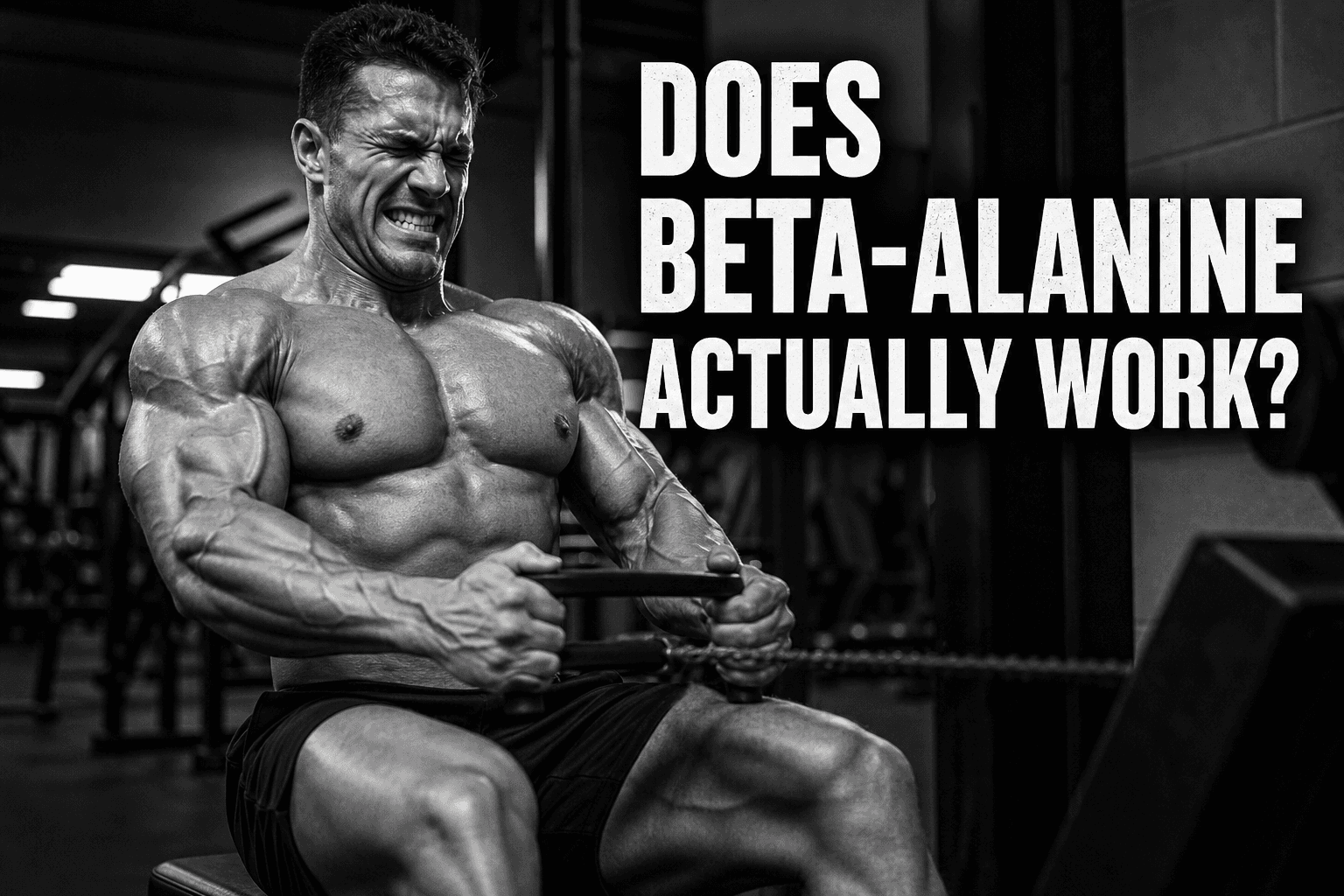
The short answer: yes — but only for efforts lasting 1 to 4 minutes
Beta-alanine works. Just not for everything your pre-workout label implies.
The supplement raises muscle carnosine — a molecule that acts as an acid buffer inside your muscle cells, soaking up the hydrogen ions that build up during hard exercise and drag your performance down. More carnosine means your muscles can sustain high-intensity work a little longer before that burning, heavy feeling forces you to stop.
But — and this is a big but — the effect is narrow. The research consistently shows benefits in continuous, high-intensity exercise lasting roughly 1 to 4 minutes. The moment you step outside that window, the evidence gets thin fast (Liang et al., 2026).
Beta-alanine buffers acid in your muscles — and that buffering is only meaningful when acid is actually the problem.
— Liang et al. (2026). No ergogenic effect of β-alanine on repeated sprint ability: a systematic review and multilevel meta-analysis of RCTs. Front Nutr.
How it actually works: carnosine is your muscle's acid sponge
Your muscle cells have a pH — a measure of how acidic or alkaline they are. During intense exercise, energy production releases hydrogen ions that make the cell environment more acidic. That acidity is a major reason your muscles fail under hard effort.
Carnosine — a compound made from two amino acids, beta-alanine and histidine — absorbs those hydrogen ions. Think of it as a sponge mopping up the acid before it shuts down your muscle's ability to contract.
The catch: your muscles make carnosine on demand, but beta-alanine is the limiting ingredient. Histidine is already available in plenty. Supply more beta-alanine, and carnosine synthesis goes up.
In one RCT, 8 weeks of beta-alanine at 6.4 g/day raised muscle carnosine by +91.1% compared to +0.04% in the placebo group (Yamaguchi et al., 2021). That's a real, measurable increase — not a rounding error.
Where it helps: the 1–4 minute window
The research is clearest for efforts where your muscles are working flat-out for somewhere between 1 and 4 minutes — think a hard 400 m or 800 m run, a rowing interval, or the final minutes of a cycling time trial.
In that zone, hydrogen ions are piling up fast enough that extra buffering capacity actually changes the outcome. A systematic review of 23 studies found that beta-alanine improved perceived exertion and biochemical markers of muscle fatigue in this kind of work — even when total performance metrics were more mixed (Berti et al., 2017).
For combat sports athletes — wrestlers, boxers, judokas — where bouts involve sustained high-intensity effort, a separate review of 7 clinical trials found significant improvements in strength, power, and total exercise work capacity with beta-alanine supplementation (Fernández-Lázaro et al., 2023).
So if your training regularly puts you in that 1–4 minute hard-effort zone, beta-alanine has a real case.
Where it doesn't help: repeated short sprints
Here's where a lot of pre-workout marketing oversells it.
If your sport or training is built around repeated short sprints — 10 seconds all-out, rest, repeat — beta-alanine probably does nothing for you.
A 2026 systematic review and meta-analysis — pooling 17 RCTs — found no statistically significant improvement in any repeated sprint ability metric: mean sprint performance (SMD = -0.018), peak sprint performance (SMD = 0.205), or fatigue decrement (SMD = -0.020). All results were within the confidence intervals of no effect (Liang et al., 2026).
Why? Very short, explosive efforts run on a different energy system — phosphocreatine — not the acid-accumulating pathway that carnosine buffers. If acid isn't the limiting factor, more buffering capacity doesn't help.
This is relevant if you're doing HIIT with very short intervals, team sports with repeated short bursts, or sprint-based conditioning.
17 RCTs, zero benefit for repeated sprint ability. The buffering doesn't kick in fast enough.
— Liang et al. (2026). No ergogenic effect of β-alanine on repeated sprint ability. Front Nutr.
The tingling is real — and it's not a sign it's working
If you've ever taken beta-alanine and felt a pins-and-needles sensation on your skin — usually your face, neck, and hands — that's called paresthesia. It's a known side effect caused by beta-alanine binding to nerve receptors just under the skin.
It's harmless. It's also completely unrelated to the performance effect. The tingling isn't a signal that muscle carnosine is going up. It's just a nerve reaction.
You can reduce it by splitting your daily dose into smaller amounts (e.g., 1.6 g taken 3–4 times a day instead of one large bolus). Slow-release forms also reduce the sensation.
The review by Berti et al. (2017) used a mean dose of 4.8 ± 1.3 g/day across the studies, over an average intervention of 5.2 ± 1.8 weeks — that's roughly the dosing range that produced the fatigue-related benefits. Below about 4 weeks, the evidence for performance effects thins out considerably.
Stop taking it and the gains disappear — slowly
Muscle carnosine doesn't stay elevated forever once you stop supplementing. It decays back toward baseline — and the performance edge decays with it.
In the Yamaguchi et al. (2021) RCT, carnosine levels that were +91% above baseline right after supplementation ended had dropped to roughly +59% at week 4, +35% at week 8, +18% at week 12, and were back to baseline by week 16. The decay in carnosine closely tracked the decay in high-intensity exercise tolerance.
This has two practical implications:
1. Beta-alanine only works while you're taking it. There's no lasting structural change.
2. You need consistent loading — not occasional pre-workout use — to keep muscle carnosine elevated enough to matter.
Interestingly, HIIT training itself can raise muscle carnosine by about +30% even without supplementation, as one RCT demonstrated (DE Salles Painelli et al., 2018). So if you're doing consistent hard-interval training, you're already moving the dial — beta-alanine would push it further.
Who should actually consider taking it
Based on the evidence, beta-alanine makes the most sense if:
- Your training or sport regularly involves sustained efforts of 1–4 minutes at high intensity — rowing, cycling time trials, 400–800 m running, wrestling or grappling rounds, boxing.
- You can commit to consistent daily dosing for at least 4–8 weeks. Popping it once before a workout won't cut it — muscle carnosine needs to accumulate.
- You split the dose to avoid disruptive tingling (1.6 g, 3–4 times per day).
If your training is mainly heavy lifting for hypertrophy, short-burst sprints, or endurance efforts over 10 minutes, the evidence for beta-alanine is weak. For strength-focused training, progressive overload training will move the needle far more than any supplement.
For combat sports athletes specifically, the evidence is stronger than many realize — 7 clinical trials showed meaningful improvements in strength, power, and work capacity (Fernández-Lázaro et al., 2023). If that's your context, it's worth trying.
How Planfit applies this
Supplements only move the needle if your training is already dialled in. Planfit programmes your sessions by goal and training level, recommends your working weight and rep range per set, and tracks your progression across every session. You'll see your per-body-part volume, your rest periods, and whether you're applying progressive overload — the variables that matter most before you even think about what's in your pre-workout.
References
- Liang et al. (2026). No ergogenic effect of β-alanine on repeated sprint ability: a systematic review and multilevel meta-analysis of randomized controlled trials.. Front Nutr. 10.3389/fnut.2026.1818755
- Yamaguchi et al. (2021). Kinetics of Muscle Carnosine Decay after β-Alanine Supplementation: A 16-wk Washout Study.. Med Sci Sports Exerc. 10.1249/MSS.0000000000002559
- Berti et al. (2017). Effects of beta-alanine supplementation on performance and muscle fatigue in athletes and non-athletes of different sports: a systematic review.. J Sports Med Phys Fitness. 10.23736/S0022-4707.16.06582-8
- Fernández-Lázaro et al. (2023). β-Alanine Supplementation in Combat Sports: Evaluation of Sports Performance, Perception, and Anthropometric Parameters and Biochemical Markers — A Systematic Review of Clinical Trials.. Nutrients. 10.3390/nu15173755
- DE Salles Painelli et al. (2018). High-Intensity Interval Training Augments Muscle Carnosine in the Absence of Dietary Beta-alanine Intake.. Med Sci Sports Exerc. 10.1249/MSS.0000000000001697