How Many Sets of Biceps Per Week? 10 Is Your Ceiling
3 RCTs · Med Sci Sports Exerc + J Strength Cond Res
4 min read
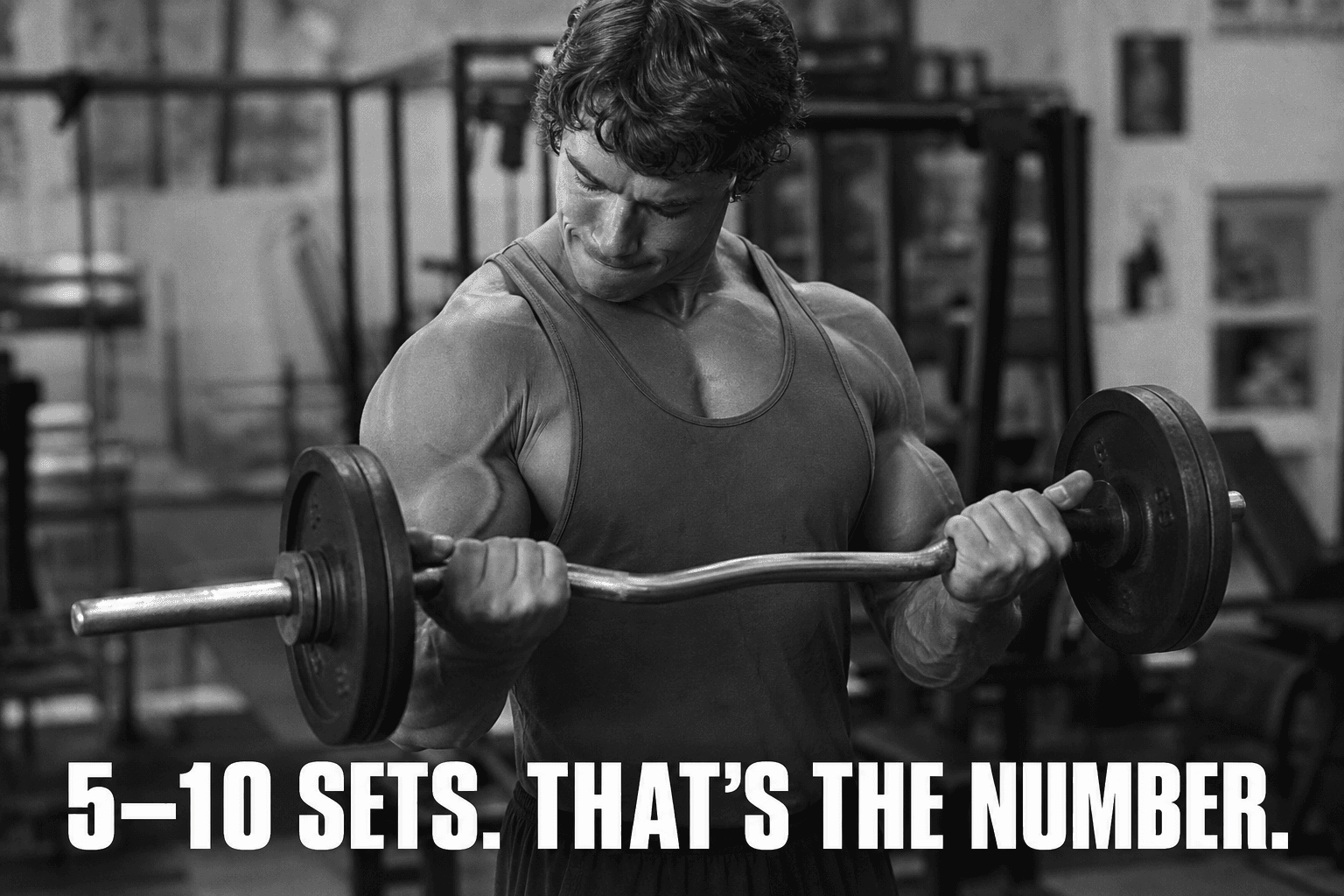
The answer: 5–10 hard sets per week
You don't need 20 sets of curls a week. You probably don't need 15.
Two independent RCTs land on the same number: 5–10 weekly sets per muscle group is where the growth happens. Going above that — 15, 20, even 32 sets — either adds nothing or actively slows you down.
Barbalho et al. (2019) ran 40 trained women through 24 weeks of resistance training at four different weekly volumes: 5, 10, 15, or 20 sets per muscle group per session. The groups doing 5 and 10 sets gained significantly more muscle thickness across all measured sites — including the biceps brachii — than the 15- and 20-set groups (Barbalho et al., 2019).
That's not a small trend. The highest-volume group grew the least.
5 and 10 sets per week beat 15 and 20 sets for biceps growth in trained women — over 24 weeks.
— Barbalho et al. (2019). Evidence for an Upper Threshold for Resistance Training Volume in Trained Women. Med Sci Sports Exerc.
What happens when you push past 16 sets
Brigatto et al. (2022) tested trained men at 16, 24, and 32 weekly sets per muscle group over 8 weeks. They tracked biceps brachii muscle thickness directly with ultrasound.
All three groups grew. But the growth didn't scale evenly. The 16-set group increased biceps thickness, and the higher volumes didn't produce a proportionally bigger return (Brigatto et al., 2022).
The pattern is consistent: more sets past a certain point adds fatigue, not muscle. Your biceps isn't holding out on you — it's already doing the job at lower volumes.
For most trained lifters, that threshold sits somewhere between 10 and 16 weekly sets. Below 10, you're likely leaving some growth on the table. Above 16, you're probably just accumulating junk volume.
If you want to go deeper on how total weekly sets translate to muscle growth, how many sets per muscle group per week covers the broader picture across all muscle groups.
At 16, 24, and 32 weekly sets, biceps thickness increased — but more sets didn't mean proportionally more growth.
— Brigatto et al. (2022). High Resistance-Training Volume Enhances Muscle Thickness in Resistance-Trained Men. J Strength Cond Res.
Why beginners need even less
If you're relatively new to training — say, under a year of consistent lifting — the Barbalho et al. (2019) data suggests 5 sets per week might be genuinely sufficient.
Your biceps responds to almost any training stimulus at that stage. The signal doesn't need to be loud; it just needs to be consistent.
Start at 6–8 weekly sets. Add 2 sets every 3–4 weeks if you're not progressing. That's a smarter ramp than jumping to 15 sets from day one and wondering why your elbows hurt.
For how rep ranges interact with this, how many reps for muscle growth is worth a look — the short answer is that the rep range matters far less than the total volume.
For trained women, 5 sets per week was enough to drive significant biceps growth across 24 weeks.
— Barbalho et al. (2019). Evidence for an Upper Threshold for Resistance Training Volume in Trained Women. Med Sci Sports Exerc.
Direct vs. indirect sets — do curls even need to be most of them?
Here's something people miss: your biceps gets hit during every row, pull-up, and lat pulldown you do. Those are indirect sets — they count.
If you're already doing 6–8 sets of pulling movements per week, you may only need 3–5 direct curl sets on top of that to land in the 10-set sweet spot.
The Barbalho et al. (2019) protocol used direct isolation work, so the numbers apply cleanly to direct sets. But in a real program, indirect volume from compound pulling work compresses the direct set requirement considerably.
Practical rule: count your rows and pull-ups first. Then add direct curl work to fill the gap to ~10 weekly sets total.
How to actually structure your weekly biceps volume
Spread your sets across at least 2 sessions per week. Doing all 10 sets in one workout overloads recovery and reduces the muscle-building signal per session.
Two sessions of 4–5 sets each beats one session of 10 sets — same total volume, better stimulus distribution.
Each set should be taken close to failure — within 1–3 reps of your limit. Sets that stop 5+ reps short of failure contribute far less to growth, which means your effective volume is lower than your set count suggests.
For the barbell bicep curl, a working weight around 70–80% of your 1RM for 8–12 reps hits the right effort zone. Keep rest periods at 90 seconds to 3 minutes between sets — shorter rest periods blunt the hypertrophy signal (you can check the rest period research in how long should you rest between sets).
And don't forget: progressive overload still applies. Volume is a dial, but adding weight or reps over time is what drives long-term biceps growth (progressive overload training).
How Planfit applies this
Planfit tracks your direct and indirect biceps sets across the week and keeps your total volume in the 5–10 set range shown to drive growth in trained lifters (Barbalho et al., 2019; Brigatto et al., 2022). It automatically distributes those sets across sessions so you're never cramming 10 sets into one workout and wondering why your arms aren't recovering. If you're under the effective threshold, it tells you. If you're past it, it trims the fluff.
References
- Barbalho M et al. (2019). Evidence for an Upper Threshold for Resistance Training Volume in Trained Women.. Med Sci Sports Exerc. 10.1249/MSS.0000000000001818
- Brigatto FA et al. (2022). High Resistance-Training Volume Enhances Muscle Thickness in Resistance-Trained Men.. J Strength Cond Res. 10.1519/JSC.0000000000003413
- Valdes O et al. (2021). Contralateral effects of eccentric resistance training on immobilized arm.. Scand J Med Sci Sports. 10.1111/sms.13821