Smith machine bench press: 5 form mistakes, per 4 RCTs
4 RCTs · J Strength Cond Res 2017 & 2024
11 min read
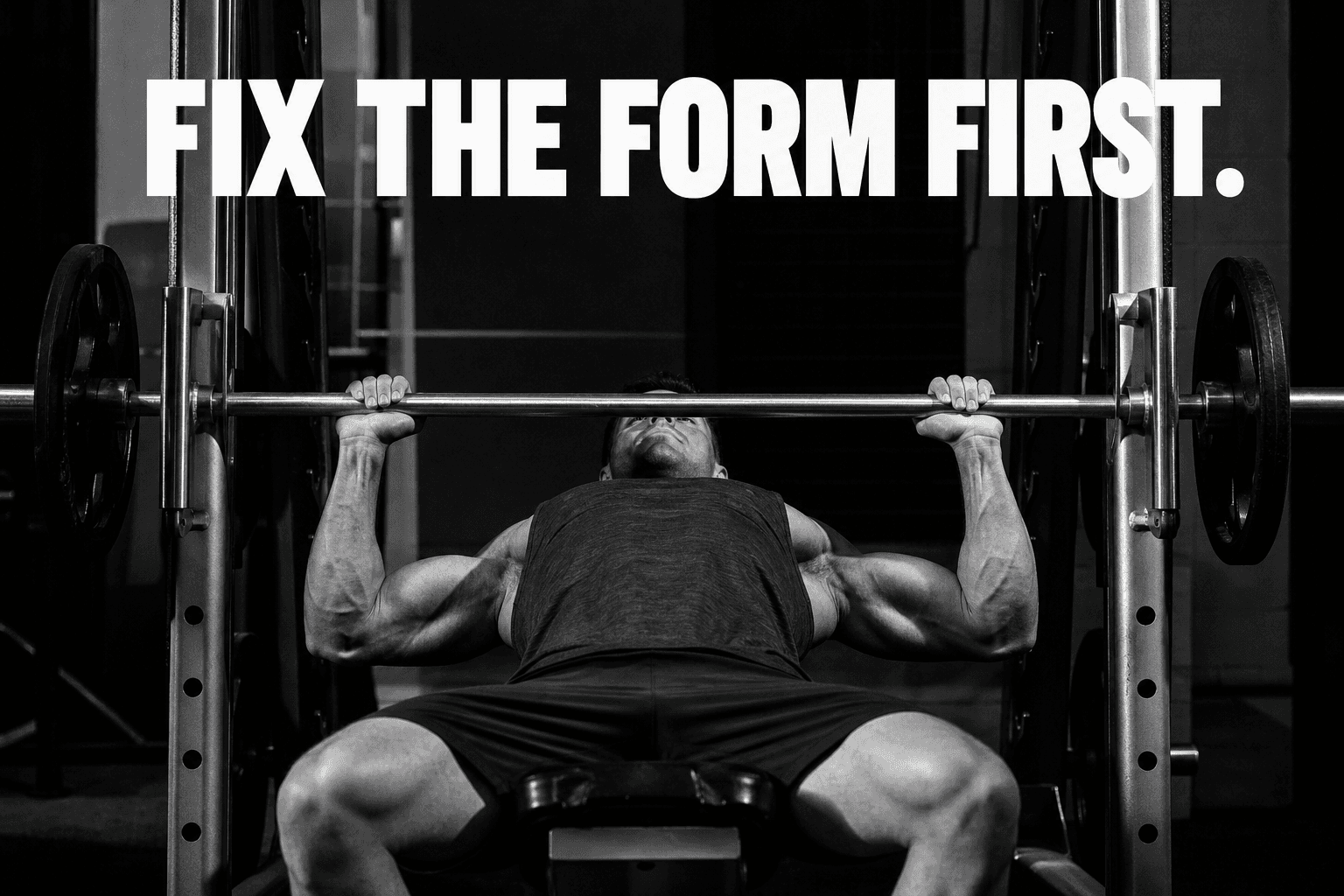
The Smith machine bench press is not a cheat code — and it is not a trap
Here is the honest answer before anything else: the Smith machine bench press builds your chest, shoulders, and triceps just as well as a barbell or dumbbells. An RCT that put 27 resistance-trained men through 8 sets of 10 across all three variations found no difference in pectoralis major thickness, peak torque, or muscle soreness recovery at any point over 96 hours post-session (Ferreira et al., 2017).
The fixed bar path is not a weakness. It frees you from balancing the bar so you can focus on the push. That is exactly why it is a smart starting point — and why sloppy form on it is such a waste.
The mistakes below are what actually cost people results and eventually shoulders. Let's fix them.
Smith machine, barbell, and dumbbell bench press produce similar pectoralis major hypertrophy and recovery.
— Ferreira et al. (2017). Chest Press Exercises With Different Stability Requirements Result in Similar Muscle Damage Recovery. J Strength Cond Res.
Muscles worked in the bench press — and what each mistake actually costs you
The bench press is a horizontal push. The three muscle groups doing the work:
- Pectoralis major — the chest muscle, your primary mover. It drives the bar up and across your body.
- Anterior deltoid — the front of your shoulder. It assists through the whole press and becomes the main mover if you flare your elbows too wide.
- Triceps brachii — the back of your upper arm. It locks out the top of every rep.
Want to see exactly where these sit on your body? The muscle anatomy map shows each one.
Each mistake below shifts load off the muscle you are trying to train and onto a structure that is not built for it. That is how injuries start — not from the exercise itself, but from form that redirects force to the wrong place.
Mistake 1 — Elbows flared to 90 degrees (shoulder pain incoming)
This is the number-one shoulder killer in the bench press, Smith machine or otherwise.
When your elbows splay out perpendicular to your torso, the head of your humerus — the ball of your upper arm bone — is forced into a position that jams the tendons of the rotator cuff against the shoulder socket every single rep. Do that under load, set after set, and shoulder injury is a matter of when, not if.
A 2024 narrative review in the Journal of Strength and Conditioning Research specifically identified poor shoulder joint angles and unmanaged muscular fatigue as the leading contributors to bench press shoulder injuries — and noted that assessing those joint angles during pressing is the clearest path to reducing risk (Motlagh et al., 2024).
The fix: Tuck your elbows to roughly 45–75 degrees from your torso — not pinned to your sides, not flared to the wings. At the bottom of the press, your forearms should be vertical (straight up from wrist to elbow when viewed from the end of the bench). That is the slot that loads the chest and keeps the shoulder in a safe position.
Shoulder joint angles and muscular fatigue are the primary contributors to bench press shoulder injuries.
— Motlagh et al. (2024). The Contribution of Muscular Fatigue and Shoulder Biomechanics to Shoulder Injury Incidence During the Bench Press Exercise. J Strength Cond Res.
Mistake 2 — Wrong bar position on the chest
Where the bar touches your chest determines which muscles are actually working.
Too high (on the upper chest, near the clavicle) means the front deltoid absorbs most of the load. Too low (on the stomach) means you lose leverage entirely and the press breaks down.
The correct touch point for a flat bench press is the lower portion of the pectoralis major — roughly in line with your nipples, or 1–2 cm below. At that position your forearms stay close to vertical, the chest is stretched under tension, and the load is shared properly between pec and triceps.
On a Smith machine this matters more than people think. Because the bar path is fixed, you have to position the bench and your body so that the bar lands in the right place. Slide the bench too far forward and the bar tracks over your upper chest. Too far back and it lands on your belly. Set the bench so that when the bar is at its lowest point, it sits at that lower-pec line — then the fixed bar path works for you, not against you.
Mistake 3 — Dropping the bar fast (and why a controlled eccentric matters)
The eccentric phase is the lowering portion — the part where you resist gravity as the bar comes down. Most beginners drop it quickly because it feels easier. That is the mistake.
A 2024 RCT using the Smith machine bench press tested two lowering speeds: a high-velocity eccentric (as fast as possible) versus a moderate-velocity eccentric (2 seconds). The results showed that the speed of the lowering phase directly affected concentric output — how powerfully you could press back up. Young women showed superior mean propulsive velocity and mean power output for both 30% and 60% of their 1RM when they used the faster, controlled eccentric (Calandrini et al., 2024).
What that means for you: lowering with intent — not slow for slowness's sake, but with muscular control rather than gravity — keeps tension on the muscle and feeds into a stronger press. Dropping the bar fast bleeds tension and turns the lift into a bounce off your chest, which is both a wasted rep and a rib injury waiting to happen.
Aim for 2–3 seconds on the way down. Feel the chest stretch. Then press.
Eccentric phase velocity significantly affects subsequent concentric bar velocity — even at 60% 1RM on the Smith machine bench press.
— Calandrini et al. (2024). Effects of Eccentric Phase Velocity on Bench Press Concentric Bar Velocity. Int J Sports Med.
Mistake 4 — No leg drive, no back arch, no stability base
The bench press is a full-body press, not an arm exercise. Your legs and back are part of the system.
Leg drive means pressing your feet flat into the floor to create tension through your whole body. It stabilises your torso so the pressing muscles can do their job cleanly. Feet dangling off the bench or propped up on it removes that stability entirely.
The arch means a natural curve in your lower back — not an exaggerated powerlifting bridge, but enough that your lumbar spine (lower back) maintains its normal inward curve rather than flattening against the bench. This positions the shoulder blades — the flat bones at the back of your shoulders — in a retracted and depressed position. That is the stable shoulder-blade position — shoulder blades pulled toward each other and pressed down, away from your ears. It protects the shoulder joint and lets the chest stretch properly at the bottom.
Lose the arch and the shoulder blades go slack. The shoulders creep forward. The chest press becomes a shoulder press with extra steps.
Set your back before every set: squeeze the shoulder blades together, press them down, plant the feet, and do not let any of it go until the set is done.
Mistake 5 — Treating the Smith machine as a replacement for all bench pressing
The Smith machine is excellent. It is not everything.
Because the bar path is fixed and guided, your stabiliser muscles — the smaller muscles that would otherwise keep a free bar on track — do less work than they would with a barbell or dumbbells. A 10-week RCT found that the group training with the Smith machine showed improvements in the trained exercise but did not show task-specificity — meaning they did not outperform untrained tasks the way the dumbbell and Swiss-ball groups did (Saeterbakken et al., 2016). The instability groups developed transferable strength; the Smith machine group's gains stayed closer to the machine itself.
That is not a reason to avoid the Smith machine. It is a reason to use it as one tool, not the only one.
For beginners: start here. The fixed path lets you learn the pressing pattern, feel where the bar should land, and build chest and triceps strength without worrying about balance. Once form is solid, rotate in some bench press or dumbbell work to develop stabiliser strength alongside it.
The Smith machine group showed no task-specificity — gains stayed close to the trained exercise rather than transferring broadly.
— Saeterbakken et al. (2016). Resistance-training exercises with different stability requirements: time course of task specificity. Eur J Appl Physiol.
Proper Smith machine bench press form — the full checklist
Here is what correct form looks like from setup to lockout:
1. Position the bench so the bar, at its lowest point, will land at your lower chest — roughly nipple line.
2. Grip width: slightly wider than shoulder-width. Thumbs wrapped around the bar (not a false/thumbless grip).
3. Shoulder blades: pull them together and press them down before you unrack. Hold that position for the entire set.
4. Lower-back arch: natural curve, not flat. Feet flat on the floor.
5. Unrack by rotating the bar (Smith machines lock with a hook — twist the bar toward you to release it).
6. Lower with control over 2–3 seconds. Elbows at 45–75 degrees from your torso — not flared, not pinned.
7. Touch the bar lightly to your lower chest. No bounce.
8. Press back up in a straight line. At the top, fully extend your elbows but do not shrug your shoulders up toward your ears.
9. Re-rack by rotating the bar back to the hooks. Do not drop it.
Every rep should feel like the chest is doing the work. If you feel it primarily in your front shoulders or your elbows are drifting wide, reset.
Smith machine vs. barbell bench press — what the data actually says
People ask this constantly. Here is the honest comparison.
Muscle growth: No measurable difference. The Ferreira et al. (2017) RCT found identical pectoralis major thickness changes across Smith machine, barbell, and dumbbell groups over the same training volume. Choose based on what you have access to and what lets you train with good form.
Strength transfer: The Smith machine is more reliable for tracking and predicting your 1RM. A study comparing load-velocity 1RM predictions across Smith machine and free-weight exercises found that Smith machine predictions were consistently more reliable and valid — measured 1RM did not differ from the minimal-velocity threshold prediction for any Smith machine exercise (Hughes et al., 2020). Free-weight bench press was also reliable, but free-weight squat and overhead press predictions were poor.
Stability demand: Lower on the Smith machine. The bar is guided, so stabiliser muscle recruitment is reduced. This is a feature for beginners learning the movement; it becomes a limitation if the Smith machine is the only tool you ever use.
Bottom line: Both work. The Smith machine is not inferior — it is different. Use it intentionally.
Incline Smith machine bench press vs. flat — which angle hits what
The incline vs. flat question is really a question about which part of the pectoralis major you want to emphasise.
The pectoralis major has two portions: the clavicular head (upper chest, attaches near the collarbone) and the sternal head (lower chest, attaches along the sternum). A flat press loads both roughly equally, with a slight edge to the sternal head. An incline — typically 30–45 degrees — shifts more load onto the clavicular head, developing that upper-chest fullness many lifters want.
On the Smith machine, the incline variation follows the same form rules: elbows at 45–75 degrees, bar landing at the upper-chest line (just below the clavicle), back and shoulder blades set before you unrack.
The one additional consideration: at a steep incline (above 45 degrees) the anterior deltoid takes over rapidly. Keep the angle at 30–45 degrees to stay in chest-dominant territory.
For most people, flat and incline work well together in the same programme. See how many sets of bench press should i do for how to split the volume between them.
Smith machine bench press vs. dumbbell bench press — what changes
The main difference is the path of the press.
With dumbbells, each arm moves independently. That means your stabilisers — the rotator cuff, the smaller shoulder muscles, the serratus anterior along your ribcage — work significantly harder to keep each dumbbell from drifting. It also means you get a slightly deeper stretch at the bottom, because the dumbbells can travel lower than a bar that stops at your chest.
The Ferreira et al. (2017) RCT found one interesting difference between the Smith machine and dumbbell groups: both the Smith machine and barbell groups experienced triceps soreness that resolved by 72 hours. The dumbbell group had no triceps soreness at all. The dumbbells' independent path reduces the triceps' stabilising demand, slightly shifting the load profile.
For hypertrophy, both work equally. The choice comes down to:
- Smith machine: better for loading heavy, learning the movement, training alone without a spotter.
- Dumbbells: better for correcting left-right imbalances, developing independent arm stability, and getting that extra range of motion at the bottom.
Shoulder pain during the Smith machine bench press — what to check first
Shoulder pain during benching has a short list of causes. Check these before assuming something is structurally wrong.
1. Elbow flare. If your elbows are past 75 degrees from your torso, the front of your shoulder is taking load it should not. Tuck the elbows and retest.
2. Bar position too high. Bar landing on the upper chest + flared elbows = maximum anterior shoulder stress. Drop the bar one inch lower on the chest.
3. Shoulder blades not set. If your shoulder blades are not retracted and depressed at the start, the shoulder joint loses its stable base. Every rep compounds the instability.
4. Fatigue late in the set. The Motlagh et al. (2024) review specifically flagged muscular fatigue as a major contributor to shoulder injury — shoulder biomechanics degrade as fatigue accumulates, and the risk compounds when lifters push through form breakdown. Stop the set 1–2 reps before your form goes. The training to failure piece covers exactly why that is not leaving gains on the table.
5. Load too high too soon. If you are using a weight that forces you to grind and compensate, the shoulder pays the tax. Dial back 10–15% and rebuild from clean reps.
How Planfit applies this
Planfit slots the Smith machine bench press into your session as a primary or accessory movement based on your training level and goal. It recommends your working weight and rep range per set, logs every set as you go, and tracks your load across sessions — nudging the weight up only when your current load stops being a genuine stimulus. You get the progressive overload without the guesswork, and your form fixes have a number attached so you can see them compound over time.
References
- Ferreira DV et al. (2017). Chest Press Exercises With Different Stability Requirements Result in Similar Muscle Damage Recovery in Resistance-Trained Men.. J Strength Cond Res. 10.1519/JSC.0000000000001453
- Motlagh JG and Lipps DB. (2024). The Contribution of Muscular Fatigue and Shoulder Biomechanics to Shoulder Injury Incidence During the Bench Press Exercise: A Narrative Review.. J Strength Cond Res. 10.1519/JSC.0000000000004973
- Calandrini et al. (2024). Effects of Eccentric Phase Velocity on Bench Press Concentric Bar Velocity in the Young and Elderly.. Int J Sports Med. 10.1055/a-2235-1694
- Saeterbakken AH et al. (2016). Resistance-training exercises with different stability requirements: time course of task specificity.. Eur J Appl Physiol. 10.1007/s00421-016-3470-3
- Hughes LJ et al. (2020). Load-velocity relationship 1RM predictions: A comparison of Smith machine and free-weight exercise.. J Sports Sci. 10.1080/02640414.2020.1794235