Wrist pain from lifting is almost always a grip or load problem — not a wrist problem
4 studies · BMC Musculoskelet Disord 2023
7 min read
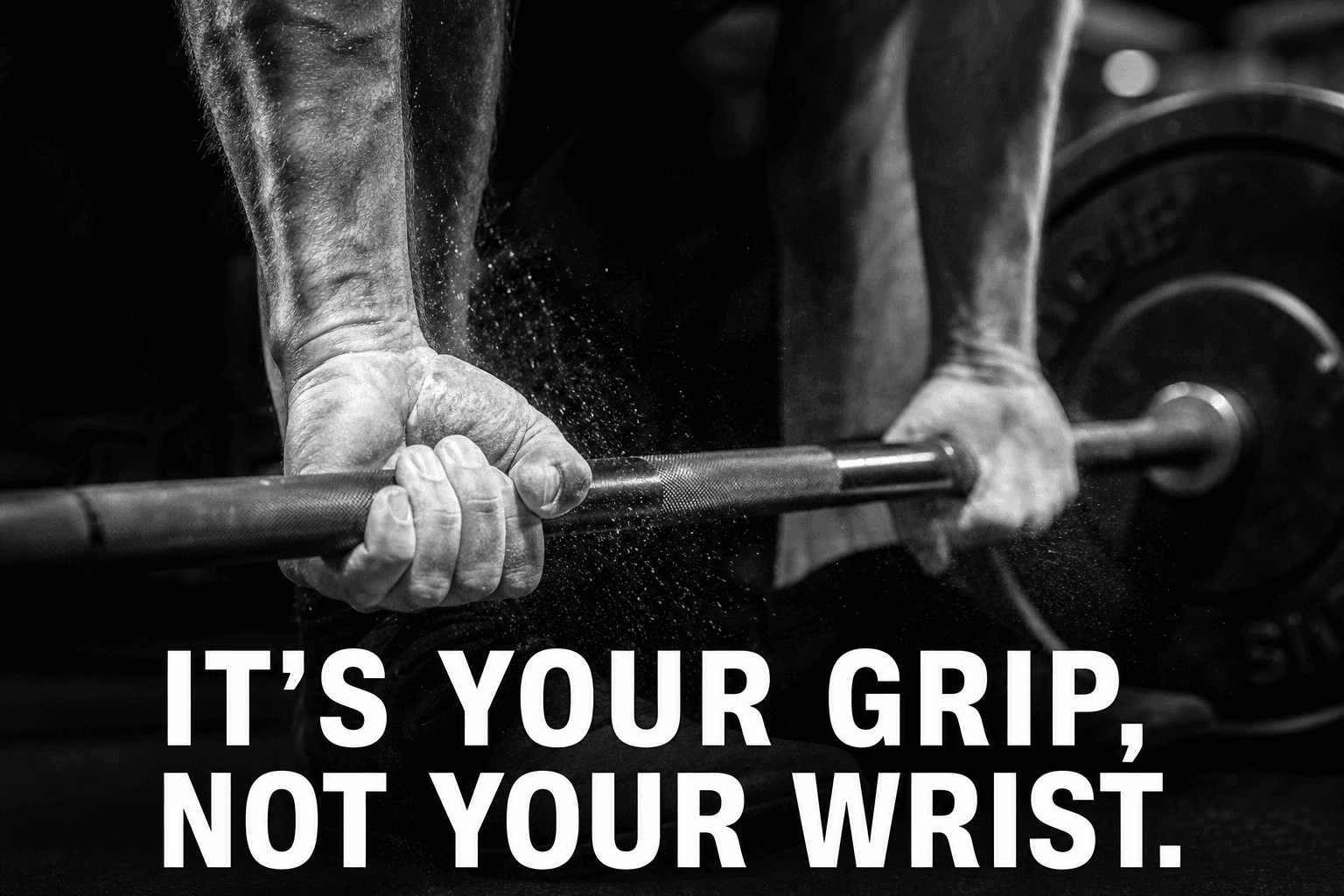
Your wrist isn't the problem — your mechanics are
Wrist pain from lifting almost never starts in the wrist joint itself. It starts upstream — in how you're gripping the bar, how wide your hands are, and how far back your wrist bends under load.
A 2023 survey of 868 competitive female weightlifters found that 28.8% reported hand and wrist joint pain, and lifting heavier weights was directly associated with higher odds of that pain (Huebner et al., 2023). These aren't beginners with bad form — they're experienced athletes. Which tells you something important: technique errors are remarkably persistent, and load amplifies them.
The good news is that most wrist pain during lifting has a mechanical cause you can fix in a single session. Let's go through what's actually driving it.
28.8% of competitive weightlifters reported wrist or hand pain — and heavier loads made it significantly worse.
— Huebner et al. (2023). Arthralgia in female Masters weightlifters. BMC Musculoskelet Disord.
Wrist extension: the single biggest culprit
Wrist extension means bending your wrist backward — so your knuckles tip away from you and the bar rolls toward your fingers instead of sitting in your palm. It looks minor. It isn't.
When your wrist extends under load, all the compressive force that should travel straight up your forearm gets redirected across the wrist joint at an angle. The more weight on the bar, the worse that angle gets. On the bench press and overhead press especially, even 15–20 degrees of extension is enough to create pinching pain on the back of the wrist within a few sets.
The fix is blunt: wrap your thumb around the bar, squeeze hard, and keep your wrist stacked directly above your forearm — knuckles toward the ceiling. If you've been using a 'thumbless' or 'suicide' grip because it feels more natural on pressing movements, this is likely your culprit.
If the bar still rolls despite your grip, your working weight may be too high for your current grip strength. Drop 10–15% and rebuild.
Grip width changes everything
A 2026 case report documented a lifter who developed a painful tendon condition — called proximal intersection syndrome, where two groups of tendons on the back of the forearm rub against each other and inflame — directly linked to repetitive lifting with a wide grip that kept the thumb joint extended for long periods (Stavros et al., 2026). This isn't just a rare edge case. It illustrates a broader principle: the wider your grip, the more your wrist deviates sideways, and the more friction builds up across the tendons that cross the wrist.
For most barbell pressing and rowing, a grip roughly shoulder-width apart keeps the wrist in a neutral position — straight, not angled. Going significantly wider shifts the load onto the outer edge of the wrist and stretches the tendons on the thumb side of your forearm under compression.
If you feel a pinching or grinding sensation on the thumb-side of your wrist, try narrowing your grip by one hand-width. Many lifters find the pain disappears within the same session.
Wide-grip lifting with prolonged thumb extension directly caused tendon inflammation — showing grip width alone can be the whole problem.
— Stavros et al. (2026). Dynamic Ultrasound Imaging of Extensor Pollicis Brevis Hypertrophy in Proximal Intersection Syndrome. J Clin Ultrasound.
Nerve compression: the pain that feels like a wrist sprain but isn't
Some wrist pain from lifting isn't coming from a joint or a tendon at all. It's coming from a compressed nerve.
A documented case from a 33-year-old male weightlifter showed exactly this: he had classic wrist pain and hand weakness after lifting, was initially treated for a wrist sprain, and didn't improve. Electrodiagnostic testing — nerve conduction studies — revealed the real cause was the median nerve being compressed under direct pressure from high-intensity lifting (Worobel et al., 2017). The median nerve runs through the carpal tunnel at the base of your palm. When you grip a barbell hard and your palm presses against the knurling under heavy load, that nerve can get pinched.
Warning signs that your pain might be nerve-related rather than joint- or tendon-related:
- Tingling or numbness in the palm, thumb, or first two fingers
- Weakness when pinching or picking things up
- Pain that lingers for hours or days after lifting, not just during it
- No improvement after fixing your wrist position
If you tick more than one of those boxes, see a sports medicine doctor or physiatrist — a doctor who specialises in musculoskeletal and nerve conditions — before continuing to train through it. Prolonged nerve compression can cause lasting damage to hand function (Worobel et al., 2017).
Shoulder and wrist pain often travel together
Here's something most people don't realise: 29.8% of the same group of 868 weightlifters who reported wrist pain also had shoulder pain (Huebner et al., 2023). That's not a coincidence.
When your shoulder mobility is limited — particularly your ability to rotate the arm outward — your body compensates by bending the wrist to get the bar into position. You think your wrist is the problem. Actually, your shoulder is making your wrist take a load it shouldn't be handling.
A quick test: stand in a doorway and try to press your palms flat against the frame overhead, elbows straight. If you can't get your arms vertical without your lower back arching or your wrists bending, your thoracic spine and shoulder mobility are limiting you. Fixing those limitations — through a proper warm-up that includes shoulder circles, band pull-aparts, and thoracic extensions — will often reduce wrist strain on pressing movements without any other change. See how to warm up before lifting for a research-backed approach to mobility work before your session.
The injury pattern in weight training: wrists are in the top three
Across a cross-sectional study of 393 weightlifters, the shoulder was the most commonly injured site — but the wrist and forearm consistently appeared in the top injury categories alongside the knee and lower back (Bukhary et al., 2023). About 27% of participants had experienced a lifting injury in the previous six months.
What that data tells you is simple: wrist injuries are common, not freak accidents. And the majority trace back to training patterns — grip position, load management, and movement quality — rather than unavoidable structural damage.
The fix is almost always the same three things:
1. Neutral wrist under load — not extended back, not bent sideways
2. Grip width appropriate to the movement — closer for pressing, wider for pulling within a pain-free range
3. Load that matches your current capacity — don't grip-and-rip past the point where form breaks
Five immediate fixes to try this session
These are the adjustments that address the most common mechanical causes of lifting wrist pain. Try them in order — most people find one of the first three solves it entirely.
1. Check your wrist position on every pressing movement.
Bar in the heel of the palm, thumb wrapped around, wrist stacked over the forearm. Not bent back. If you have to choose between wrist position and bar contact point, protect the wrist position — always.
2. Narrow your grip by one hand-width.
Specifically on bench press, overhead press, and barbell rows. A shoulder-width grip keeps the wrist in a neutral side-to-side angle. Test it and notice whether the thumb-side pinching reduces.
3. Reduce the weight by 10–15% and rebuild.
Most wrist issues get worse with load before they get better. Dropping weight lets you lock in the fixed mechanics without the bar fighting you. You're not losing progress — you're protecting it.
4. Add wrist circles and forearm stretches to your warm-up.
Before any pressing or pulling, ten slow wrist circles each direction, then hold a forearm stretch — palm down, fingers pointing back, arm extended — for 20 seconds each side. This reduces tendon friction before it starts.
5. Try wrist wraps for heavy sets — but not as a crutch.
Wrist wraps — fabric straps that wind around the wrist joint and limit extension — can offload stress during heavy pressing. They're a useful short-term tool while you're building grip strength and fixing mechanics. Don't rely on them for light-to-moderate work or you'll delay the underlying fix.
One thing to avoid: pushing through sharp pain. Dull fatigue in the forearms is normal. Sharp, localised wrist pain that spikes during a specific movement is not. Stop the set, reduce load, and check your position. If the pain persists across multiple sessions despite fixing your mechanics, get it assessed before it becomes a chronic issue.
How Planfit applies this
Wrist pain from lifting is almost always a load and mechanics issue — and Planfit addresses both sides of it. The app recommends working weight and rep ranges calibrated to your training level for every pressing and pulling movement, so you're not jumping load faster than your grip and wrist mechanics can handle. It tracks your progression history per exercise, which means you can see exactly when a weight increase coincided with form breakdown. And the rest timer keeps inter-set recovery consistent — because fatigue is often what turns acceptable wrist extension into painful wrist extension by the end of a workout. Fix the mechanics. Let the app manage the load.
References
- Huebner M et al. (2023). Arthralgia in female Masters weightlifters.. BMC Musculoskeletal Disorders. 10.1186/s12891-023-06814-y
- Stavros AT et al. (2026). Dynamic Ultrasound Imaging of Extensor Pollicis Brevis Hypertrophy in Proximal Intersection Syndrome: A Case Report and Literature Review.. Journal of Clinical Ultrasound. 10.1002/jcu.70018
- Worobel JS et al. (2017). Recurrent Median Nerve Injury in a Weight Lifter.. American Journal of Physical Medicine & Rehabilitation. 10.1097/PHM.0000000000000555
- Bukhary HA et al. (2023). Prevalence and Pattern of Injuries Across the Weight-Training Sports.. Cureus. 10.7759/cureus.49759