Barbell front squat form: 5 mistakes, backed by 4 studies
4 studies · J Strength Cond Res RCTs
8 min read
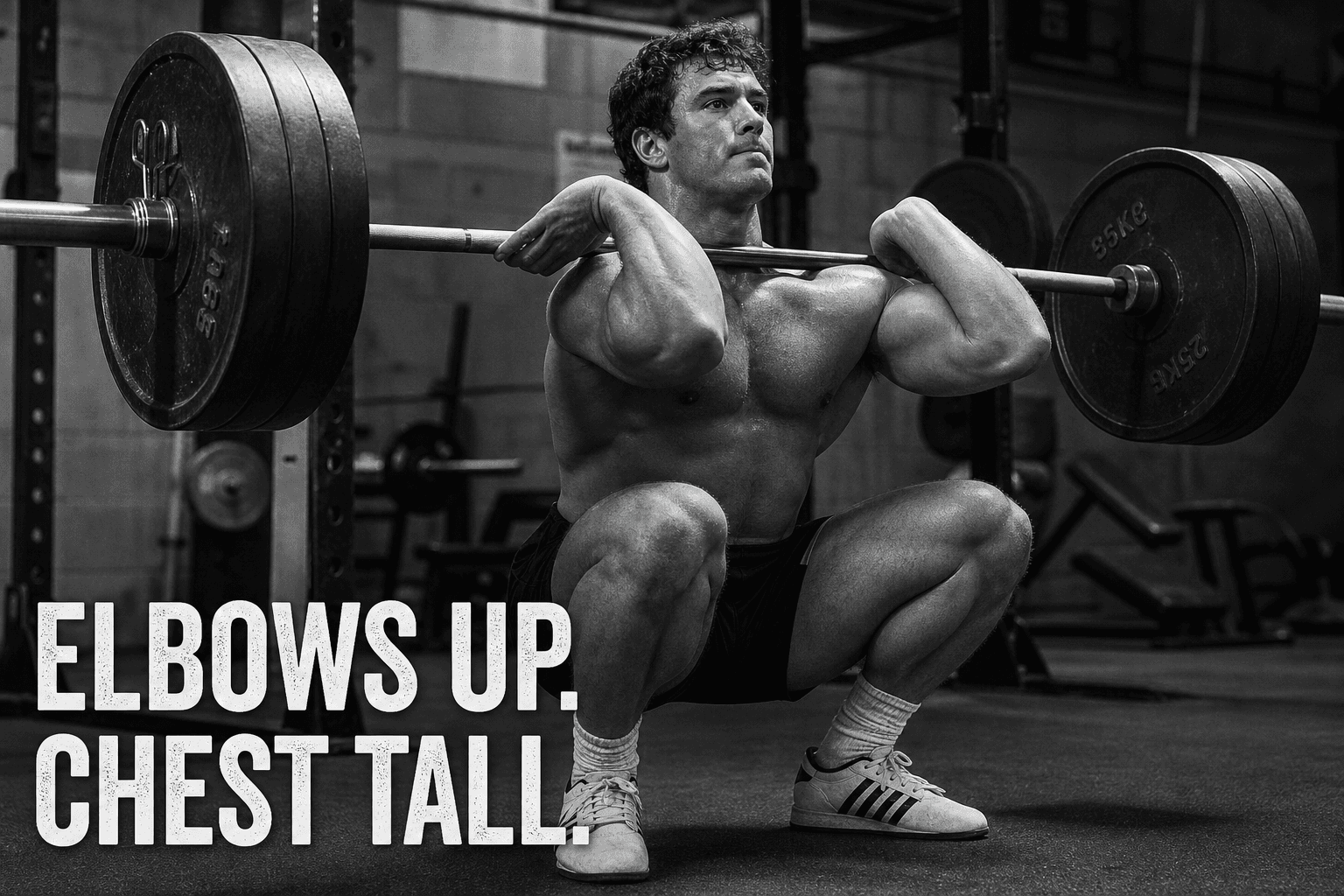
Why the front squat punishes bad form harder than any other squat
The front squat is brutally honest. The bar sits on your front deltoids — the shelf your shoulders make when you drive your elbows forward — instead of across your upper back. That one change moves the load directly over your midfoot and forces your torso to stay nearly vertical. Lean even slightly forward and the bar rolls off. There's no hiding.
That same quality is why form mistakes feel catastrophic in the front squat but barely register in the back squat. A 2020 study measuring trunk muscle activity found that front loading — bar resting on the front of the body — demands significantly more core muscle engagement than back loading, because your spine has to stay upright without a bar behind it to counterbalance (Roth et al., 2020). That's the front squat's superpower. It's also why five very specific errors show up again and again.
Fix these five and the lift clicks into place. Leave them, and you'll either dump the bar or load your lower back in ways it was never designed to handle.
Front loading demands more core engagement than back loading — the torso has to stay upright with nothing to counterbalance it.
— Roth et al. (2020). Trunk muscle activity during different types of low weighted squat exercises. J Sports Sci.
Mistake 1: Elbows dropping during the descent
This is the number-one front squat killer. Your elbows are the rack — they hold the bar in place. The moment they drop, the bar slides forward down your arms, your torso tips forward to chase it, and the whole lift falls apart.
Keep your elbows up and forward throughout the entire rep. Aim for them to be parallel to the floor, or slightly above. If your wrists ache in the standard clean grip (bar resting across fingers, arms parallel to floor), a cross-arm grip works: fold your arms across the bar and grip the opposite shoulder. The bar position stays identical; the wrist angle changes.
A useful cue: before you unrack, drive your elbows up as high as they'll go, then squat. You'll feel how the bar locks into the shelf. That's the position you're maintaining all the way down and all the way back up.
Mistake 2: Heels rising off the floor
If your heels come up as you descend, one of two things is happening: your ankle mobility is limited, or your weight has shifted too far forward onto your toes.
Ankle mobility — how far your shin can travel forward over your foot — is genuinely limited for many people. A quick test: stand 10 cm from a wall and try to touch your knee to it without your heel lifting. If you can't, mobility work is the fix, not just technique cues. Daily calf stretches and ankle circles before you squat will help over weeks.
If your mobility is fine but heels still rise, the problem is bar position or elbow height. When the bar drifts forward, your whole centre of mass shifts over your toes and your heels follow. Drive the elbows back up — you'll often feel your heels settle back down immediately.
A heel raise under the plate or a squat shoe with a raised heel buys you ankle range while you build mobility. It's not cheating — it's a training tool.
Mistake 3: Chest caving and upper back rounding
The front squat demands a tall, upright chest. When your upper back rounds — thoracic flexion, meaning your mid-back curls forward — the bar loses its shelf and your elbows drop to compensate. It's a chain reaction.
Roth et al. (2020) found that front-loaded squats require noticeably higher activation of the external oblique and erector spinae — the muscles that run along either side of your spine — compared to back squats at equivalent loads. That extra demand is a feature, not a bug. But it means your upper-back strength and mobility have to be up to the job.
Cue: "Proud chest." Before you descend, take a big breath into your belly (this is called bracing — stiffening your core like you're about to take a punch), pull your shoulder blades together slightly, and drive your chest up. Hold that position on the way down. If your upper back rounds the moment you hit parallel — the point at which your thighs are horizontal — the weight is too heavy. Drop 10–20% and rebuild.
Front squats require higher erector spinae and external oblique activation than back squats — your upper back has to earn its keep.
— Roth et al. (2020). Trunk muscle activity during different types of low weighted squat exercises. J Sports Sci.
Mistake 4: Loading too heavy, too soon
The front squat almost always gets loaded relative to your back squat — and that comparison is where the error happens. Most lifters front squat roughly 80–85% of what they back squat. When you load more than that, the technique demands outpace the mobility and strength you actually have.
A 2019 RCT tracking bar velocity across loads found that the load-velocity curve — how fast you can move the bar at different percentages of your maximum — behaves similarly in the front and back squat up to 70% of your 1RM (Spitz et al., 2019). The meaningful differences show up at 90%+, where front squat mechanics become significantly harder to maintain. For technique work, 60–75% of your front squat 1RM is the zone where you can actually groove good movement. Save 85–90% for sessions where your form is already dialled in.
Not sure what that weight is? Use plate calculator to work out your starting load and plate combinations before you step up to the bar.
Mistake 5: Ignoring the eccentric — the lowering phase
Most beginners think about squatting down. They should think about controlling the descent.
The eccentric phase — the part where you lower yourself down — is where you build the tension that makes the concentric (pushing back up) powerful and safe. A 2017 study on eccentric overload in the front squat found that a controlled eccentric followed by a maximal concentric produced higher peak velocity and peak power than a sloppy descent at the same load (Munger et al., 2017). In plain terms: a slow, controlled lower made the drive up significantly more explosive.
Take 2–3 seconds to lower. Don't fall into the hole. Control the bar, brace your core through the entire descent, and initiate the drive up from the moment you hit depth — that crossover point from down to up is called the stretch-shortening cycle, which is just the elastic snap your muscles produce when you reverse direction under load. A controlled eccentric maximises that snap.
For related technique principles on the pull side of training, see deadlift form.
A controlled 3-second eccentric produced higher peak velocity on the way up than a sloppy descent at the same load.
— Munger et al. (2017). Acute effects of eccentric overload on concentric front squat performance. J Strength Cond Res.
Proper front squat form from setup to lockout
Here's the correct sequence in one place:
Setup. Unrack the bar onto your front deltoids with a clean grip (fingertips under the bar, wrists extended back) or a cross-arm grip. Drive elbows forward and up — aim for parallel to the floor. Feet shoulder-width apart, toes turned out 15–30°.
Brace. Big breath into your belly, core tight, chest proud. Hold this through the rep.
Descent. Push your knees out in the direction your toes point. Take 2–3 seconds to lower. Sit into the squat rather than leaning forward. Heels stay flat. Elbows stay high.
Depth. Aim for thighs parallel to the floor, or below if mobility allows. The front squat rewards depth because the upright torso lets your knees travel forward without lower-back strain.
Drive. Push the floor away. Lead with your elbows — the moment elbows drop, hips shoot back and you turn it into a good-morning. Think "elbows first" on the way up.
Lockout. Hips and knees extend at the same rate. Don't hyperextend your lower back at the top.
For a full comparison of squat variations and the common mistakes across all of them, proper squat technique goes deeper on the fundamentals.
Front squat vs. back squat: which one is right for you?
Both are valid. The choice depends on your goal and your body.
A 2017 RCT comparing six weeks of front squat versus hip thrust training found that the front squat group showed meaningfully better gains in vertical jump height and front squat strength — movements that require upright, quad-dominant force production (Contreras et al., 2017). The front squat is the better builder for sports that require you to decelerate, jump, or produce force straight up.
The back squat — bar across your upper traps — allows more forward lean and tends to load the posterior chain (glutes, hamstrings, lower back) more heavily. It's generally easier to load heavier, which makes it the more common choice for pure strength.
If you're new to squatting, the front squat is actually a great teacher. The bar will tell you immediately when your form breaks down. Many coaches use it as a diagnostic tool: if you can front squat cleanly, your back squat mechanics are almost certainly sound too.
Six weeks of front squatting produced meaningfully better vertical jump and front squat strength gains than six weeks of hip thrusting.
— Contreras et al. (2017). Effects of a six-week hip thrust vs. front squat RCT. J Strength Cond Res.
Goblet squat form: the best drill before you touch a barbell
Before you load a barbell on your front delts, spend a few sessions with a goblet squat — a dumbbell or kettlebell held at chest height with both hands, elbows pointing down. The goblet squat teaches the same upright torso, forward knee travel, and heel-down position as the front squat, but at a fraction of the load and with no wrist flexibility required.
Once you can goblet squat cleanly with a weight equivalent to 20–25% of your bodyweight, the barbell front squat will feel intuitive rather than alien. Think of the goblet as your diagnostic warm-up drill — and as goblet squat benefits covers, it carries its own performance benefits well beyond the warm-up phase.
How Planfit applies this
Planfit programmes the front squat as either a primary movement or a technique drill depending on your training level. Before your working sets, it queues up auto-suggested warm-up sets — lighter loads at the right percentage of your working weight — so you're grooving the elbow-up, upright-torso position before the bar gets heavy.
As your form stabilises across sessions, Planfit's progressive overload tracking nudges the weight up only when the current load stops being challenging. You're never guessing when to add plates — the app watches your logged sets and decides for you.
Between sets, the rest timer keeps your recovery consistent so fatigue isn't the reason your elbows drop on set three.
How Planfit applies this
Planfit programmes the front squat as either a primary movement or a technique drill depending on your training level. Before your working sets, it queues up auto-suggested warm-up sets — lighter loads at the right percentage of your working weight — so you're grooving the elbow-up, upright-torso position before the bar gets heavy.
As your form stabilises across sessions, Planfit's progressive overload tracking nudges the weight up only when the current load stops being challenging. You're never guessing when to add plates — the app watches your logged sets and decides for you.
Between sets, the rest timer keeps your recovery consistent so fatigue isn't the reason your elbows drop on set three.
References
- Roth R et al. (2020). Trunk muscle activity during different types of low weighted squat exercises in normal and forefoot standing conditions.. J Sports Sci. 10.1080/02640414.2020.1800358
- Spitz RW et al. (2019). Load-velocity relationships of the back vs. front squat exercises in resistance-trained men.. J Strength Cond Res. 10.1519/JSC.0000000000002962
- Munger CN et al. (2017). Acute effects of eccentric overload on concentric front squat performance.. J Strength Cond Res. 10.1519/JSC.0000000000001825
- Contreras B et al. (2017). Effects of a six-week hip thrust vs. front squat resistance training program on performance in adolescent males: A randomized controlled trial.. J Strength Cond Res. 10.1519/JSC.0000000000001510