Deadlift form: 5 mistakes, per three 2025 RCTs
3 RCTs · 2025 priority journals
8 min read
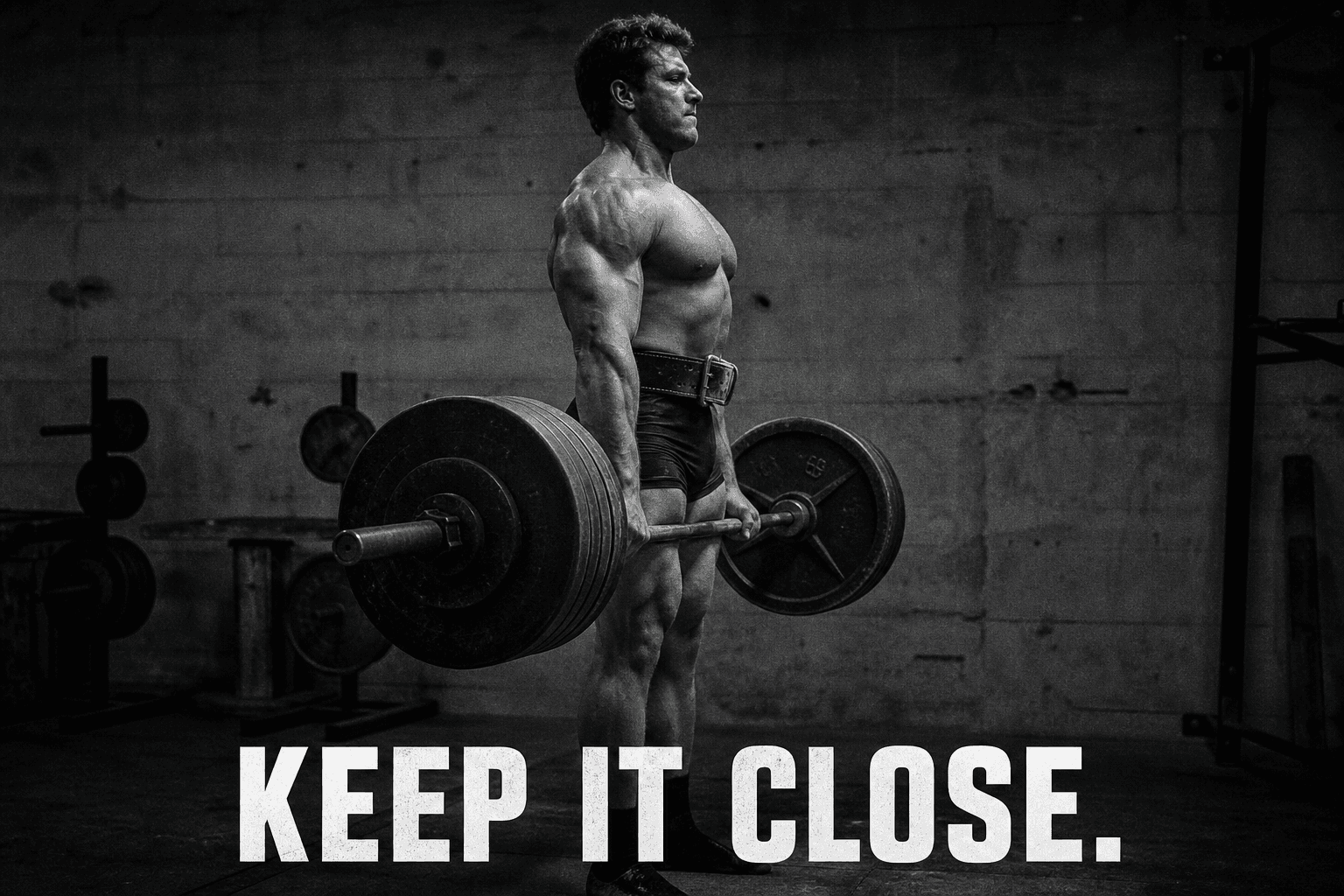
The mistake most beginners make before the bar even leaves the floor
Bad deadlift form almost always starts the same way: people treat the deadlift like a squat they start from the floor up. They bend their knees deep, sit their hips down low, and try to leg-press the bar off the ground. That's not a deadlift. That's a slow squat with a bad bar path.
The deadlift is a hip hinge — pushing your hips back, not sitting your hips down. The difference matters more than you think. A hip hinge keeps the bar over your mid-foot, loads your hamstrings under a stretch, and lets your posterior chain — the muscles down the back of your body: glutes, hamstrings, and lower back — do the work they're built to do.
A squat-style setup does the opposite. The bar drifts forward, your lower back rounds to compensate, and the posterior chain checks out early. The result: weak off the floor, lower back fatigue, and almost no hamstring stimulus.
Fix this first. Everything else in deadlift form is downstream of the hip hinge.
The deadlift is a hip hinge — pushing your hips back, not sitting your hips down.
Your back rounds — and here's what that actually costs you
A rounded lower back under load creates lumbar shear — sideways force on the lower-back vertebrae that the discs and ligaments weren't designed to absorb repeatedly. It doesn't always hurt immediately. It accumulates.
The cue that fixes it fastest: "chest up, proud chest." Not "arch your back" — that often causes people to hyperextend. Just lift your chest before you pull. Your spine will follow into a long, neutral position on its own.
The second cue: "push the floor away" instead of "pull the bar up." It shifts your mental model from pulling with your arms to driving through your legs, which keeps your hips from shooting up first and dumping the load onto your lower back.
If your upper back rounds — the thoracic region, the middle of your spine — that's almost always a lat engagement problem. Before you pull, take a big breath, brace your core like you're about to take a punch, then think: "protect your armpits." That squeezes your lats — the large muscles down the sides of your back — against your ribcage and locks the upper back rigid.
The bar isn't touching your shins — and it should be
Watch a beginner deadlift and you'll often see the bar hanging 3–4 inches in front of their shins. That gap is a moment arm problem — the farther the load sits from the joint it's loading (your hip), the more strain it creates on the lower back to move the same weight.
Every centimetre the bar drifts forward multiplies the stress on your spine. Keep the bar dragging up your shins — literally scraping them on the way up. That's not a style choice. It's physics.
Shin scraping also tells you your lats are engaged. When the lats switch off, the bar swings forward. If your shins stay clean, check your setup.
Practical fix: before you pull, push the bar into your shins with your lats. Think "protect the bar" or "screw the floor." The bar doesn't move, but the tension does — it locks the system before the weight even breaks the ground.
Every centimetre the bar drifts forward multiplies the stress on your spine.
The Romanian deadlift isn't just a variation — it's a hamstring tool with a 10% growth record
Most beginners treat the Romanian deadlift (RDL) as a lighter, easier version of the conventional deadlift. It's not. It's a different tool targeting a different quality: hamstring length and growth under a lengthened stretch — the position where the muscle is longest.
In a 2025 RCT, participants who trained the RDL twice a week for just 6 weeks grew their hamstrings' cross-sectional area by 10% and increased biceps femoris fascicle length — the length of the muscle fibres — by 9% (Crawford et al., 2025). Fascicle length matters because longer fibres mean a faster, more injury-resistant muscle. That's not a side effect — that's the adaptation.
The RDL's form cue is specific: hinge at the hip with soft knees, lower the bar until you feel a strong pull in the back of your thighs, then drive your hips forward to stand. The bar stays close to your legs the whole time. You don't lower it to the floor — you lower it to the point your hamstrings run out of range, which for most people is mid-shin.
If you feel it in your lower back more than your hamstrings, your knees are probably locked out completely (too much spinal load) or you're rounding forward instead of hinging. Soft knees — a slight bend, not a squat bend — keeps the tension where it belongs.
Also worth knowing: the RDL and Nordic hamstring curl (an exercise where you kneel and lower your torso toward the floor using only your hamstrings) produced the same fascicle-length changes and the same hamstring growth after 6 weeks. Neither was clearly better (Crawford et al., 2025). The RDL just happens to load more weight and fit naturally into a strength programme.
Stiff-leg vs Romanian: they're not the same lift
The stiff-leg deadlift (SDL) and the RDL look almost identical. The difference: in the SDL, your knees stay straighter throughout the movement and the bar often touches the floor at the bottom. The RDL stops when your hamstrings hit their limit, and your knees have a soft bend.
Those small differences change which part of the hamstring gets hit hardest. A 2025 RCT found that 9 weeks of stiff-leg deadlifts produced 34% strength gains and grew the semimembranosus — one of the three hamstring muscles, sitting on the inner back of the thigh — by 11% more than the other hamstring heads (Morin et al., 2025, J Strength Cond Res). The RDL hits the semitendinosus more preferentially.
For most beginners, the RDL is the right starting point: the floor contact is removed, so spinal load is lower, and the movement teaches the hip hinge pattern cleanly. Graduate to the SDL — or to conventional deadlifts off the floor — once the hip hinge is automatic.
Strength also transfers between variants. The same research showed that training the SDL improved Nordic curl strength by about 20%, and training the Nordic curl improved SDL strength by about 10% (Morin et al., 2025, J Strength Cond Res). You don't need to train every deadlift variation. Pick one, get strong at it, and the strength carries over.
You don't need to train every deadlift variation. Pick one, get strong at it, and the strength carries over.
— Morin et al. (2025). Minimal Role of Hamstring Hypertrophy in Strength Transfer Between Nordic Hamstring and Stiff-Leg Deadlift. J Strength Cond Res.
The breathing and bracing step everyone skips
Breath and brace is the step that separates a 100 kg deadlift that feels manageable from one that wrecks your back. Most beginners skip it because nobody tells them it's as important as the setup.
Here's the sequence: before you pull, take a full breath into your belly — not your chest — and hold it. Then brace your core like you're about to get punched. That combination creates intra-abdominal pressure — a rigid column of air inside your torso — that supports your spine from the inside.
This is called the Valsalva manoeuvre when done intentionally under load. It's not dangerous for healthy people on heavy sets. What IS dangerous is pulling without it — that's when the spine buckles.
Release the breath at the top of the rep, or after you've returned the bar to the floor. Never exhale at the bottom of a heavy pull. The moment the pressure releases is the moment the spine loses its support column.
One breath per rep on heavy work. On lighter warm-up sets, you can breathe more freely — but build the habit early.
A simple form checklist for your next session
Before you add weight, run through this in order:
1. Foot position. Hip-width apart, toes pointed out slightly. Bar over mid-foot — about 2–3 cm from your shins.
2. Grip. Double overhand to start (both palms facing you). Hook grip or mixed grip only when the weight demands it.
3. Hip hinge, not squat. Push your hips back to the bar. Shins roughly vertical or slightly forward. Hips above the knees, below the shoulders.
4. Chest up, lats engaged. "Proud chest" and "protect your armpits." Upper back rigid before you pull.
5. Breath and brace. Big belly breath, brace hard, then pull.
6. Bar path. Straight up, dragging your shins. If it swings forward, your lats dropped.
7. Lock out. Stand tall at the top — hips through, glutes squeezed. Don't hyperextend your lower back to finish the rep.
For the RDL specifically, add: lower until your hamstrings pull, not until the bar hits the floor. Control the descent — the eccentric phase (lowering the weight under control, when the muscle lengthens) is where most of the growth stimulus lives, as Crawford et al. (2025) specifically selected an eccentrically biased protocol for that reason.
If you want to go deeper on how many sets of deadlifts to actually do per session, how many sets of deadlifts should i do covers the volume question with RCT data. And if lower back pain shows up after lifting, lower back pain after deadlift breaks down when it's normal soreness vs. a red flag.
Drill the hinge with the romanian deadlift first — the shortened range makes a rounding back obvious — then move to the deadlift once the pattern holds.
How Planfit applies this
Deadlift form only compounds into results when the load is rising week over week. Planfit picks the right deadlift variant for your training level, logs every set and rep, and nudges you to add weight the moment your current load stops being hard. You get the form cues in the exercise library and the progression tracking in one place — so you're not leaving 10% hamstring growth on the table.
References
- Crawford SK et al. (2025). Hamstrings Muscle Architecture and Morphology Following 6 wk of an Eccentrically Biased Romanian Deadlift or Nordic Hamstring Exercise Intervention.. Med Sci Sports Exerc. 10.1249/MSS.0000000000003701
- Morin T et al. (2025). Robustness of hamstring muscle activation strategies following selective hypertrophy induced by Nordic hamstring curl and stiff-leg deadlift exercises.. J Appl Physiol (1985). 10.1152/japplphysiol.00237.2025
- Morin T et al. (2025). Minimal Role of Hamstring Hypertrophy in Strength Transfer Between Nordic Hamstring and Stiff-Leg Deadlift: A Blinded Randomized Controlled Trial.. J Strength Cond Res. 10.1519/JSC.0000000000005159