Bulgarian split squat form: 5 fixes, per a 2025 RCT
3 studies · 2025 RCT + J Strength Cond Res
7 min read
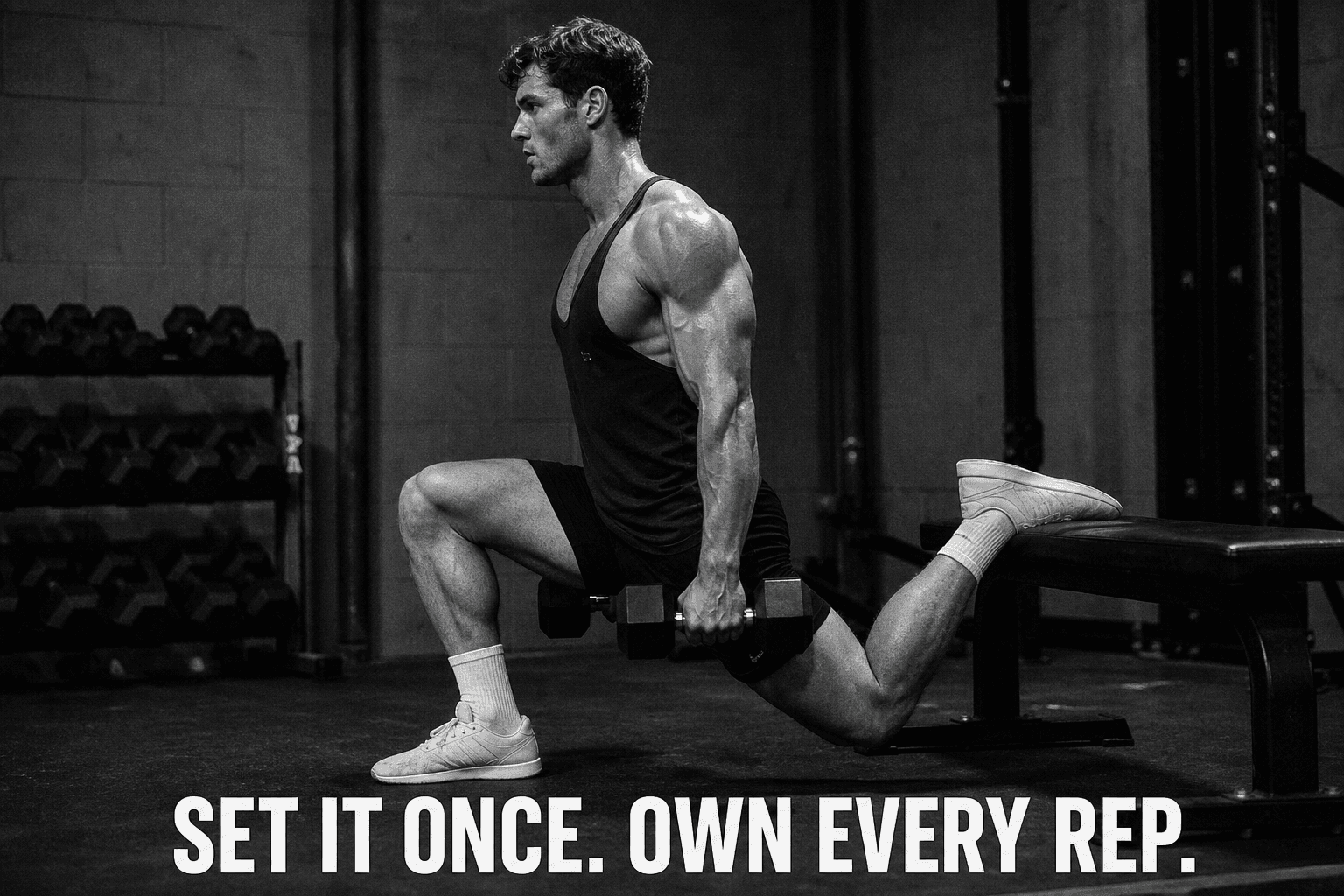
The Bulgarian split squat is brutal — but most people make it harder than it needs to be
Most form breakdowns on the Bulgarian split squat don't happen because the exercise is dangerous. They happen because a few simple setup errors put the wrong muscles in charge from the first rep.
Get the setup right and this is one of the best single-leg exercises you can do. Get it wrong and you'll feel it in your hip flexors, your lower back, and your ego — not your quads and glutes.
Here are the five mistakes that show up most often, and exactly what to do instead.
Mistake 1: Your front foot is in the wrong place
This is the one that breaks almost every beginner's first set.
If your front foot is too close to the bench, you end up on your toes at the bottom and your knee shoots way past your foot. If it's too far away, your hip drops to the floor and you lose all control.
The fix: stand about 2–3 feet in front of the bench before you even place your rear foot. Then test the bottom position — your front shin should be roughly vertical, and your knee should track over your second toe, not caving inward.
A useful cue: imagine your front foot is in the same place it would be for a regular lunge. Start there, then adjust by a half-step if needed. It takes one set to dial in — don't skip it.
Mistake 2: Rear foot position — flat vs. toes down matters
Most people rest the top of their foot flat on the bench. That works fine. But others try to prop themselves on their toes — and that turns the rear leg into an active driver instead of a passive support.
Your rear leg is not the working leg. It's a kickstand. The moment it starts pushing, you lose the whole point of the exercise: loading one leg at a time.
A 2025 randomized crossover study (Topçu et al., 2025) looked at exactly what happens when you change the stability of the rear foot — comparing a stable platform, a BOSU ball, a Swiss ball, and a TRX suspension — in 23 trained athletes. Glute max, hamstrings (biceps femoris and semitendinosus), and both quad heads (vastus lateralis and vastus medialis) all showed significantly greater activation during the ascent phase compared to descent (p < 0.001 for most muscles). The rear-foot condition changed which muscles dominated, not just how hard they worked.
Bottom line: keep the top of your rear foot on the bench, toes relaxed. If you're wobbling too much, lower the bench height — don't fight for balance by gripping with your rear toes.
Glute max, hamstrings, and quads all fired significantly harder on the way up — the ascent is where your form either holds or collapses.
— Topçu et al. (2025). Effects of rear-foot instability devices on lower-limb muscle activation during the Bulgarian split squat. Sci Rep.
Mistake 3: Not going deep enough — or going too deep
Range of motion — how far you lower your hips on each rep — is the variable beginners get most confused about.
Not going deep enough means you're shortchanging the quad and glute stretch at the bottom, which is where a big chunk of the growth signal comes from. Going too deep without the hip mobility to support it means your lower back rounds and your pelvis tilts forward — which shifts the load to your spine instead of your legs.
Target: rear knee to about 1–2 inches off the floor, front thigh roughly parallel to the ground. That's the sweet spot for most people.
Research on the load-velocity relationship in the Bulgarian split squat found that trained athletes had a mean range of motion of 44.7 ± 3.7 cm at working loads (Rabal-Pelay et al., 2024). That's a real, substantial range — not a quarter-rep dip. If your range is significantly shorter than that, your hip flexors are probably too tight or your front-foot placement needs adjusting.
If you can't hit that depth without your torso folding forward, add a hip flexor stretch dynamic vs static stretching to your warm-up before your split squat sets.
Mistake 4: Torso angle — straight up isn't always right
You've probably been told to keep your chest up and your back straight. That's mostly correct — but it's not the whole story.
A perfectly vertical torso in the Bulgarian split squat loads your quads heavily. A slight forward lean — about 10–20 degrees — shifts more of the work onto your glutes and hip extensors — the muscles running down the back of your hips.
Neither angle is wrong. The mistake is not choosing intentionally.
If your goal is quad size, stay upright. If your goal is glute development, allow a controlled lean. The failure mode is an accidental lean caused by weak core control or a front foot that's too close — that's when your lower back takes over and the whole thing falls apart.
A drill that helps: do your first set with just bodyweight, deliberately trying both torso angles. You'll feel the difference immediately. Then pick the one that matches your goal and commit to it with load.
Mistake 5: Loading too fast before the pattern is solid
The Bulgarian split squat has a steep learning curve. The balance demand is real — especially in the first few sessions. Beginners often put plates on the bar before they've actually grooved the movement pattern.
Strength research confirms you should be tracking bar speed, not just load. Rabal-Pelay et al. (2024) showed a strong load-velocity relationship in the Bulgarian split squat (R² = 0.945) — meaning your bar speed at a given percentage of your one-rep max is highly predictable. When your speed drops significantly, you're at or past your limit for that session.
In plain terms: if your reps are slowing down fast and your form is already wobbling, adding more weight won't build muscle faster. It'll just make the wobbling worse.
Start with just your bodyweight for 2–4 weeks until the balance is automatic. Then add a dumbbell in each hand before you ever touch a barbell. Once 20 kg of dumbbells feels easy and your form is clean through the full range, the barbell is ready for you.
For a related look at how load decisions affect unilateral leg training, see the how many sets of squats should i do article — the set and rep logic carries over directly.
The load-velocity relationship in the Bulgarian split squat is highly predictable (R² = 0.945) — when your bar speed drops, you've hit your limit for the day.
— Rabal-Pelay et al. (2024). Load-velocity relationship in the Bulgarian split-squat exercise. J Strength Cond Res.
The bonus mistake: ignoring side-to-side differences
Almost everyone has a stronger leg and a weaker leg. The Bulgarian split squat exposes that gap immediately — and that's one of the reasons it's so valuable.
Don't try to use the same weight on both sides right away. It'll push you into compensation patterns on the weaker side and teach your body the wrong motor pattern from the start.
Research tracking the load-velocity relationship between dominant and non-dominant legs found that while 1RM differed between sides (as expected), the relationship between relative load — expressed as a percentage of each leg's own 1RM — and bar speed was stable across both limbs (Rabal-Pelay et al., 2024). That means you can train each leg at the right intensity for that leg and still be doing equivalent work.
Practically: your weaker leg sets the reps. Do the same number on your stronger side. Let the weight differ if it needs to. Over 6–8 weeks, the gap closes.
After a knee injury or surgery, this asymmetry becomes clinically important. Henderson et al. (2025) found that flywheel Bulgarian split squat training in athletes returning from ACL reconstruction improved jump height and knee joint contribution in the reconstructed leg — and helped close the gap between legs — over 16 sessions. The same principle applies to healthy lifters: the Bulgarian split squat is one of the best tools for bringing a lagging leg up to speed.
If the weaker side keeps collapsing, drop back to the dumbbell bulgarian split squat with bodyweight only and rebuild the pattern before you reload.
How Planfit applies this
Planfit programmes the Bulgarian split squat as either a primary movement or an accessory lift depending on your training level and goal. It recommends a starting weight and rep range for each leg, tracks your sets and progression trends over time, and flags when your load hasn't moved in several sessions — so you never accidentally plateau by playing it too safe. The rest timer between sets is set to the research-backed duration for unilateral strength work, not a generic default.
References
- Topçu H et al. (2025). Effects of rear-foot instability devices on lower-limb muscle activation during the Bulgarian split squat in male football players.. Sci Rep. 10.1038/s41598-025-32203-7
- Rabal-Pelay J et al. (2024). Load-velocity relationship in the Bulgarian split-squat exercise.. J Strength Cond Res. 10.1519/JSC.0000000000004897
- Henderson FJ and Shimokochi Y. (2025). Inertial one-leg squat training and drop jump biomechanics in athletes with anterior cruciate ligament reconstruction after return to sport.. J Strength Cond Res. 10.1519/JSC.0000000000004983