Heat beats ice for sore muscles — especially after 24 hours, per a 2021 meta-analysis
5 studies · 32-RCT meta-analysis (2021)
6 min read
What's actually happening when you're sore
DOMS stands for delayed onset muscle soreness — the ache that shows up 24 to 72 hours after a hard workout, not right away. That delay is the whole point of the name.
It comes from eccentric contractions — reps where the muscle lengthens while it's still under load, like the lowering phase of a squat or the negative on a curl. That lengthening causes small amounts of real muscle damage, and that damage is what triggers the soreness you feel a day or two later (Ranchordas et al., 2017).
It's not dangerous, and it's not proof your workout "worked." does soreness mean muscle growth covers why soreness and muscle growth don't actually track together — you can grow plenty from a session that leaves you barely sore. But DOMS is uncomfortable, and it can drag down your performance in the next session if you don't manage it well.
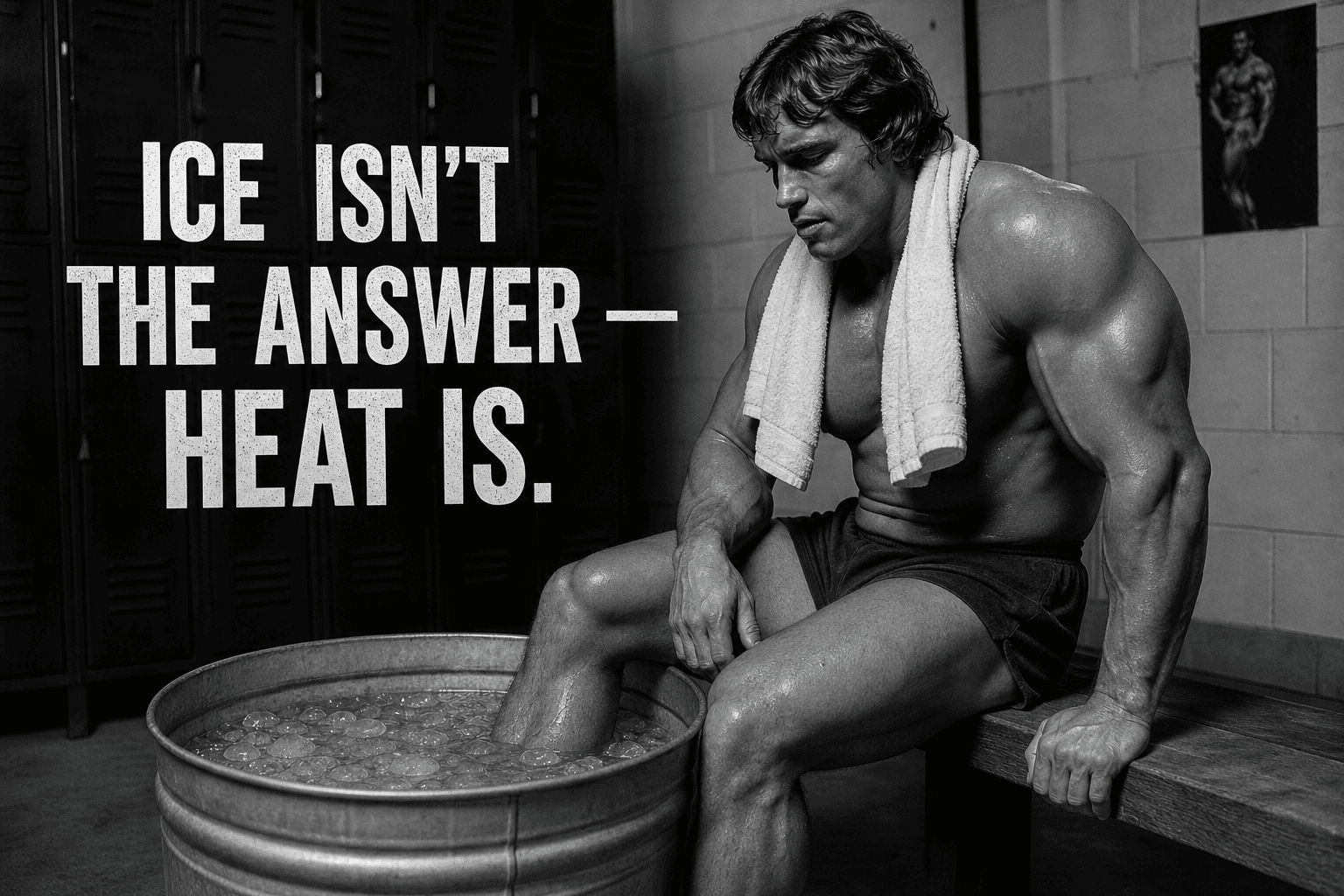
Heat beats ice — especially after the first day
Cold only wins in a narrow window. Applied within an hour of training, cold therapy — ice packs, cold water immersion — meaningfully cuts soreness in the first 24 hours after exercise (Wang et al., 2021). That's from a meta-analysis, a study that statistically pools results across many trials to get one bigger, more reliable answer — in this case, 32 randomized controlled trials (RCTs, where people are randomly split into groups and compared) covering 1,098 people.
Past that first day, cold basically stops working for pain.
Heat works the whole time. Hot packs reduced soreness both within the first 24 hours and beyond it — and heat had the single strongest pain-relief effect of anything tested in the review (Wang et al., 2021).
So if the goal is simply making the ache go away, a heating pad is the better tool overall — and it's the only one of the two that still helps on day two and three, when ice has already stopped doing anything.
Cold water immersion isn't about the ache — it's about tomorrow's performance
Cold water immersion (CWI) means sitting in cold water, usually somewhere around 50-59°F, right after training. In trained soccer players, CWI after a match didn't do much extra for how sore they said they felt — but it did protect what they could do the next day (Veen et al., 2026).
Strength — measured as how hard a muscle can contract against resistance — recovered better with CWI. Jump height recovered better. Creatine kinase, a blood marker that rises when muscle fibers get damaged, dropped more. Sprint speed, though, didn't move either way.
All of that is reported as an SMD — a stats term for effect size, where a bigger number means a bigger real-world difference between the CWI group and the group that did nothing.
The takeaway: CWI is a tool for "can I perform again soon," not a tool for "does it feel better right now." If you're training again within a day or two — back-to-back sessions, a tournament, game two of a weekend — it's earned its place. If you're just annoyed by the soreness itself, it's not the fix.
If you do ice, the dose matters
Not all cold water immersion is the same. A 2025 network meta-analysis — a study design that compares several treatment doses against each other, not just "treatment vs. nothing" — pooled 55 RCTs testing different combinations of soak time and water temperature (Wang et al., 2025).
The combination that best cut soreness and sped up jump-height recovery was 10 to 15 minutes at 11-15°C, roughly 52-59°F (Wang et al., 2025). Going colder, down to 5-10°C, worked too — but not noticeably better than the milder version.
In plain terms: there's no reward for suffering through the coldest tub you can find. A moderately cool bath for a set 10-15 minutes does the job just as well.
10 to 15 minutes at 11–15°C beat colder water for recovery — there's no bonus for suffering more.
— Wang et al. (2025). Impact of different doses of cold water immersion on recovery from acute exercise-induced muscle damage. Front Physiol.
Supplements probably won't fix your soreness
Antioxidant supplements — vitamin C, vitamin E, and similar pills marketed to fight post-workout muscle damage — are one of the most common things people take to try to dodge DOMS. A Cochrane review, one of the strictest evidence reviews that exists in medicine, found the evidence too weak and inconsistent to say antioxidants meaningfully reduce soreness (Ranchordas et al., 2017).
BCAAs — branched-chain amino acids, a specific trio of protein building blocks — fare a little better, but only a little. A 2024 meta-analysis of 18 RCTs found BCAA supplementation modestly lowered creatine kinase, the muscle-damage marker, both right after training and 72 hours later (Salem et al., 2024). That's a real but small effect on a blood marker — not the same thing as guaranteeing you'll feel less sore.
If you're going to spend money and effort on recovery, hitting your daily protein target with protein calculator is a better bet than a bottle of antioxidant pills. Total protein intake has a far stronger evidence base for muscle repair than any single soreness supplement covered here.
What to actually do about DOMS
Match the treatment to what you actually need. Sore right now and just want relief? Reach for heat, any time — it still works even two or three days out (Wang et al., 2021). Training again within 24-48 hours and need your legs back, not just comfort? Cold water immersion, 10-15 minutes at 11-15°C, is the better call (Veen et al., 2026), with a network meta-analysis across dose and duration variations backing the same protocol (Wang et al., 2025).
Don't count on antioxidant pills to prevent soreness in the first place — the evidence doesn't back that use (Ranchordas et al., 2017). And don't chase soreness on purpose. Grinding every set to complete failure or piling on unfamiliar eccentric-heavy work racks up muscle damage without a bigger growth payoff to show for it. training to failure covers why stopping a few reps short of failure builds just as much muscle with a lot less of the damage that drives DOMS.
If foam rolling is already in your routine, it's still worth keeping — benefits of foam rolling has a real, if modest, effect on soreness and range of motion. The bigger point is consistency: showing up for the next session matters more than any single recovery trick.
How Planfit Applies This
Planfit's Analysis tab tracks muscle-recovery status per body part and logs your training volume automatically, so you're not guessing whether a sore muscle group is actually ready to go again. Pair that with progressive overload tracking — Planfit only nudges your working weight up once your current load has stopped being challenging — so you keep building without stacking unnecessary damage on muscles that haven't recovered yet.
References
- Wang X et al. (2021). Heat and cold therapy reduce pain in patients with delayed onset muscle soreness: A systematic review and meta-analysis of 32 randomized controlled trials.. Phys Ther Sport. 10.1016/j.ptsp.2021.01.004
- Veen K et al. (2026). The Impact of Cold-Water Immersion on Post-Match Recovery in Trained Soccer Players: A Systematic Review and Meta-Analysis.. Scand J Med Sci Sports. 10.1111/sms.70202
- Wang Y et al. (2025). Impact of different doses of cold water immersion (duration and temperature variations) on recovery from acute exercise-induced muscle damage: a network meta-analysis.. Front Physiol. 10.3389/fphys.2025.1525726
- Ranchordas MK et al. (2017). Antioxidants for preventing and reducing muscle soreness after exercise.. Cochrane Database Syst Rev. 10.1002/14651858.CD009789.pub2
- Salem A et al. (2024). Attenuating Muscle Damage Biomarkers and Muscle Soreness After an Exercise-Induced Muscle Damage with Branched-Chain Amino Acid (BCAA) Supplementation: A Systematic Review and Meta-analysis with Meta-regression.. Sports Med Open. 10.1186/s40798-024-00686-9