Dumbbell vs Machine Shoulder Press: Which Should You Do?
By Planfit Editorial Team · 4 min read
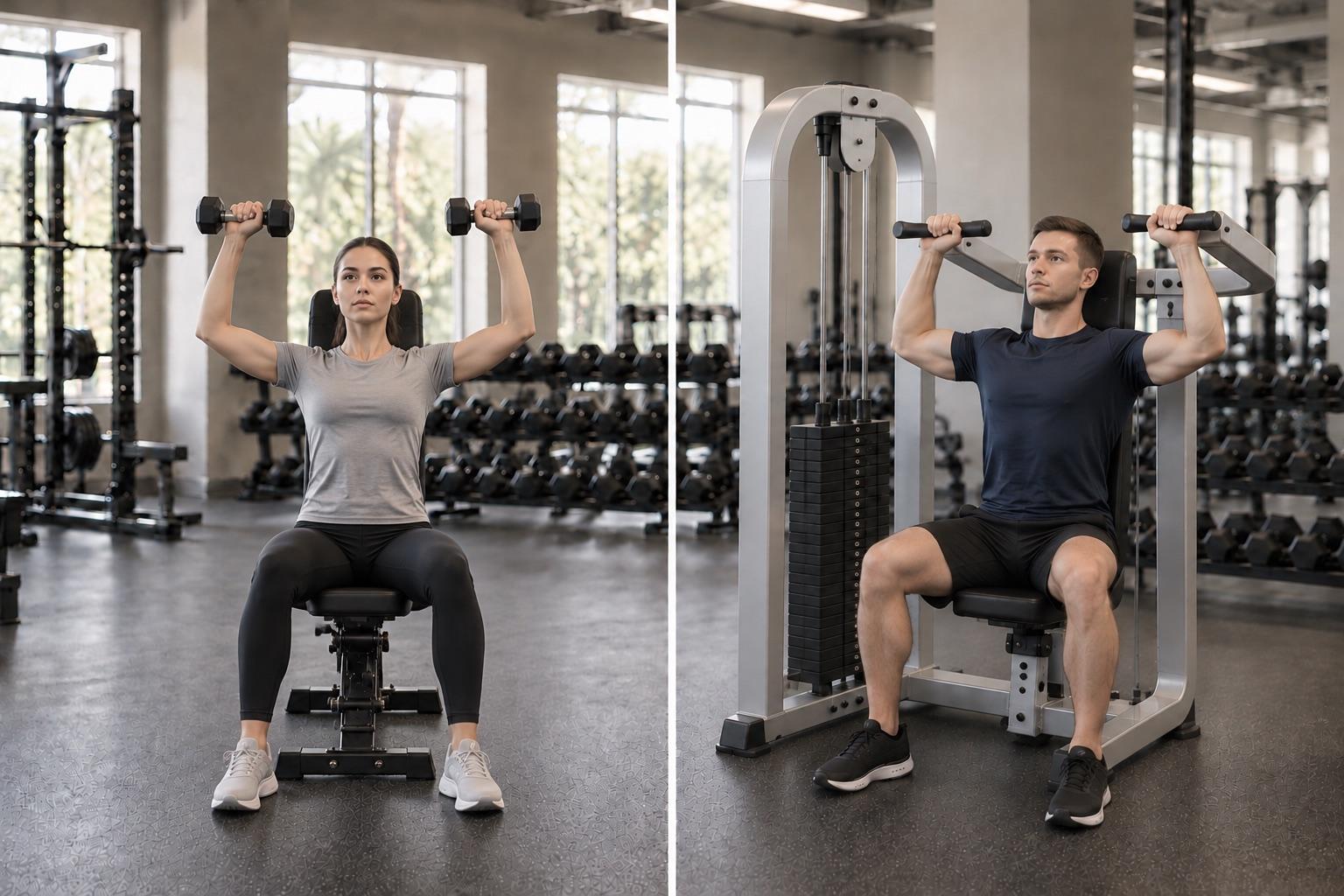
1. Dumbbell or machine: which is better for shoulder growth?
Neither, by much. When you compare the dumbbell shoulder press vs the machine, both build about the same muscle over time. A 2023 review of 13 studies found that free weights (dumbbells and barbells) and machines built about the same amount of muscle (Haugen et al., 2023).
What does change is how each one feels while you press.
- Dumbbells: nothing guides them, so your shoulders also have to keep the weights steady. Pressing with dumbbells put more work on the shoulder muscles than pressing with a barbell or a machine (Saeterbakken & Fimland, 2013; Coratella et al., 2022).
- Machine: here, "machine" means the seated shoulder press machine: you sit, push two handles overhead and pick the weight with a pin. It's not the Smith machine, where you press a barbell on rails. The handles move along a set path, so you don't have to stop the weight from drifting forward, back or to the sides like you do with dumbbells. That makes it easier to learn, and you can stop safely at any point.
How to pick:
- It's your first time: start with whichever you can press at least 8 times, light dumbbells (2 to 5 lb) or the lightest plate on the machine. If both work, start with the machine. The handles move along a set path, so the movement is easier to learn.
- You can't press the machine's lightest plate 8 times: start with dumbbells. They come as light as 2 lb, so you can start lighter than on the machine.
- Your arms wobble or your hands end up at different heights with dumbbells: go down one dumbbell size. If they still wobble, learn the movement on the machine first.
- You moved up a dumbbell and lost a lot of reps: that's normal. Dumbbells usually go up 5 lb at a time, and going from 30 lb to 35 lb is about 17% heavier in one step. To build reps with your current pair before moving up, read How to Progress When You Can't Add Weight on Dumbbells.
- You train at home, or the machine is always taken: use dumbbells. Your shoulders will grow just as well.
2. How many sets and reps should you do?
You don't need both. Doing one press consistently is enough to build your shoulders.
- Use a weight you can press at least 8 times without leaning back.
- Move up once you hit the highest rep number in the table on every set. For 3 x 8-12, that means 12 reps on all three sets. Next workout, go up one plate on the machine, or to the next pair of dumbbells.
- Log the dumbbell and machine presses separately. The weights don't match, because a machine's numbers vary from brand to brand.
If you want to know more about adding weight over time, read Progressive Overload Is the Only Variable That Actually Guarantees Muscle Growth.
3. Going further: should you press sitting or standing?
If you're a beginner, sit. You can press about 10% more with dumbbells seated than standing, but standing puts more work on the side and back of your shoulders and on your abs (Saeterbakken & Fimland, 2012; Saeterbakken & Fimland, 2013).
So neither is wrong. Seated lets you go heavier with your back held in place. Standing works more muscles but asks for more balance. If your lower back arches a lot when you press standing, sit down and lean your back against the bench.
Frequently asked questions
Is the shoulder press the same as the overhead press or the military press?
It's the same movement: pushing a weight from your shoulders to above your head. The names usually point to the equipment. "Overhead press" most often means a standing barbell press. "Military press" is a standing barbell press with your feet close together. "Shoulder press" is often used for the seated dumbbell or machine version.
Is a neutral grip shoulder press better than the regular grip?
With a neutral grip, your palms face each other. Your elbows then stay more in front of you instead of out to the sides. We didn't find a study showing it builds more or less muscle than the regular grip. If pressing with your palms facing forward bothers your shoulders, try the neutral grip with dumbbells, or on a Shoulder Press Machine that has those handles.
Is a 40 lb dumbbell shoulder press good?
It depends on your size, your experience and how many reps you do, so there's no single number. Compare yourself with your own log instead. If you're pressing the same weight for more reps, or more weight for the same reps, than you did a month ago, your shoulders are getting stronger.
Get a routine that fits you
If it's hard to decide which shoulder exercises to do and how many sets, let Planfit handle it. Answer a few questions about your goal, experience and equipment, and Planfit builds a routine with shoulder exercises.
References
- Haugen ME, Vårvik FT, Larsen S, Haugen AS, van den Tillaar R, Bjørnsen T. (2023). Effect of free-weight vs. machine-based strength training on maximal strength, hypertrophy and jump performance - a systematic review and meta-analysis.. BMC Sports Sci Med Rehabil. 10.1186/s13102-023-00713-4
- Coratella G, Tornatore G, Longo S, Esposito F, Cè E. (2022). Front vs Back and Barbell vs Machine Overhead Press: An Electromyographic Analysis and Implications For Resistance Training.. Front Physiol. 10.3389/fphys.2022.825880
- Saeterbakken AH, Fimland MS. (2013). Effects of body position and loading modality on muscle activity and strength in shoulder presses.. J Strength Cond Res. 10.1519/JSC.0b013e318276b873
- Saeterbakken AH, Fimland MS. (2012). Muscle activity of the core during bilateral, unilateral, seated and standing resistance exercise.. Eur J Appl Physiol. 10.1007/s00421-011-2141-7