The pump lasts 30–60 min after a workout — not growth
3 studies · 2025 J Sport Health Sci review
5 min read
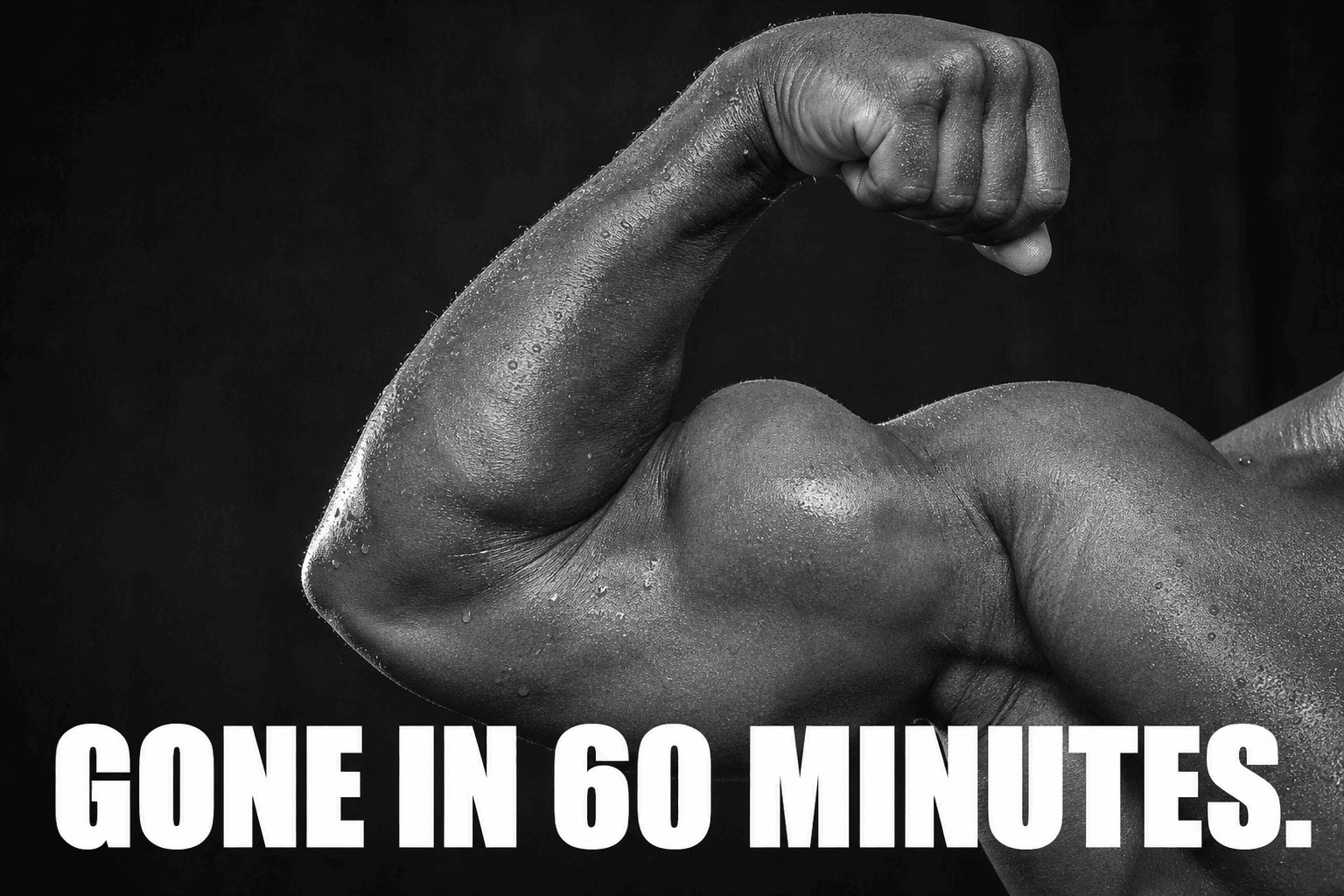
The pump is gone in 30–60 minutes — and that's fine
A pump — that tight, skin-stretching fullness you feel mid-set — lasts 30 to 60 minutes after a workout, then fades. Sometimes faster if you cool down hard or skip a post-workout meal.
The feeling is real. Blood floods the working muscle, fluid shifts from your bloodstream into the tissue, and you look noticeably bigger for a short window. But that window closes quickly.
Here's the part that might sting: chasing the pump won't build more muscle. A 2025 review in the Journal of Sport Health Science was blunt — cell swelling and metabolic stress from the pump are not supported by evidence as meaningful contributors to hypertrophy (Van Every et al., 2025).
The pump is gone in 30–60 minutes. It feels great. It just doesn't drive growth.
What's actually happening during a pump
When you do a set, your muscles burn through fuel and produce metabolic byproducts — things like lactate and hydrogen ions. Your body responds by routing more blood to the area to clear the debris and deliver oxygen.
Blood plasma (the fluid part of blood) is pushed out of capillaries and into the space between muscle cells. That fluid accumulation — called intracellular and extracellular swelling — is what makes the muscle look and feel bigger.
It's temporary by design. Once you stop lifting, blood flow normalises, the fluid gets reabsorbed, and the swelling resolves. Thirty to sixty minutes is the typical window — longer if you trained a large muscle group hard, shorter if you did light accessory work.
Does the pump mean your muscles are growing?
No. A big pump does not mean big gains.
This is one of the most persistent myths in lifting. The idea is that cell swelling from the pump triggers a hypertrophic signal — a growth signal — in the muscle. It sounds plausible. The cell swells, senses mechanical stress, and adapts.
But the evidence doesn't hold up. Van Every et al. (2025) reviewed the mechanistic research and concluded that claims about metabolic stress and cell swelling meaningfully contributing to muscle growth are not supported by scientific evidence.
The pump is a byproduct of training, not a mechanism of it. Just like does soreness mean muscle growth isn't a reliable measure of growth, neither is the pump. You can get a massive pump from light, high-rep sets and grow very little. You can train heavy with almost no pump and drive significant hypertrophy.
Cell swelling from the pump does not meaningfully contribute to muscle hypertrophy.
— Van Every et al. (2025). Load-induced human skeletal muscle hypertrophy: Mechanisms, myths, and misconceptions. J Sport Health Sci.
Early size gains from training: mostly swelling, not muscle
Here's a related number worth knowing. In the first 3 weeks of a resistance training programme, your muscles look bigger on a scan. A 2016 study measured vastus lateralis (the outer quad muscle) cross-sectional area — the size of the muscle slice on an ultrasound — and found a ~2.7% increase after just 3 weeks. Sounds like fast progress (Damas et al., 2016).
But when the researchers checked for edema — the medical word for fluid accumulation in tissue — they found the early swelling accounted for a substantial chunk of that apparent size increase. Actual structural muscle growth only became the dominant driver by week 10, when the edema had resolved.
A 2019 RCT confirmed this pattern with a sharper tool — MRI rather than ultrasound. It showed that high-load training produced clear edema markers in the first 3 weeks. Low-load blood-flow-restriction training caused less edema but still showed early cross-sectional area increases (Shiromaru et al., 2019). In both cases, early "size" was partly fluid, not fibre.
The takeaway: if you start a programme and look bigger after two weeks, some of that is real, and some of it is your muscles being mildly swollen from the new stimulus. That's not a reason to worry — it's just accurate expectations.
What actually drives muscle growth (not the pump)
Mechanical tension is the primary driver. That means loading a muscle under stretch, pushing it close to its capacity, and progressively increasing the demand over time.
Mechanical tension — the force generated when a muscle contracts against a load — activates the pathways that signal muscle fibres to grow. Metabolic stress (the burn, the pump) can accompany hard training, but the tension is doing the work (Van Every et al., 2025).
This is why progressive overload training is the variable that actually guarantees growth across time. Not whether you felt a pump. Not how sore you were the next day.
A pump can be a sign that you worked the muscle through a full range of motion with adequate volume — which are good things. But it's a loose proxy, not a direct signal. Don't use it as your primary feedback.
How to use the pump as a useful (if imperfect) tool
The pump isn't useless. Here's where it earns its place.
As a mind-muscle connection cue. If you're doing a dumbbell bicep curl and feel no pump after several sets, you might be letting other muscles take over. A pump in the target muscle is a rough signal you're actually loading it.
As a volume check. Getting a pump usually requires enough sets and reps to accumulate metabolic stress. If you never get a pump in a muscle, you might not be doing enough volume. But the reverse isn't true — a pump alone doesn't confirm you did enough.
Not as a hypertrophy measure. The research is clear. Cell swelling resolves. What stays is determined by how much mechanical tension you applied and whether you progressed the load over time. Check out how many sets per muscle group per week for the actual volume numbers that drive growth.
How Planfit applies this
Planfit doesn't track your pump. It tracks the thing that actually matters: whether you lifted more than last time. The app logs every set, monitors your load history per exercise, and nudges you to add weight or reps when your current load has stopped being a real challenge. That's the stimulus that builds muscle. The pump is a nice side effect — let it fade, keep the progression.
References
- Van Every et al. (2025). Load-induced human skeletal muscle hypertrophy: Mechanisms, myths, and misconceptions.. J Sport Health Sci. 10.1016/j.jshs.2025.101104
- Damas F et al. (2016). Early resistance training-induced increases in muscle cross-sectional area are concomitant with edema-induced muscle swelling.. Eur J Appl Physiol. 10.1007/s00421-015-3243-4
- Shiromaru et al. (2019). Differential muscle hypertrophy and edema responses between high-load and low-load exercise with blood flow restriction.. Scand J Med Sci Sports. 10.1111/sms.13516