How many sets of calf raises? 12 a week beats 6
4 studies · 3 RCTs · Kassiano 2024 & 2023
5 min read
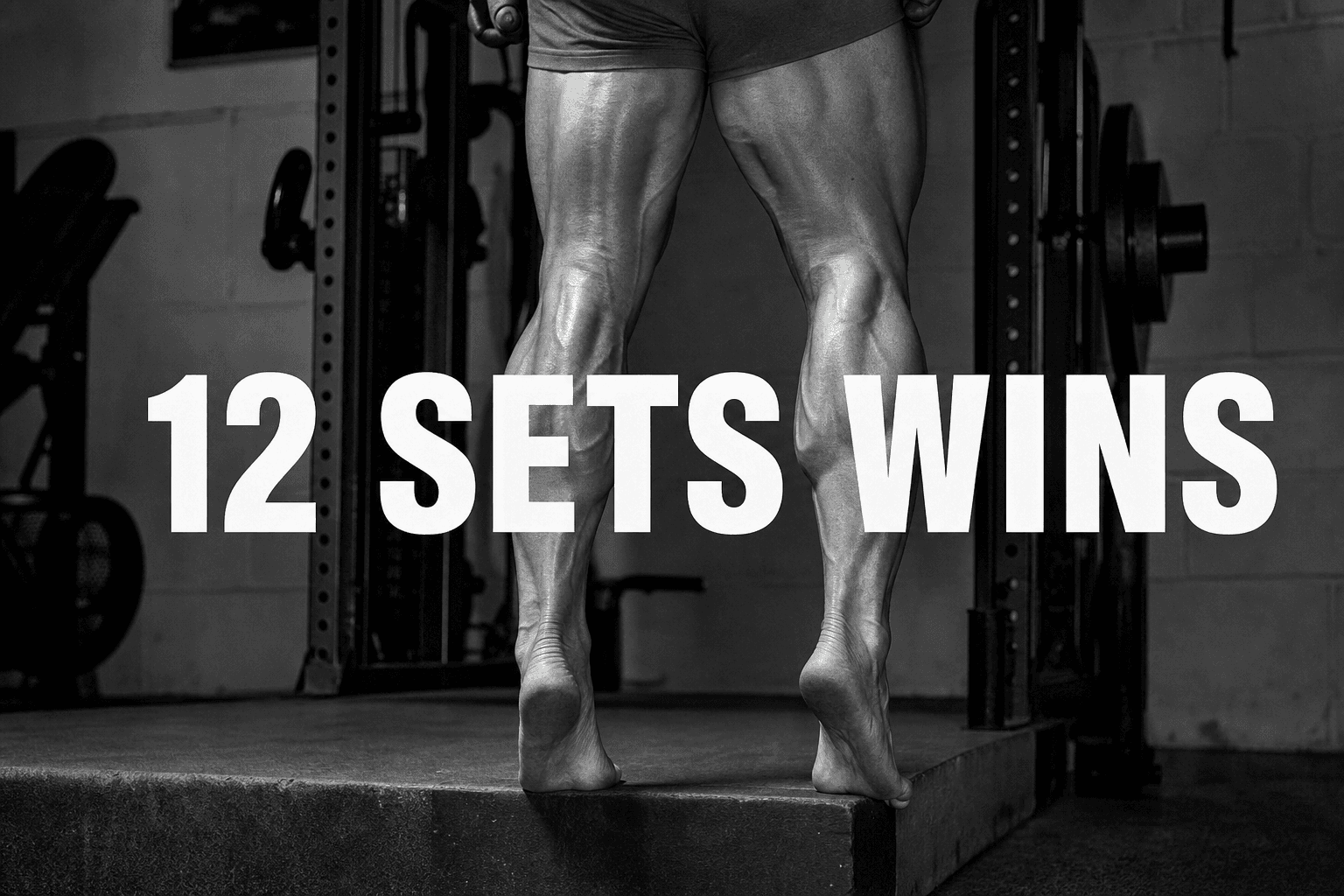
The answer: 12 sets per week, split across 3 sessions
If you're doing 6 sets of calf raises a week, you're leaving real growth on the table.
A 2024 RCT put 61 untrained women through 6 weeks of calf training at three different weekly volumes — 6 sets, 9 sets, or 12 sets — and measured muscle thickness with ultrasound. The 12-SET group grew their lateral gastrocnemius — one of the two calf muscles at the back of the lower leg — by 14.3%, versus 8.1% in the 6-SET group. The soleus, the flatter muscle sitting underneath, followed the same pattern: 12.7% vs 6.7% (Kassiano et al., 2024).
That's not a marginal difference. 12 sets grew the overall calf complex almost twice as fast as 6. And importantly, 9 sets didn't beat 6 — so there seems to be a threshold somewhere between 9 and 12 where the extra volume really kicks in.
12 sets grew the calf complex 12.0% in 6 weeks. 6 sets got 6.9%.
— Kassiano et al. (2024). Bigger Calves from Doing Higher Resistance Training Volume? Int J Sports Med.
Why calves need more volume than most muscles
Your calves are postural muscles. They fire hundreds of times a day just keeping you upright and moving. That means they're built for endurance — they resist fatigue, they recover fast, and they don't respond to low doses the way a less-trained muscle would.
That's exactly why the 6-set group in Kassiano et al. (2024) still grew — they just grew slower. Your calves will respond to almost any calf work. The question is whether you're giving them enough of a novel stimulus above what daily walking already provides.
The practical upshot: don't treat calf raises like a finisher you squeeze in at the end. Give them their own volume budget, the same way you would for chest or quads. See how many sets per muscle group per week for how this logic applies across every muscle group.
Straight-leg vs. bent-leg: you need both
Here's something most people miss: the gastrocnemius (the bulky, two-headed muscle that makes up the visible mound of your calf) crosses the knee joint. When your knee is bent, it goes slack — and the soleus, the muscle underneath, takes over.
A 2023 study compared straight-leg and bent-leg calf raises directly. Straight-leg calf raises produced 8.8% more muscle swelling in the medial gastrocnemius and 14.5% in the lateral gastrocnemius. Bent-leg calf raises — done seated — produced 15.4% more swelling in the soleus (Kassiano et al., 2023).
Neither exercise trains both muscles equally. If you're only doing standing calf raises, you're undertrained in the soleus. If you're only doing seated raises, your gastrocnemius isn't getting enough of a stimulus.
The fix: split your 12 weekly sets roughly 50/50 between standing (straight leg) and seated (bent leg) calf raises. That covers the full muscle group.
Foot position shifts the stimulus inside the gastrocnemius
The gastrocnemius has two heads — medial (inner) and lateral (outer). Foot position changes how the load is distributed between them.
A 9-week RCT measured calf muscle thickness under three foot positions: toes pointed outward, toes forward, and toes pointed inward. Toes out grew the medial (inner) head by 8.4% — significantly more than toes in, which grew it by only 3.8%. Toes in grew the lateral (outer) head by 9.1%, beating toes out at 5.5% (Nunes et al., 2020).
None of these differences are dramatic enough to redesign your whole programme around. But if you want balanced calves — inner and outer developed evenly — rotating foot positions across your weekly sets is worth the effort. It costs you nothing and adds meaningful variety to the stimulus.
Toes out grew the medial head 8.4%. Toes in grew the lateral head 9.1%.
— Nunes et al. (2020). Different Foot Positioning During Calf Training. J Strength Cond Res.
Range of motion: the bottom half is where the growth happens
This one surprises people. Most lifters assume full range of motion — heel all the way down, toes all the way up — is always best. For the gastrocnemius, that's not what the data says.
A 2023 RCT split 42 women into three groups: full range, the bottom half of the movement (heel down to neutral), and the top half (neutral to toes pointed). After 8 weeks, the bottom-half group grew the medial gastrocnemius by 15.2% — more than double the full-range group's 6.7%, and more than four times the top-half group's 3.4% (Kassiano et al., 2023).
The bottom position is where the gastrocnemius is at its longest — stretched under load. That stretch is the signal. If you're bouncing through reps without letting your heel drop, you're skipping the most productive part of the movement.
Practically: use a step or a calf block. Let the heel drop below parallel at the bottom, pause briefly, then push up. You don't need to limit to the bottom half exclusively — but make sure you're controlling that lower portion instead of rushing through it.
The bottom half of the calf raise grew the medial gastrocnemius 15.2% — vs 6.7% for full range.
— Kassiano et al. (2023). Greater Gastrocnemius Hypertrophy After Partial ROM Training at Long Muscle Lengths. J Strength Cond Res.
How to put it all together: a simple weekly template
Here's what the research actually calls for, combined into one practical approach:
Target: 12 sets per week, across 3 sessions (4 sets per session)
- Standing calf raise (straight leg, on a step): 2 sets per session. Heel drops below the platform at the bottom. Toes vary — forward one session, slightly out the next.
- seated calf raise (bent leg): 2 sets per session. This hits the soleus that standing raises miss.
- Rep range: 15–20 reps per set, close to failure. The RCT protocols used 15–20 repetition maximum — meaning you couldn't have done rep 21 with good form (Kassiano et al., 2024).
- Frequency: 3 days a week, not back-to-back. Calves recover faster than larger muscles, but they still need a day between sessions.
If you're starting from zero, begin at 6 sets (2 per session) and add 2 sets every 2–3 weeks until you reach 12. Don't jump to 12 on week one — the soreness will be real.
How Planfit applies this
Planfit programmes both standing and seated calf raises into your sessions based on your training level and goal. It recommends the working weight and rep range per set, tracks your volume across the week so you can see whether you're hitting your 12-set target, and nudges the load up when your current weight stops being challenging — the same progressive overload logic the research says actually drives calf growth. You don't have to remember the template above; the app runs it for you.
References
- Kassiano W et al. (2024). Bigger Calves from Doing Higher Resistance Training Volume?. Int J Sports Med. 10.1055/a-2316-7885
- Kassiano W et al. (2023). Greater Gastrocnemius Muscle Hypertrophy After Partial Range of Motion Training Performed at Long Muscle Lengths.. J Strength Cond Res. 10.1519/JSC.0000000000004460
- Kassiano W et al. (2023). Muscle Swelling of the Triceps Surae in Response to Straight-Leg and Bent-Leg Calf Raise Exercises in Young Women.. J Strength Cond Res. 10.1519/JSC.0000000000004491
- Nunes JP et al. (2020). Different Foot Positioning During Calf Training to Induce Portion-Specific Gastrocnemius Muscle Hypertrophy.. J Strength Cond Res. 10.1519/JSC.0000000000003674