Close Grip vs Wide Grip Lat Pulldown: Which Is Better?
By Planfit Editorial Team · 5 min read
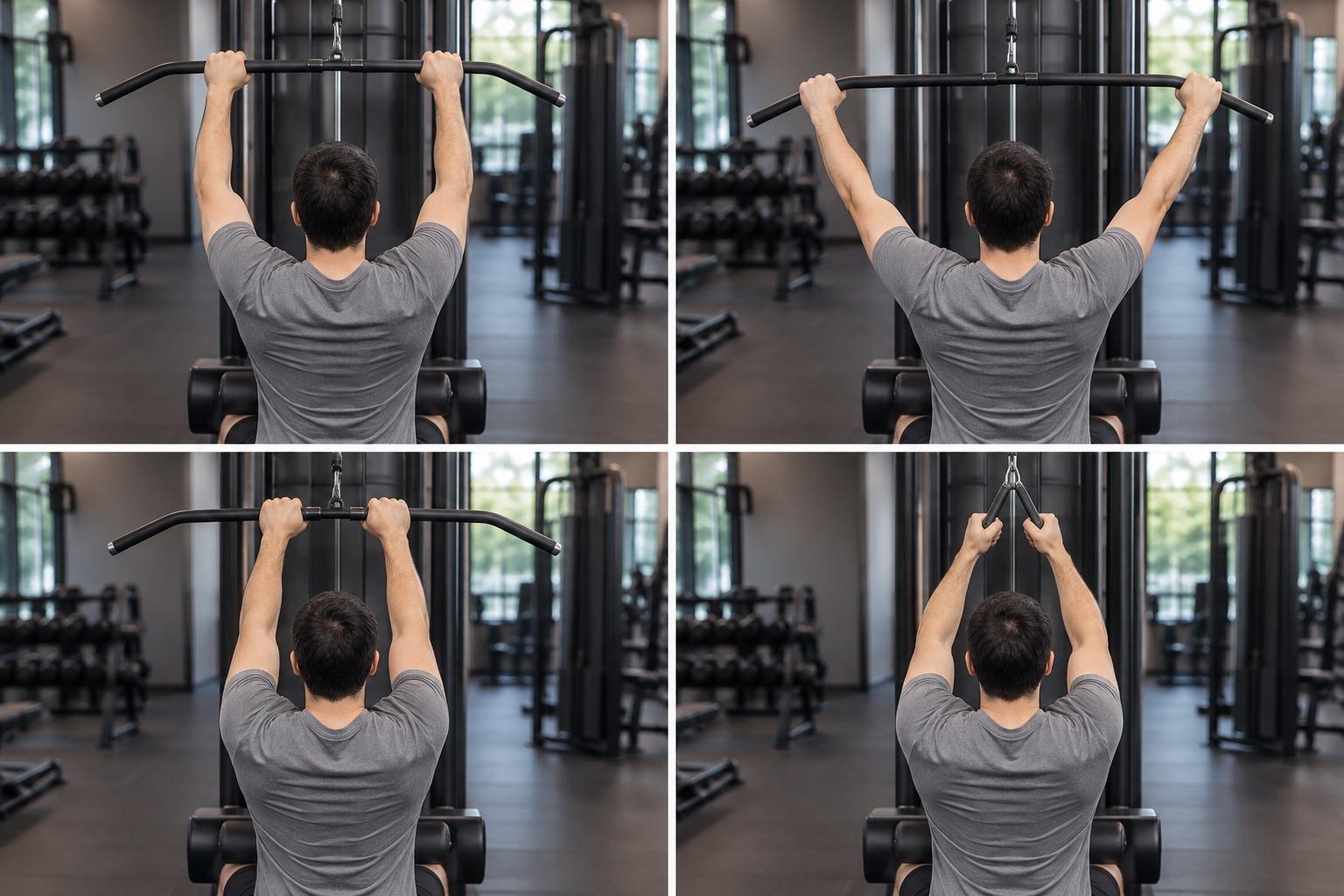
1. Does a wide grip hit your back harder?
No. Studies that changed grip width and hand direction on the lat pulldown found that your lats (the large muscles on the sides of your back) worked about equally hard with a close grip or a wide grip (Andersen et al., 2014; Buonsenso et al., 2025). So start with a medium grip, a little wider than your shoulders.
2. What changes with grip width, and which to pick
Your back gets about the same work with either grip, but a few other things change.
How to pick:
- It's your first time: use a medium grip, one fist wider than your shoulders on each side.
- A wide grip bothers your shoulder or elbow: move your hands in to shoulder width. Your back still gets about the same work. If it still hurts with a close grip, stop doing the exercise and see a doctor or physical therapist.
- A close grip feels like it's all arms: check your form before you change your grip. Your biceps (the front of your upper arm) worked about as hard with a close grip as with a wide grip (Andersen et al., 2014; Lusk et al., 2010). To fix your form, read Why Can't I Feel My Back on Lat Pulldowns?.
3. How to grip the bar and pull
The basic movement is the same for every grip. What changes is where your hands go and which way your elbows come down.
Medium grip: hold the long bar with your palms facing away, one fist wider than your shoulders on each side. When you pull the bar down to your collarbones, your hands should be right above your elbows. If your hands are well outside your elbows, your grip is too wide.
Wide grip: hold the long bar where it starts to bend down at each end. If your shoulders are stiff and a close grip makes it hard to straighten your arms overhead, a wide grip may feel easier. Don't go wider than the bends, though. The wider your arms go out to the sides, the more load on your shoulders (shown in pull-ups, Pouly et al., 2026).
Close grip, long bar: hold the long bar with your hands right above your shoulders. If you bring your hands closer than that, your wrists tend to bend. If your wrists feel uncomfortable, use the V-bar.
Close grip, V-bar: hook the V-shaped handle onto the cable and hold it with your palms facing each other. Pull it the same way as a close grip. In Planfit, this is the Neutral Grip Lat Pulldown.
How to pull:
- Set the thigh pad so it holds your thighs down and you can't lift off the seat.
- Stand up, grab the bar with your grip, and sit down with your arms straight.
- Lift your chest and lean back just a little, about 10 degrees.
- Pull the bar down until it touches your collarbones, then stop. With a wide grip, your elbows come down from out at your sides. With a close grip or the V-bar, keep your elbows in front of you and close to your body, and don't keep pulling them back behind you.
- Let the bar go back up slowly, over about 2 seconds, until your arms are straight again.
If you pull with your arms, you will feel it mostly in your arms. Think of your hands as hooks and drive your elbows down. If you have to swing your upper body back to move the bar, the weight is too heavy. Go one plate lighter.
4. How to do wide and close grips on back day
You don't need to do both a wide and a close grip. Doing one grip consistently is enough. If you want to alternate, don't add sets. Just split them between the grips. The table below shows 6 lat pulldown sets a week.
- Use a weight you can pull for 10 to 12 reps without rocking your upper body.
- Once you can do 12 reps on every set, go up one plate on the stack next time.
- Log each grip separately, since you will pull different weights. To learn more about adding weight, read Progressive Overload Is the Only Variable That Actually Guarantees Muscle Growth.
5. Going further: does hand direction matter too?
So far this has been about how far apart your hands are. You can also change which way your palms face: overhand, underhand or neutral.
- Overhand (palms facing away): the standard lat pulldown.
- Neutral (palms facing each other): done with the V-bar, a V-shaped handle on the cable.
- Underhand (palms facing you): done on the long bar with your hands about shoulder width apart.
Hand direction doesn't change your back's work much. One study did find an overhand grip worked your back a little more, so start with overhand and switch if your wrists, elbows or shoulders feel uncomfortable (Buonsenso et al., 2025; Lusk et al., 2010).
Frequently asked questions
Does a wide grip make your back wider?
There's no good evidence that it does. Your lats are the muscles that make your back look wide, and studies that measured how hard they work found about the same with a wide or a close grip (Andersen et al., 2014). How much your back grows depends on how many sets you do for it each week. If you're worried about your back getting bigger, do fewer sets instead of switching grips.
How much weight should I use when I switch grips?
Start one plate lighter on the stack than your usual weight. With a wide grip, you can usually pull a little less weight than with a medium or close grip.
Does a lat pulldown work your back the same way as a seated cable row?
Both work your lats, but not in the same way. Compared with a lat pulldown, a seated row works the muscles between your shoulder blades more (Lehman et al., 2004). So if you want to build your back evenly, do a Seated Cable Row as well as your lat pulldown.
Get a routine that fits you
If it's hard to decide which exercises to do and how many sets, let Planfit handle it. Answer a few questions and Planfit builds a routine with back exercises, matched to your goal and experience.
References
- Andersen V, Fimland MS, Wiik E, Skoglund A, Saeterbakken AH. (2014). Effects of grip width on muscle strength and activation in the lat pull-down.. J Strength Cond Res. 10.1097/JSC.0000000000000232
- Buonsenso A, Di Fonza D, Di Claudio G, et al. (2025). Electromyographic Analysis of Back Muscle Activation During Lat Pulldown Exercise: Effects of Grip Variations and Forearm Orientation.. J Funct Morphol Kinesiol. 10.3390/jfmk10030345
- Lusk SJ, Hale BD, Russell DM. (2010). Grip width and forearm orientation effects on muscle activity during the lat pull-down.. J Strength Cond Res. 10.1519/JSC.0b013e3181ddb0ab
- Lehman GJ, Buchan DD, Lundy A, Myers N, Nalborczyk A. (2004). Variations in muscle activation levels during traditional latissimus dorsi weight training exercises: An experimental study.. Dyn Med. 10.1186/1476-5918-3-4
- Pouly T, Garcia A, Valgalier A, Herbaut A, Vigouroux L. (2026). Effects of grip width and angle on sEMG, joint kinematics and moments during pull-ups.. Sports Biomech. 10.1080/14763141.2026.2743113