Why Can't I Feel My Back on Lat Pulldowns? 5 Fixes
6 min read
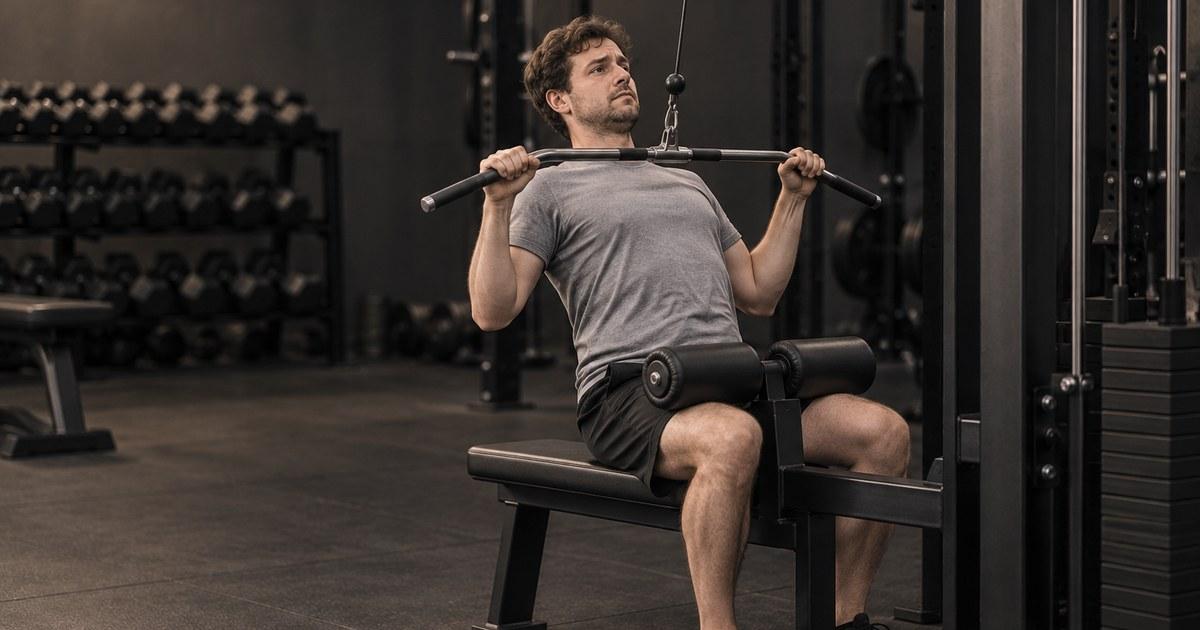
Your arms burn on lat pulldowns but your back feels nothing. Is that normal?
Yes. The Lat Pulldown is one of the best exercises for building your back. But you hold the bar in your hands and pull, so your biceps (the front of your upper arms) and your forearms (elbow to wrist) work too. Your arm muscles are much smaller than your back and tire out first, so you feel them before your back. This happens a lot to beginners, and your back is harder to feel because you can't see it while you train. Feeling your arms first doesn't mean your back isn't working.
What you can change is how much of the work your back gets:
- You feel it only in your arms: you are pulling the bar with your hands. Fix 1.
- You feel it in your neck and the top of your shoulders: your shoulders are shrugging up. Fix 2.
- You feel nothing much at all: your reps are often cut short (Fix 3). The weight may also be too heavy, so your body swings (Fix 4).
Fix your form first, then judge by the weight and reps, not by the feeling. If you pull more reps at the same weight, or more weight for the same reps, your back is getting stronger. If you went lighter to fix your form, watch whether the reps and weight climb again from there.
1. Feel it only in your arms? Think about lowering your elbows
If you try to pull the bar with your hands, your biceps and forearms take over. Instead, think about bringing your elbows down.
- Grab the bar a little wider than your shoulders, palms facing away from you. Don't squeeze it hard. Relax your thumb and wrap the bar mainly with your pinky and ring fingers.
- Brace your stomach the way you would right before a cough, and lean your upper body back slightly. Don't arch your lower back.
- Bring your elbows down to the sides of your ribs. The bar comes down to your upper chest.
- If your elbows stay out in front of your chest and the bar stops in front of your face, your arms are doing the pulling (left photo below).
If your arms still tire out first, move the pin up one plate to go lighter. Pick a weight you can pull for 10 to 12 reps without your arms giving out first.
It is normal for your biceps to work too. In a study of beginners, learning to pull with the back made the lats (the large muscles along the sides of your back) work harder, while the biceps worked no less than before (Snyder & Leech, 2009). So don't worry about your biceps working. Just focus on bringing your elbows down to your ribs.
2. Feel it in your neck? Pull your shoulders down first
When your shoulders shrug up toward your ears, the muscles on top of your shoulders and at the base of your neck (upper traps) take over. So pull your shoulders down before you bend your elbows.
- Sit with your thighs under the pad and hold the bar with your arms straight.
- Before you bend your elbows, pull your shoulders down, away from your ears. When they go down, your neck looks longer and the gap between your ears and shoulders opens up.
- Keep your shoulders down, then pull your elbows down to your ribs.
- As the bar goes back up, it is fine if your shoulders rise a little, but don't shrug them up to your ears. Start the next pull by pulling your shoulders down again.
Before your first set, practice step 2 alone for 10 reps with a light weight: arms straight, pull only your shoulders down away from your ears, then slowly return to the starting position. This teaches you to start each rep with your back.
3. Straighten your arms all the way on the way back
Many lifters start the next pull before their arms are straight, so the bar stays a few inches below the top. That skips the part of the rep where your back muscles stretch the most.
Let the bar rise until your elbows are fully straight. It is fine if your shoulders rise a little here. Start the next pull by pulling your shoulders down first.
Full range of motion also builds more strength than partial reps (Pallarés et al., 2021). If you can't finish the full range with your current weight, go lighter.
4. Go lighter and pause at the squeeze
If the weight is too heavy, you start leaning far back and jerking it, and momentum does the work instead of your back.
- Use a weight you can pull for 10 to 12 reps while your upper body stays at the same slight lean, without rocking forward and back. If your body has to rock to bring the bar down, the weight is too heavy.
- Pause for 1 second when your elbows reach the sides of your ribs.
- Let the bar back up over 2 to 3 seconds instead of letting it drop.
See how to focus on a muscle with lighter weights for more.
5. Still nothing? Swap the exercise
If you have fixed your form and still only feel your arms on lat pulldowns, try the arm pulldown. If your body still swings even after you go lighter, try the seated row machine or the incline row.
Quick checklist: fix it in this order
- Hold the bar lightly and think about lowering your elbows, not pulling with your hands.
- Pull your shoulders down away from your ears before you bend your elbows.
- Straighten your arms all the way each time the bar goes back up.
- Use a weight you can pull for 10 to 12 reps and pause for 1 second.
- Still nothing? Switch to one of the exercises above.
Don't try to fix everything at once. Work down the list one step at a time.
Frequently asked questions
My back isn't sore after a workout. Did it work?
Yes. Soreness is not a sign that your muscles are growing. It fades as you repeat the same workout, but the results keep adding up. Check the weight and reps instead: if you are pulling more reps or more weight than before, it is working. For more, see why you can grow without soreness.
Should I use an overhand or underhand grip on lat pulldowns?
Start with palms facing away from you. In one study, that grip worked the lats more than palms facing you (Lusk et al., 2010).
How far should I lean back on lat pulldowns?
Only slightly. It is enough if the bar can come down past your face to your upper chest. If you lean far back, the pull turns into a row, where you pull toward your body, and you tend to swing the weight. If your lower back arches, the weight is too heavy.
I can't feel my back on pull-ups either. Is it the same problem?
Usually, yes. On pull-ups too, pull your shoulders down away from your ears before you pull, then think about bringing your elbows down to the sides of your ribs. If you can't do full pull-ups yet, practice on the Assisted Pull Up or the lat pulldown first.
I can't feel my chest when I bench either. Is it the same cause?
Often. Your chest does most of the pushing on the bench and your back does most of the pulling on lat pulldowns, but arm muscles help too: your triceps on the bench, your biceps on lat pulldowns. Arm muscles are smaller than your chest or back, so they tire out first and that is where you feel it. See why you can't feel your chest when benching.
Learn your lat pulldown form by voice
When you train alone, it is hard to keep track of where your elbows are or whether your shoulders are creeping up. Each exercise in Planfit comes with a guide. With voice coaching, you can hear the starting position, the movement, and your breathing step by step and practice 3 reps, and you hear form tips during your sets too.
References
- Snyder BJ, Leech JR. (2009). Voluntary increase in latissimus dorsi muscle activity during the lat pull-down following expert instruction.. J Strength Cond Res. 10.1519/JSC.0b013e3181bb7213
- Pallarés JG, Hernández-Belmonte A, Martínez-Cava A, et al. (2021). Effects of range of motion on resistance training adaptations: A systematic review and meta-analysis.. Scand J Med Sci Sports. 10.1111/sms.14006
- Lusk SJ, Hale BD, Russell DM. (2010). Grip width and forearm orientation effects on muscle activity during the lat pull-down.. J Strength Cond Res. 10.1519/JSC.0b013e3181ddb0ab