The biggest fitness myths, debunked: what a 2025 survey of 721 gym-goers revealed
2 studies · 2025 Sci Rep survey of 721 gym-goers
6 min read
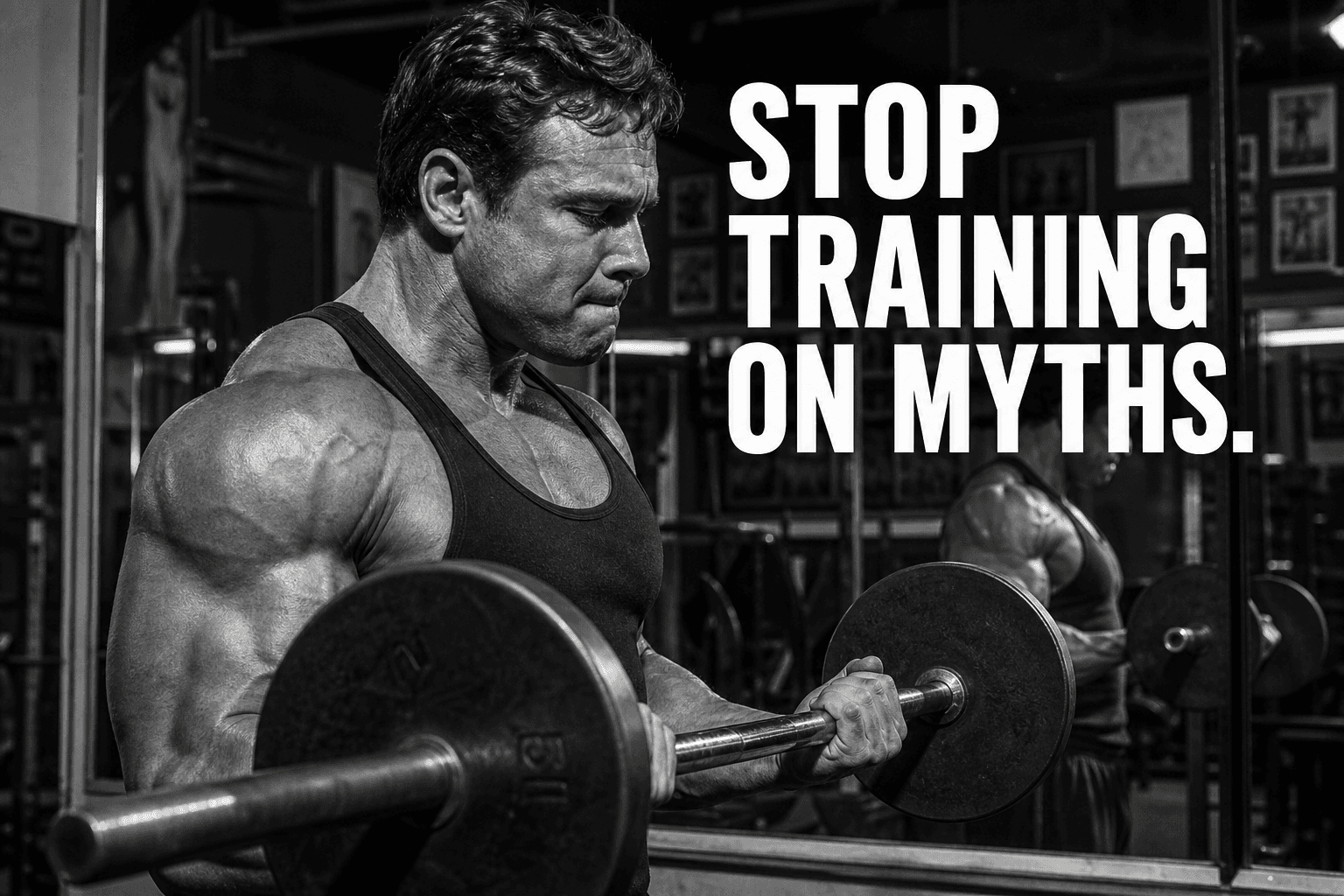
Most gym-goers are still training on bad information
Here's the uncomfortable truth: a 2025 survey of 721 Austrian gym-goers found that only 5 out of 14 basic resistance-training facts were correctly identified by the majority (Unger et al., 2025). That means most people in the gym — people who show up consistently — are making programme decisions based on things that aren't true.
This isn't a beginner problem. It cuts across training levels. The myths are sticky because they feel logical, or because someone credible once repeated them.
Below are the ones that matter most — the ones quietly sabotaging the most programmes right now.
Only 5 out of 14 basic resistance-training facts were correctly identified by a majority of gym-goers.
— Unger et al. (2025). Knowledge of gym goers on myths and truths in resistance training. Sci Rep.
Myth 1: The pump means you're building muscle
The pump — that tight, swollen feeling in a muscle mid-set — feels productive. It isn't a signal of muscle growth.
Cell swelling, or "the pump", does not meaningfully contribute to hypertrophy. A 2025 review in the Journal of Sport and Health Science examined every proposed mechanism for muscle growth and found no solid evidence that metabolic stress or cell swelling drives the process (Van Every et al., 2025). The same review dismissed acute hormonal spikes — the testosterone surge you get from a heavy set — as equally irrelevant to long-term muscle gain.
What actually builds muscle? Mechanical tension — the physical force placed on muscle fibres when they contract under load, especially near the end of their range. The pump can happen without meaningful tension. Chasing it is a distraction.
This doesn't mean pump-focused training is worthless. High-rep sets still create mechanical tension if they're taken close to failure. But the pump itself is not the mechanism — it's a side effect.
Cell swelling and metabolic stress are not meaningful contributors to muscle hypertrophy.
— Van Every et al. (2025). Load-induced human skeletal muscle hypertrophy: Mechanisms, myths, and misconceptions. J Sport Health Sci.
Myth 2: Soreness tells you the workout worked
Soreness — that aching stiffness 24–48 hours after a session — has no reliable relationship with muscle growth. You can have a maximally effective session and feel nothing the next day. You can feel wrecked and have done very little productive training.
Soreness tracks novelty and muscle damage — what happens when you do something unfamiliar, like a new exercise or a longer range of motion than usual. That is a different thing from the mechanical tension that the 2025 J Sport Health Sci review identifies as the primary stimulus for hypertrophy (Van Every et al., 2025). Damage is a by-product of training, not the mechanism that makes muscle grow.
If you're measuring workout quality by how sore you are, you're measuring the wrong thing. Measure progressive overload — whether the weight or reps went up over time — and you're measuring what actually matters. See does soreness mean muscle growth for the full breakdown.
Myth 3: Hormones from lifting drive your muscle gains
You've probably heard it: big compound movements spike testosterone and growth hormone, and that's why they build more muscle than isolation work.
The hormonal spike from a heavy set is real. Its effect on muscle growth is not.
The 2025 review by Van Every et al. looked hard at this claim and found that systemic hormone responses — the testosterone, growth hormone, and IGF-1 that briefly rise after a resistance session — do not meaningfully contribute to load-induced hypertrophy (Van Every et al., 2025). The signal that matters is local mechanical tension at the muscle fibre level, not the hormone circulating in your blood.
This matters practically. It means there's no magic to high-rep, low-rest "anabolic" circuits if the actual mechanical stimulus is lower. And it means isolation exercises — curls, lateral raises, leg extensions — are not at a disadvantage just because they don't produce a hormonal spike.
Systemic hormones — testosterone, growth hormone, IGF-1 — do not meaningfully drive load-induced muscle hypertrophy.
— Van Every et al. (2025). Load-induced human skeletal muscle hypertrophy: Mechanisms, myths, and misconceptions. J Sport Health Sci.
Myth 4: Low-load, high-volume training builds as much strength as heavy lifting
Here's where a real finding gets flipped into a myth.
Low-load, high-rep training (think 20–30 reps per set, taken close to failure) can build a similar amount of muscle size as heavy, low-rep training. That part is true. But for maximal strength — the absolute most weight you can lift once — heavy loading wins. Light loads do not fully replicate the strength adaptations that come from lifting heavy.
This is one of the few things most gym-goers get right. In the 2025 Austrian survey, the statement that low-load, high-volume training is as effective as high-load training with regard to maximal strength was one of only five out of fourteen that a majority answered correctly — and they correctly identified it as a myth (Unger et al., 2025).
What this means in practice: if your goal is muscle size, rep range is flexible. If your goal is to get stronger at a specific lift — deadlift, squat, bench — you need to spend time with heavier loads. Both have a place; neither replaces the other.
For the rep-range data across 4 RCTs, how many reps for muscle growth covers it directly.
Myth 5: Resistance training kills your flexibility
This one keeps people away from the weights room entirely — the idea that lifting makes you stiff and inflexible.
It doesn't. The 2025 survey found that a majority of gym-goers correctly identified "resistance training reduces flexibility" as a myth (Unger et al., 2025). Full-range-of-motion resistance training — taking a joint through its complete movement path under load — can actually improve flexibility, not reduce it.
The confusion probably comes from watching heavily muscled people who move poorly. That's a training-design problem, not a lifting problem. Muscles trained at a shortened range over a long period can become less mobile. But that's the opposite of what good resistance training looks like.
If you're lifting through full ranges, with controlled movement on the way down — the lowering phase of a squat, the bottom of a pull-up — you're not getting stiffer. You may actually be getting more mobile.
Resistance training does not reduce flexibility — that is a myth confirmed by systematic review.
— Unger et al. (2025). Knowledge of gym goers on myths and truths in resistance training. Sci Rep.
What actually builds muscle — and why it matters to get this right
Strip away the myths and the mechanism is straightforward: mechanical tension is the primary driver of muscle hypertrophy (Van Every et al., 2025). Mechanical tension — the force on muscle fibres when they contract under a load they have to work hard to move — triggers the molecular signals that cause muscle to adapt and grow.
Everything else — the pump, the hormones, the soreness, the sweat — is noise around that signal.
Practically, this means your programme should be built around progressive overload: adding more load, more reps, or more quality sets over time so that the tension on your muscles keeps increasing as they adapt. See progressive overload training for the full evidence base on why this is the one variable that always matters.
The 2025 review also addressed something worth flagging: expectations. There is an upper limit to how fast muscle grows. Even under ideal conditions, muscle hypertrophy is a slow process measured in months and years, not weeks. Programmes that promise dramatic transformation in 30 days are selling something the physiology can't deliver (Van Every et al., 2025).
Knowing what actually works — and ignoring what doesn't — isn't just academic. It changes how you train, what you track, and whether you're making progress or just feeling like you are.
How Planfit applies this
Every myth on this list has the same fix: train based on what the evidence says drives results — mechanical tension, progressive overload, and tracked volume.
Planfit recommends working weight and rep targets per set, tracks your load across sessions, and nudges the weight up when your current load stops being a challenge. It logs your sets and reps in real time, so your progression is visible and measurable — not guessed at by how sore you are the next morning.
The pump is optional. The progress is not.
References
- Unger M et al. (2025). Knowledge of gym goers on myths and truths in resistance training.. Scientific Reports. 10.1038/s41598-025-87485-8
- Van Every et al. (2025). Load-induced human skeletal muscle hypertrophy: Mechanisms, myths, and misconceptions.. Journal of Sport and Health Science. 10.1016/j.jshs.2025.101104