Overtraining symptoms: 0 of 39 studies found a biomarker
5 reviews · Sports Med + Int J Sports Physiol Perform
6 min read
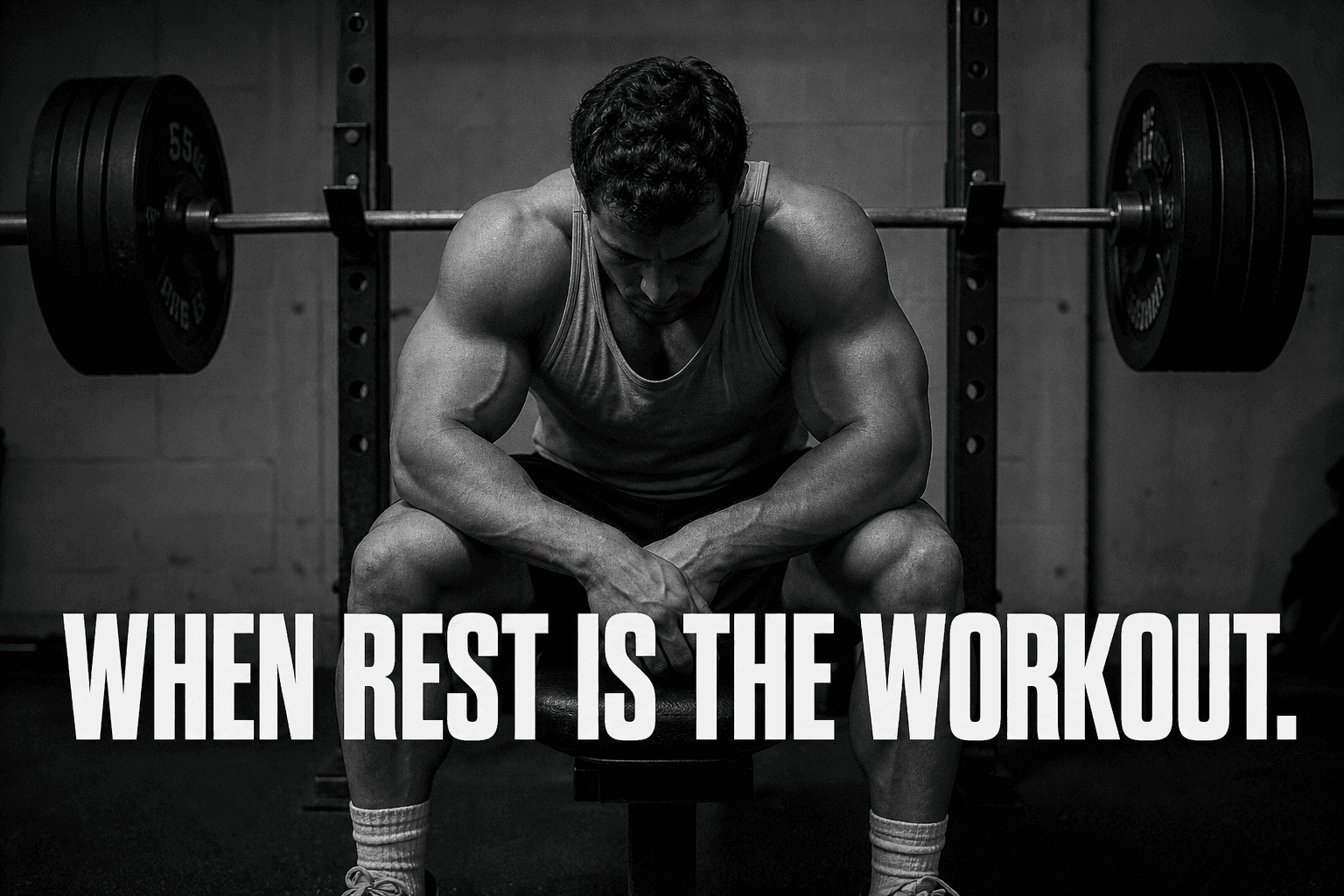
Your body isn't broken — it's overloaded
You've been training hard for weeks. Your lifts are going backwards. You wake up tired even after 9 hours of sleep. Your mood is terrible and you're not sure why.
That pattern has a name: overtraining syndrome, or OTS. And the frustrating truth is that it's one of the hardest conditions in sport science to confirm — a scoping review of 5,561 studies found that not a single biomarker has been validated as a reliable diagnostic test for OTS (Carrard et al., 2022).
That doesn't mean it isn't real. It means you need to read the symptoms carefully — because most of them mimic other problems.
Not one biomarker has been validated as a reliable OTS test — across 39 eligible studies.
— Carrard et al. (2022). Diagnosing Overtraining Syndrome: A Scoping Review. Sports Health.
What overtraining syndrome actually is (and what it isn't)
OTS exists on a spectrum. Here's how to think about the three stages:
Functional overreaching — a short block of extra-hard training that makes you temporarily worse. Give it a few days of rest and you bounce back stronger. This is planned and normal.
Non-functional overreaching — the accumulated training load tips over into weeks of declining performance. Recovery takes weeks, not days. This is the warning sign.
Overtraining syndrome — performance has been suppressed for more than 4 weeks, mood has changed, and no short rest fixes it. This is where the clinical label applies (Weakley et al., 2022).
The problem: these stages blur together. Researchers found that vague terminology and a lack of prospective monitoring make it nearly impossible to study OTS cleanly in real time (Weakley et al., 2022). Most people only realise they've crossed the line in hindsight.
The symptoms to watch — and why they're easy to misread
OTS produces symptoms in two overlapping categories: physical and psychological. Both matter. Neither alone is enough to confirm the diagnosis.
Physical red flags:
- Performance dropping across multiple sessions — not just a bad day, but a trend over weeks
- Persistent muscle heaviness or fatigue that sleep doesn't fix
- Elevated resting heart rate in the morning (a rough but practical proxy)
- Increased frequency of minor illness — the immune system takes a hit when chronic inflammation goes unchecked
Psychological red flags:
- Mood swings, irritability, or low motivation that weren't there before
- Sleep disturbances despite physical exhaustion
- Loss of enjoyment in training — the thing that used to energise you now feels like a chore
Why are these easy to misread? Because they're identical to the symptoms of simply not eating enough. A 2021 Sports Medicine review found that 86% of training-overload studies showed signs of low energy availability — meaning many supposed OTS cases were actually athletes underfuelling rather than overtraining (Stellingwerff et al., 2021).
Before you call it overtraining, check your food intake.
86% of training-overload studies showed signs of low energy availability — meaning the culprit may be underfuelling, not the training itself.
— Stellingwerff et al. (2021). Overtraining Syndrome and Relative Energy Deficiency in Sport. Sports Med.
The inflammation link: what's actually happening inside
When training volume stays high and recovery stays low, your body enters a state of chronic, low-grade inflammation — think of it as your immune system permanently stuck in cleanup mode after a workout it never fully resolved.
The main drivers are pro-inflammatory proteins called cytokines — specifically IL-6, TNF-alpha, and IL-1beta. When these stay elevated for weeks, they interact with your central nervous system, your hormones, and your gut, producing the mood changes, fatigue, and performance drops associated with OTS.
This matters practically: it means OTS isn't just a muscle problem. It's a whole-body stress response. You can't train through it. And you can't supplement your way out of it. The only lever that works is reducing training load and recovering properly.
Nutrition is the hidden variable most people ignore
Here's the piece that surprises most athletes: you can eat yourself into OTS-like symptoms without ever touching your training volume.
When energy intake drops — whether from intentional dieting or just not eating enough to match your output — the hypothalamic-pituitary axis (the hormonal control centre in your brain) responds as if it's under threat. Hormones that regulate stress, reproduction, and mood all shift. The result looks and feels exactly like OTS (Stellingwerff et al., 2021).
A 2023 narrative review on nutrition and OTS found that carbohydrate availability in particular is a critical lever — low carb intake during high-volume training phases is one of the fastest routes to non-functional overreaching (la Torre et al., 2023).
If your training hasn't changed but your symptoms have, look at the plate first. You may not be training too much — you may just not be eating enough to support the training you're already doing. Use the protein calculator to check whether your intake is actually matching your output.
Why there's no blood test that confirms it
This is the part that frustrates athletes and coaches alike: after decades of research, there is still no single test — blood, hormonal, or otherwise — that can confirm OTS.
Carrard et al. (2022) searched over 5,500 studies and found only 39 that even came close to meeting the diagnostic criteria. Three scoring systems — the EROS-CLINICAL, EROS-SIMPLIFIED, and EROS-COMPLETE scores — were identified as the most structured diagnostic tools available, but none have been validated widely enough to become a clinical standard.
The reason is structural: OTS develops over months, but most studies only measure athletes at one point in time. You can't diagnose a downward trend if you only have one data point. Armstrong et al. (2021) argue that OTS needs to be understood as a complex systems problem — many interacting factors, not a single cause — and that machine learning tools analysing multiple data streams simultaneously may be the only way to reliably detect it in the future.
For now, the most honest answer is: OTS is a diagnosis of exclusion. You rule out illness, injury, poor sleep, underfuelling, and life stress — and if the performance drop persists beyond 4 weeks despite addressing those, OTS becomes the working explanation.
OTS is a diagnosis of exclusion — rule everything else out first.
— Carrard et al. (2022). Diagnosing Overtraining Syndrome: A Scoping Review. Sports Health.
What to actually do when you suspect overtraining
The good news: the intervention is straightforward, even if the diagnosis isn't.
Step 1 — Reduce training load immediately. Drop volume by 40–60% for at least 1–2 weeks. Don't try to maintain intensity while dropping volume. Both need to come down. Cut the heaviest systemic lifts first — the barbell squat and deadlift cost far more recovery per set than isolation work, so trimming their sets buys back the most recovery.
Step 2 — Audit your food intake. Are you eating enough total calories? Are carbohydrates high enough to support your training? Low energy availability is the most common OTS mimic — fix this before anything else (Stellingwerff et al., 2021).
Step 3 — Prioritise sleep. Sleep is when the hypothalamic-pituitary axis resets. If your sleep is broken, everything else heals slower.
Step 4 — Track mood and performance, not just weights. A simple morning mood rating (1–10) alongside your training log gives you the trend data that research says is the most useful early-warning signal (Weakley et al., 2022).
Step 5 — If symptoms persist beyond 4 weeks despite all of the above, see a sports medicine physician. OTS at the clinical level needs professional management, not more self-experimentation.
For what it's worth: most recreational lifters who think they're overtrained are actually under-recovered — poor sleep, low calories, and back-to-back training days without a genuine rest day. Fix those first. If you want to read more about the recovery side of the equation, doms recovery covers what actually works for soreness and recovery after hard sessions.
How Planfit applies this
Planfit tracks your load and volume across every session and charts your progression per exercise — so a stall or reversal shows up in your own history instead of going unnoticed. It also recommends rest between sets based on your training intensity, and monitors recovery status and volume per muscle group so you can see when one body part is being hit disproportionately hard week after week. If the data says you are trending down, you will see it — before your body forces the conversation.
References
- Weakley J et al. (2022). Overtraining Syndrome Symptoms and Diagnosis in Athletes: Where Is the Research? A Systematic Review.. International Journal of Sports Physiology and Performance. 10.1123/ijspp.2021-0448
- Stellingwerff T et al. (2021). Overtraining Syndrome (OTS) and Relative Energy Deficiency in Sport (RED-S): Shared Pathways, Symptoms and Complexities.. Sports Medicine. 10.1007/s40279-021-01491-0
- Carrard J et al. (2022). Diagnosing Overtraining Syndrome: A Scoping Review.. Sports Health. 10.1177/19417381211044739
- Armstrong LE et al. (2021). Overtraining Syndrome as a Complex Systems Phenomenon.. Frontiers in Network Physiology. 10.3389/fnetp.2021.794392
- la Torre ME et al. (2023). The Potential Role of Nutrition in Overtraining Syndrome: A Narrative Review.. Nutrients. 10.3390/nu15234916