Seated Leg Press vs Leg Press: Which One Should You Use?
By Planfit Editorial Team · 6 min read
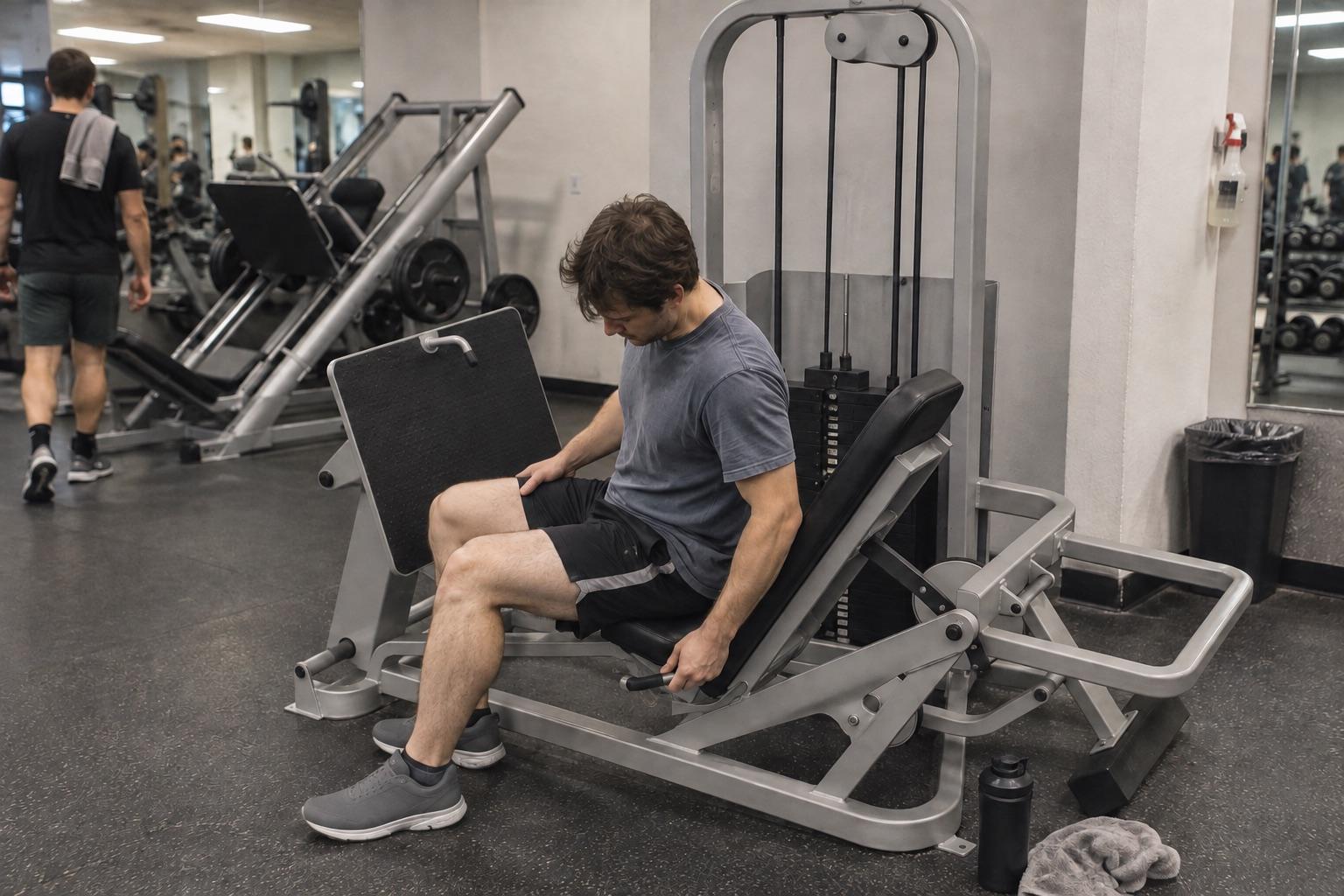
What's the difference between a seated leg press and a leg press?
When people say "leg press," they usually mean the 45-degree leg press: you sit leaning back, and a sled loaded with weight plates slides up and down a slanted track. The seated leg press is the machine where you sit more upright and push straight ahead, and you pick the weight by moving a pin in a weight stack. "Horizontal leg press" is another name for the seated one.
A third machine, the vertical leg press, has you lie on your back and push the weight straight up toward the ceiling. "Lying leg press" isn't one specific machine: gyms use the name for the vertical press, or for a horizontal machine where you lie almost flat. If you push up toward the ceiling, treat it like the vertical press. If you push straight ahead, treat it like the seated one.
All of them train the same muscles with the same movement: you bend your knees and hips, then push the platform away. What changes is where each rep starts, how you add weight, and how deep you can go.
Why can you lift so much more on the 45-degree leg press?
If you can press twice your body weight on the 45-degree machine but barely your own weight on the seated one, you're not doing anything wrong. The same number puts a different load on your legs on each machine.
- On a 45-degree machine, you don't push all of the plates. The track carries part of the load and your legs push about 70% of the plates you put on, before friction. Load 200 lb of plates and your legs push roughly 140 lb of it.
- The sled weighs something too. The empty sled adds weight before you load a single plate, and it differs by machine. The makers list a starting weight of 84 lb for the Technogym Pure Strength Leg Press, 101 lb for the Technogym Pure Strength Linear Leg Press, and 118 lb for the Hammer Strength Plate-Loaded Linear Leg Press. That is why the same plates can feel heavier on one 45-degree machine than another.
- The seated machine starts with your knees bent the most. You push from the hardest spot right away. On the 45-degree machine you start with straight legs and lower the weight first.
So only compare weights on the same machine.
Do they work different muscles?
Not much. All three machines work the same muscles: mainly the front of your thighs (quadriceps) and your glutes, with the back of your thighs (hamstrings) helping.
Which muscles you feel depends more on where you put your feet than on which machine you use. When researchers changed only where the feet sat on a horizontal leg press, using heavy weights, feet low on the platform worked the front of the thighs more, and feet high worked the glutes more (Da Silva et al., 2008).
- To feel it more in the front of your thighs: put your feet in the lower part of the platform, shoulder-width apart. Keep your whole foot, heels included, flat on the platform.
- To feel it more in your glutes and hamstrings: put your feet in the upper part of the platform. Your knees will bend less and your hips will bend more.
- For your calves: you can also do Calf Raise on Seated Leg Press Machine on the seated machine, pushing with only the balls of your feet.
Which leg press should beginners use?
Beginners can start on either the seated leg press or the 45-degree leg press.
Start on the seated machine instead if:
- You can't do 12 reps with the empty sled. Put the pin in the top slot and you start at the machine's lightest weight.
- The safety handles still feel unfamiliar. The seated machine has no handles to lock and unlock.
Two things to watch on any leg press:
- Stop going down when your tailbone starts to lift off the seat. That point is your depth for now. Going lower than that rounds your lower back.
- Don't straighten your knees all the way when you push. Stop with them slightly bent.
If you started on the seated machine, move to the 45-degree machine when you can do 12 reps there with the empty sled, or when the seated machine feels cramped because you're tall. On the 45-degree machine, the sled is locked by two safety handles at your sides: push the sled up a little and turn them outward to unlock it. After your last rep, push all the way up and turn them back in before you take your feet off.
Try the vertical leg press once your hips stay on the pad all the way down on the 45-degree machine. On the vertical machine, your hips tend to roll up off the pad as you lower the platform, which rounds your lower back.
How to pick the weight when you switch machines
You can't bring your weight over from another machine, so find your weight again on every new machine.
- Do 10 reps with a light weight.
- Each set, go one pin heavier (or add one pair of plates on a 45-degree machine). The weight where the last 2 or 3 of 10 reps become hard is your weight on this machine.
- Write down that weight, and also the seat position number on seated machines. A different seat position changes how heavy the same pin feels.
Log each machine as its own exercise. You are making progress if, on the same machine, you do more reps with the same weight, or the same reps with a heavier weight. If you want to know how many reps to aim for, read How Many Reps for Muscle Growth?
More to know: linear leg press, hip press and squat press
You may see other names on machines at your gym. Here's what they usually are:
- Linear leg press: a leg press whose sled slides along a straight track, usually at about 45 degrees. Some makers use the name for their 45-degree machine. Use it like the 45-degree leg press.
- Hip press: instead of sliding on a track, the platform swings on a lever arm, so it moves in an arc. Makers sell it as a glute machine. The Hammer Strength Plate-Loaded Hip Press is one of these.
- Squat press: you stand with pads on your shoulders and push your body up, closer to a squat than a leg press. It's similar to the Hack Squat Machine.
Frequently asked questions
Can you build big legs with just the leg press?
Yes. The leg press works the front of your thighs and your glutes, and they grow when you keep adding weight or reps. Your hamstrings help less, so add a hamstring exercise such as a leg curl if you want to train your whole lower body.
Can I do the leg press instead of squats?
Yes. Both build your thighs and glutes. Squats also make you balance the weight with your back and core, and the leg press doesn't. If you want to know how to choose, read Squat vs. Leg Press.
Is a lying leg curl the same as a lying leg press?
No. In a lying leg curl you lie face down and bend your knees to pull a pad toward your glutes. It trains the back of your thighs. In a leg press, you push a platform away with your feet.
Should I do more than one leg press machine in the same workout?
You don't need to. They work the same muscles, so doing 3 to 4 sets on one machine is enough. If yours is taken, you can use another leg press. Log it as a separate exercise.
Get a leg day that fits you
Not sure which leg exercises to do, or how many sets? Answer a few questions and Planfit recommends a workout routine that fits you.
References
- Da Silva EM, Brentano MA, Cadore EL, et al. (2008). Analysis of muscle activation during different leg press exercises at submaximum effort levels.. J Strength Cond Res. 10.1519/JSC.0b013e3181739445