Sleep and muscle recovery: 30% less protein synthesis
4 studies · 2 RCTs + 2 priority reviews
7 min read
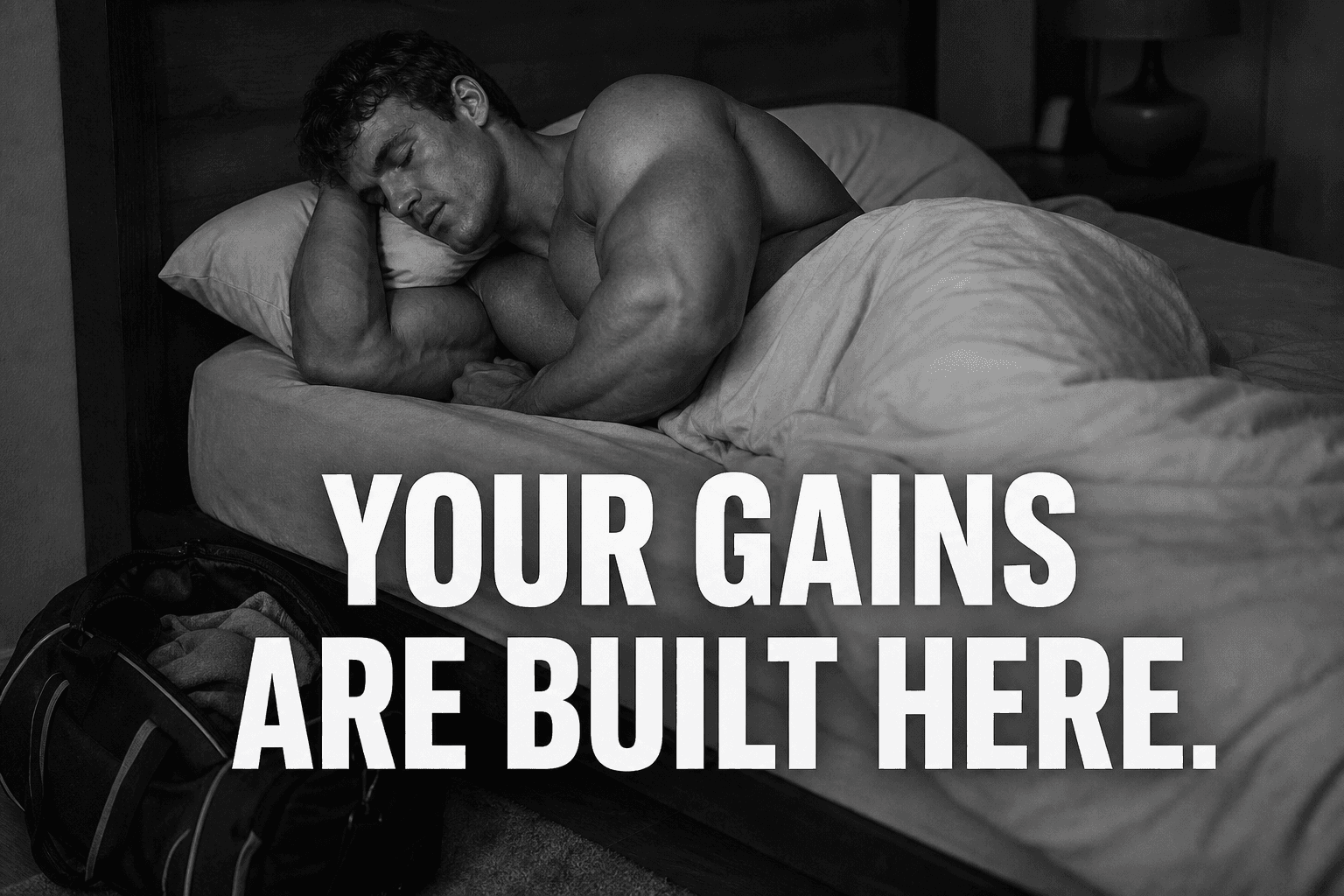
Sleep is when muscle actually grows
You don't grow in the gym. You grow in bed.
The gym is where you create the signal — the mechanical damage that tells your body to rebuild bigger. But the rebuilding itself? That's a sleep job. And when you cut sleep short, you don't just feel groggy. You actively slow down muscle protein synthesis — the process where your body stitches new muscle tissue together.
Sleep deprivation after hard exercise triggers a spike in IL-6, an inflammatory cytokine — a small protein your immune system uses to signal tissue stress. In athletes who went 48 hours without sleep after a muscle-damaging session, IL-6 climbed significantly higher than in those who slept normally (Dáttilo et al., 2020). That matters because elevated IL-6 keeps your body in a breakdown state rather than a repair state.
This isn't about feeling sore. It's about whether your body can actually rebuild what you tore down.
Sleep deprivation after exercise spikes IL-6 — keeping the body in breakdown mode instead of repair mode.
— Dáttilo et al. (2020). Effects of Sleep Deprivation on Acute Skeletal Muscle Recovery after Exercise. Med Sci Sports Exerc.
Growth hormone: the reason 7–9 hours is non-negotiable
Most of your daily growth hormone — the hormone that drives muscle repair and fat metabolism — is released during deep sleep, specifically during the first few hours after you fall asleep.
Cut sleep short and you cut that hormone pulse short. A narrative review covering both athletic and military populations found that sleep extension increased GH and IGF-1 anabolic responses — IGF-1 is another repair hormone — and improved pain sensitivity after muscle injury (Chennaoui et al., 2021). 'Anabolic' here just means 'muscle-building': IGF-1 tells your muscle cells to absorb amino acids and rebuild.
This is also why napping matters less than you might hope. The deep sleep stage (slow-wave sleep) is concentrated in the first half of the night. A 20-minute afternoon nap doesn't replicate it. Full nights, consistently, are what move the needle.
How much sleep deprivation actually costs you
You might think one or two bad nights won't matter. They do — especially right after a hard training session.
In Dáttilo et al.'s RCT — where people were randomly assigned to 48 hours of no sleep vs. normal recovery sleep — muscle voluntary contraction (how much force you can produce) was significantly impaired in the sleep-deprived group compared to controls (Dáttilo et al., 2020). Creatine kinase — a blood marker for muscle damage — also stayed elevated longer.
A broader picture comes from Chennaoui et al.'s review, which pooled evidence across sport and military settings: when sleep duration drops and training load rises at the same time, muscle injury risk climbs (Chennaoui et al., 2021). The combination is the danger zone. One without the other is manageable. Together, they compound.
The takeaway: missing sleep the night after a hard leg day isn't neutral. It extends how long your muscles stay damaged and delays the window when growth is possible.
Pre-sleep protein: the easiest recovery upgrade you're probably skipping
Here's the thing about overnight recovery: your muscles are hungry during it — but most people stop eating 3–4 hours before bed.
A 2023 RCT found that eating 45g of protein right before sleep increased both myofibrillar and mitochondrial protein synthesis rates overnight, compared to a placebo (Trommelen et al., 2023). Myofibrillar proteins are the structural proteins that make up the contractile machinery of your muscle — the parts that actually generate force. Mitochondrial proteins power your muscle cells' energy systems. Both went up.
- Mitochondrial synthesis rate: 0.087 %/h (protein) vs. 0.067 %/h (placebo) — a 30% relative increase
- Myofibrillar synthesis rate: 0.060 %/h (protein) vs. 0.047 %/h (placebo) — a 28% relative increase
This wasn't a one-off. A 2016 review by the same group confirmed that pre-sleep protein needs to be at least 40g to produce a robust increase in muscle protein synthesis overnight, and that prior exercise makes the effect stronger — the body directs more of those amino acids into new muscle rather than other tissues (Trommelen et al., 2016).
Casein vs. whey before bed: does the type of protein matter?
Casein has long been the go-to pre-sleep protein because it digests slowly — releasing amino acids over several hours, which matches the overnight repair window. Whey digests faster.
But the 2023 Trommelen RCT directly compared them — and found no significant difference between casein and whey on overnight muscle protein synthesis rates (Trommelen et al., 2023). Both outperformed placebo equally.
So if you have casein on hand, use it. But if you only have whey — or a Greek yoghurt, a glass of milk, a protein shake — the type matters far less than whether you actually eat it. Getting 40–45g of protein in before bed is the lever. The source is a secondary detail.
Casein or whey — both beat placebo equally overnight. The dose is what counts.
— Trommelen et al. (2023). Pre-sleep Protein Ingestion Increases Mitochondrial Protein Synthesis Rates. Sports Med.
Magnesium for muscle recovery and sleep: what the evidence actually supports
You've probably seen magnesium marketed as the ultimate sleep-and-recovery supplement. The reality is more nuanced.
Magnesium is involved in over 300 enzymatic processes in the body, including muscle contraction and relaxation and sleep regulation. If you're deficient, supplementing will likely improve sleep quality and reduce muscle cramps. But if your levels are already normal, the effect is much smaller — our article on magnesium for muscle cramps covers the cramp side in detail.
From a recovery angle, the mechanism is indirect: better sleep quality → more deep slow-wave sleep → more GH secretion → faster muscle repair. Chennaoui et al.'s review specifically highlights the GH/IGF-1 pathway as central to sleep's repair effect (Chennaoui et al., 2021). Magnesium that genuinely improves sleep does, in that sense, support recovery.
Practical bottom line: if you're sleeping poorly or regularly feel muscle cramps, magnesium glycinate or magnesium threonate (forms that absorb well) at 200–400mg before bed is a low-risk addition. Don't expect miracles if your sleep is already solid.
How long does muscle recovery actually take — and what delays it?
For most training sessions, the acute soreness and performance dip resolve within 24–48 hours. But harder efforts take longer.
A 2025 systematic review of professional soccer players — competing every 72 hours — found that even after 72 hours, vertical jump ability and hamstring strength were still significantly impaired, even though sprint speed and change-of-direction had fully recovered (Drayton et al., 2025). If elite athletes with full recovery support are still compromised at 72 hours after a match, a hard leg day in the gym deserves more than one night's sleep before you hammer those muscles again.
The variables that lengthen recovery are exactly what you'd expect: poor sleep, low protein intake, high training volume, and inadequate time between sessions. Fix the sleep and the nutrition and the other factors get easier to manage. You can also see the soreness side of this in our piece on doms recovery.
A rough guide:
- Light session (machines, moderate volume): 24h recovery
- Hard compound session (heavy barbell squat, deadlift): 48–72h
- Maximal effort or competition: 72h+
Three things to do tonight
The research points to three concrete actions — none of them require a supplement stack or a fancy protocol.
1. Protect the night after a hard session. If you trained legs or did heavy compound work this evening, that night's sleep is your highest-leverage recovery tool. Aim for 7–9 hours. Don't sacrifice it for screen time.
2. Eat 40–45g of protein within 30 minutes of sleep. Any complete protein source works — casein, whey, Greek yoghurt, cottage cheese, a protein shake with milk. The 30-minute pre-sleep timing is when the 2023 Trommelen RCT administered it (Trommelen et al., 2023). Don't overthink the source — just hit the dose. Use the protein calculator if you're unsure how much protein you're getting across the day.
3. Don't combine high training load with short sleep. That's the combination Chennaoui et al. flag as the real injury multiplier (Chennaoui et al., 2021). If life is forcing a sleep-deprived week, reduce training volume proportionally — not intensity, just total sets. One or two fewer sets per session costs you almost nothing in adaptation but keeps the injury risk in check.
How Planfit applies this
Planfit tracks your volume and progressive overload across every session — so if you're logging consistently, you'll see when you're stacking hard sessions back-to-back without enough recovery days in between. The app's muscle-recovery status feature flags which muscle groups are still under load from previous sessions, so you're not guessing whether your legs are ready for another squat day.
If you want to keep the gains coming without burning yourself out, let the tracking do the work.
How Planfit applies this
Planfit tracks your training volume, progressive overload, and muscle-recovery status across sessions. It flags which muscle groups are still recovering — so you're not piling load onto muscles that haven't finished rebuilding from the last session. Pair that with the pre-sleep protein habit and a consistent 7–9 hours, and the app keeps the training stimulus honest.
References
- Dáttilo M et al. (2020). Effects of Sleep Deprivation on Acute Skeletal Muscle Recovery after Exercise.. Med Sci Sports Exerc. 10.1249/MSS.0000000000002137
- Chennaoui M et al. (2021). How does sleep help recovery from exercise-induced muscle injuries?. J Sci Med Sport. 10.1016/j.jsams.2021.05.007
- Trommelen J et al. (2023). Pre-sleep Protein Ingestion Increases Mitochondrial Protein Synthesis Rates During Overnight Recovery from Endurance Exercise: A Randomized Controlled Trial.. Sports Med. 10.1007/s40279-023-01822-3
- Trommelen J et al. (2016). Pre-Sleep Protein Ingestion to Improve the Skeletal Muscle Adaptive Response to Exercise Training.. Nutrients. 10.3390/nu8120763
- Drayton AM et al. (2025). The Time Course of Postmatch Physical Impairments in Professional Soccer: A Systematic Review.. J Strength Cond Res. 10.1519/JSC.0000000000005252