Unilateral training builds equal muscle: 2025 meta-analysis
5 studies · 2025 Sports Med meta-analysis
6 min read
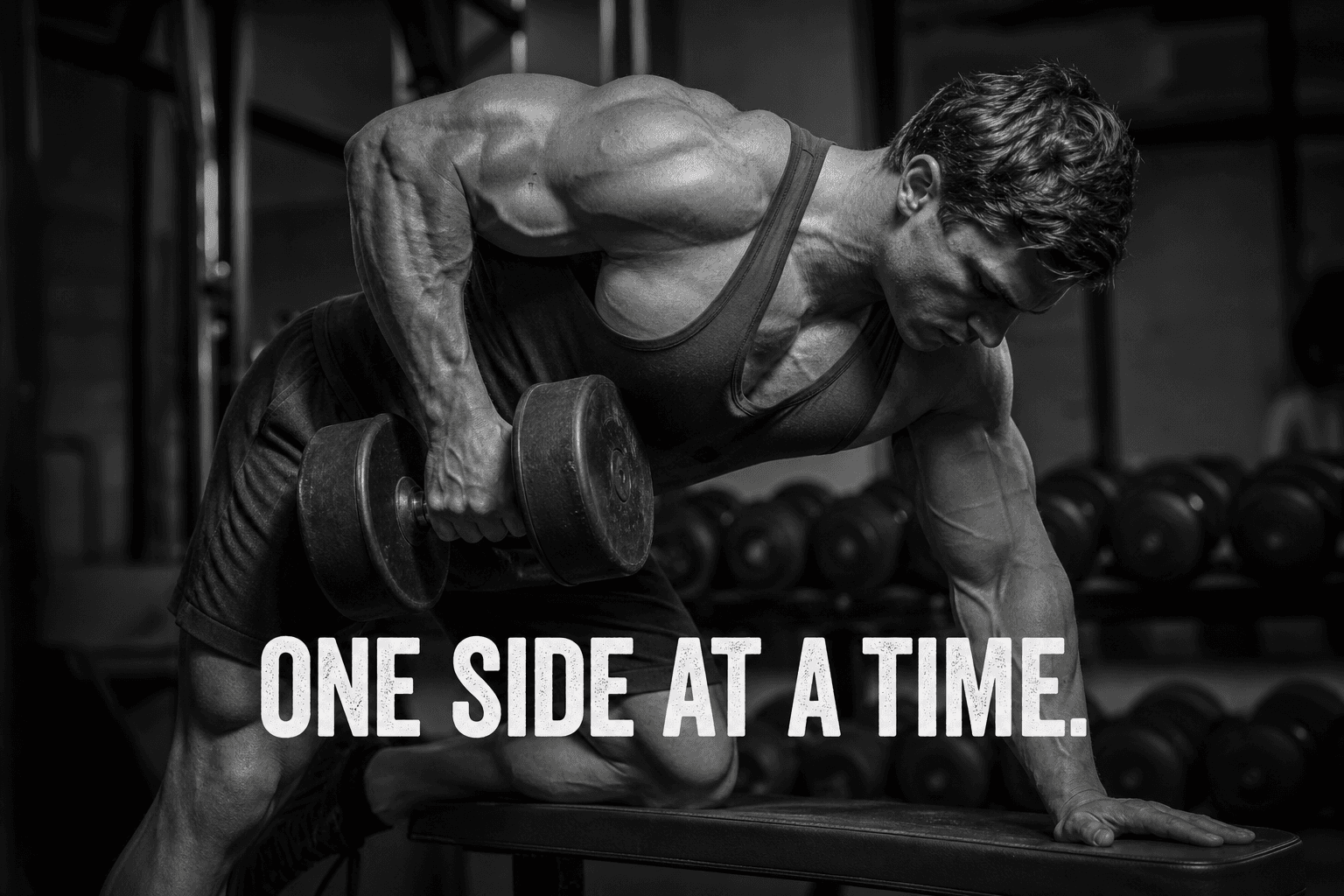
Unilateral vs bilateral: the muscle growth is identical
Here's the bottom line up front: training one limb at a time builds exactly the same amount of muscle as training both limbs together.
A 2025 systematic review and meta-analysis in Sports Medicine pooled 9 studies and found zero significant difference in muscle hypertrophy between unilateral and bilateral resistance training (effect size: −0.21, 95% CI: −3.56 to 3.13, P = 0.57). That's a near-zero effect with a confidence interval wide enough to say: the data simply can't tell them apart (Kassiano et al., 2025).
So if someone is selling you a program on the basis that lunges are "superior" to squats for quad growth, or that single-arm presses are "more effective" than barbell presses — that claim isn't backed by the current evidence. The stimulus is the stimulus. See how many sets per muscle group per week for more on what the actual driver of hypertrophy is.
Unilateral vs bilateral training: no significant difference in muscle hypertrophy across 9 studies.
— Kassiano et al. (2025). Comparison of Muscle Growth and Dynamic Strength Adaptations Induced by Unilateral and Bilateral Resistance Training. Sports Med.
Strength is where the two diverge — and it matters
Muscle size: tied. Strength: not tied.
The same 2025 meta-analysis found that bilateral training produced superior bilateral strength gains (effect size: 0.56, P = 0.01), while unilateral training produced superior unilateral strength gains (effect size: −0.65, P = 0.001) (Kassiano et al., 2025).
What that means in practice: if your goal is a bigger squat 1RM — a movement that uses both legs at once — squatting will get you there faster than lunging. But if you need single-leg strength (for sport, rehab, or carrying an asymmetry), unilateral work is the more direct route.
This is the specificity principle at work. The body adapts to the exact task you give it. Train the movement pattern you want to get stronger at.
Cross-education: training one arm makes the other arm stronger
This is the part most lifters have never heard of — and it's genuinely surprising.
Cross-education is the phenomenon where training one limb increases strength in the opposite, untrained limb. You train the right arm only; the left arm gets stronger too, even though it never touched a weight. That's not a metaphor. It's a measurable effect driven by the nervous system.
A meta-analysis of 31 RCTs (785 subjects) found an average 11.9% strength increase in the untrained contralateral limb — that's the opposite side — following unilateral training (95% CI: 9.1–14.8%, P < 0.00001) (Manca et al., 2017).
The lower body shows an even larger effect: +16.4% contralateral strength gain in the legs versus +9.4% in the arms (Manca et al., 2017). The mechanism appears to be neural — changes in how the brain and spinal cord recruit motor units — rather than the muscle itself getting bigger on the untrained side.
Training one limb strengthens the other by an average of 11.9% — even with zero direct training.
— Manca et al. (2017). Cross-education of muscular strength following unilateral resistance training: a meta-analysis. Eur J Appl Physiol.
What cross-education actually means for you
Most lifters file cross-education under "interesting but irrelevant." That's a mistake.
Scenario 1: You have an injured limb. If you can't train your right leg because of a knee injury, training your left leg unilaterally will slow down strength loss in the injured right leg. That's not theoretical — it's been measured. Andrushko et al. (2018) reviewed the available evidence on immobilization studies and found that cross-education can completely prevent the ~13% strength decline and ~4% muscle-size decline expected after 3–4 weeks of arm immobilization.
The implication: if you're in a cast or recovering from surgery, training the opposite healthy limb isn't wasted time. It's protective.
Scenario 2: You have a left-right strength imbalance. Unilateral training on your weaker side has a disproportionately large effect on that limb — and cross-education provides a secondary benefit to the stronger side too. It's a net-positive for closing the gap.
For exercise prescription, Voskuil et al. (2023) reviewed the design strategies that maximize cross-education and found that eccentric contractions — where you lower the weight slowly under control, the muscle lengthening phase — produce the largest transfer to the untrained limb.
Cross-education extends to muscular endurance, not just strength
We knew about strength transfer. What about endurance — how long a muscle can sustain effort before failing?
A 2024 scoping review in Sports Medicine examined 21 studies on unilateral training and muscular endurance transfer to the untrained limb (Song et al., 2024). The overall picture: cross-education of endurance does appear to occur, though the evidence is less consistent than for strength, partly because studies use different ways to measure endurance (time to failure, total work done, repetition tests).
The practical takeaway: if you're training one side due to injury or rehab, you're not just maintaining strength in the idle limb. There's a reasonable chance you're partially maintaining its staying power too.
Cross-education of endurance is real — but the evidence is earlier-stage than for strength.
— Song et al. (2024). Cross-Education of Muscular Endurance: A Scoping Review. Sports Med.
When to use unilateral training — and when to stick with bilateral
Given all of this, here's the practical framework:
Use unilateral when:
- You need to close a clear size or strength imbalance between sides.
- You're rehabbing an injury and want to slow muscle loss in the affected limb.
- Your sport demands single-leg or single-arm output (running, throwing, martial arts).
- You want variety without sacrificing hypertrophy — the muscle growth is the same.
Stick with bilateral (or prioritize it) when:
- Your main goal is a bigger bilateral 1RM — squat, deadlift, bench press.
- You're chasing maximum load in a session (bilateral movements let you lift more total weight per set).
- You're limited on time and need the most efficient path to volume.
The honest answer: most programs benefit from both. Use bilateral movements as your primary strength work, and unilateral movements — the dumbbell lunge, the split squat, single-arm rows — as accessories. You get the bilateral strength specificity from the main lifts and the imbalance correction from the accessories.
If split squat form is something you're working on, bulgarian split squat form covers the five most common technique errors in detail.
How Planfit applies this
Planfit programs both unilateral and bilateral movements based on your training level and goal. When a session calls for accessory work, it slots in single-leg or single-arm exercises — lunges, split squats, single-arm rows — alongside your primary bilateral lifts.
For each exercise, Planfit recommends a target weight and rep range, logs your sets in real time, and tracks progression across sessions. If one side is consistently lagging, the per-exercise history makes that asymmetry visible. And as your loads stop being challenging, Planfit nudges the weight up — keeping the stimulus progressing on both sides.
How Planfit applies this
Planfit programs both unilateral and bilateral movements based on your training level, equipment, and goal. When a session calls for accessory work, it slots in single-leg or single-arm exercises — lunges, split squats, single-arm rows — alongside your primary bilateral lifts.
For each exercise, Planfit recommends a target weight and rep range, logs your sets as you go, and tracks progression across sessions. As the load stops being challenging, the recommendation moves up, so the stimulus keeps progressing.
References
- Kassiano W et al. (2025). Comparison of Muscle Growth and Dynamic Strength Adaptations Induced by Unilateral and Bilateral Resistance Training: A Systematic Review and Meta-analysis.. Sports Med. 10.1007/s40279-024-02169-z
- Manca A et al. (2017). Cross-education of muscular strength following unilateral resistance training: a meta-analysis.. Eur J Appl Physiol. 10.1007/s00421-017-3720-z
- Andrushko JW et al. (2018). Contralateral effects of unilateral training: sparing of muscle strength and size after immobilization.. Appl Physiol Nutr Metab. 10.1139/apnm-2018-0073
- Voskuil CC et al. (2023). Exercise prescription and strategies to promote the cross-education of strength: a scoping review.. Appl Physiol Nutr Metab. 10.1139/apnm-2023-0041
- Song JS et al. (2024). Cross-Education of Muscular Endurance: A Scoping Review.. Sports Med. 10.1007/s40279-024-02042-z