Tempo training: what 6 reviews say about lifting slower
6 studies · Sports Med 2021 review
7 min read
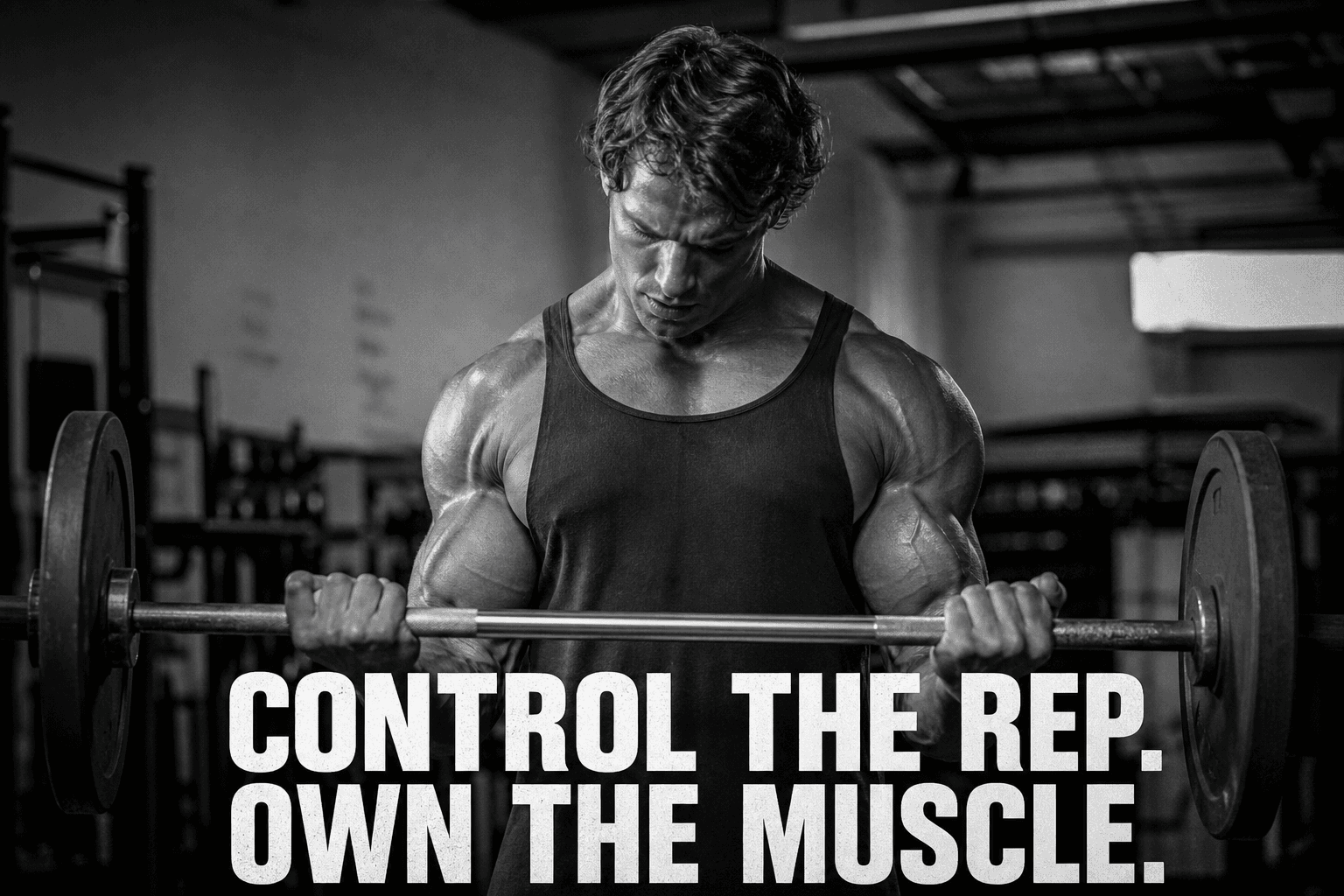
What tempo training actually is (in plain terms)
Tempo training means lifting and lowering with a deliberate, pre-set count — instead of just moving the weight as fast as feels natural.
You've probably seen a number like 3-1-2-0 written on a programme. Each digit is a phase of the rep:
- First number — how many seconds to lower the weight (the eccentric phase — muscles lengthening under load)
- Second number — how long to pause at the bottom
- Third number — how many seconds to lift the weight (the concentric phase — muscles shortening)
- Fourth number — pause at the top before the next rep
So 3-1-2-0 on a bench press means: 3 seconds down, 1-second pause on your chest, 2 seconds pressing up, no pause at the top.
The eccentric phase — the lowering — is the part tempo training affects most. And that distinction matters a lot for how you programme it (Wilk et al., 2021).
Tempo training isn't about going slow for the sake of slow — it's about controlling the phase that produces the most stress on the muscle.
— Wilk et al. (2021). The Influence of Movement Tempo During Resistance Training on Muscular Strength and Hypertrophy Responses. Sports Med.
What a slower eccentric phase does to muscle growth
The eccentric phase — lowering the weight — is where the muscle is working hardest while getting longer. That combination produces more mechanical tension — the pulling force on muscle fibres that tells the body to grow.
Here's what the research says about manipulating that phase:
A 2025 meta-analysis of 9 studies (166 participants) compared shorter eccentric durations against longer ones. Muscle hypertrophy results were nearly identical — Hedge's g = 0.05, which is statistically indistinguishable from zero (Amdi et al., 2025).
What that tells you: going slower on the way down doesn't automatically produce more muscle than a controlled but faster tempo. The body doesn't seem to care whether you take 2 seconds or 4 seconds — as long as you're not dropping the weight with zero control.
The 2021 Sports Medicine review agrees: the research on tempo and hypertrophy doesn't point to one superior speed. What matters more is total volume and the quality of tension — not the stopwatch (Wilk et al., 2021).
The honest takeaway: a 2–8 second total rep duration is the practical window for hypertrophy. Anything inside that range appears equivalent (Androulakis et al., 2023).
Where tempo training does make a clear difference: strength and jump performance
Here's where the numbers get interesting — and where your goal should change how you train.
Faster eccentrics win for explosive performance. The same 2025 meta-analysis found that shorter eccentric durations improved countermovement jump height by a practically meaningful margin (Hedge's g = −0.73, 90% CI = −1.34 to −0.12) (Amdi et al., 2025). That's a real, sport-relevant result.
If you play a sport that requires jumping, sprinting, or quick changes of direction, slowing your eccentric down is the wrong call. Faster, more explosive lowering keeps the nervous system primed for power output.
Longer eccentrics slightly edge out shorter ones for maximal strength — especially in trained lifters. The same meta-analysis found a small positive signal (g = 0.33, 90% CI = 0.07 to 0.60) in trained participants when eccentric phase was extended (Amdi et al., 2025).
The mechanism makes sense: slower lowering keeps more time under load, which may reinforce motor patterns and build more positional strength through the range of motion — the full arc of movement a joint travels through.
Summary by goal:
- Building max strength → lean toward longer eccentrics (3–4 seconds down)
- Building explosive power → shorter eccentrics, more intent (1–2 seconds down)
- Building muscle size → either works; just stay in the 2–8 second total rep window
Faster eccentrics improved jump height by g = 0.73. Slower eccentrics gave trained lifters a small strength edge. Your goal decides which you use.
— Amdi et al. (2025). The effect of eccentric phase duration on maximal strength, muscle hypertrophy and countermovement jump height. J Sports Sci.
The trade-off: slow tempo means less load, fewer reps
There's a real cost to slowing down — and most people don't account for it.
Slower tempos lower how much weight you can lift. A lot. Research shows that when you add time to the eccentric phase, the load you can handle with a given rep count drops significantly (Wilk et al., 2020).
That matters for programming. If your 1RM — the most you can lift once — was tested at a natural tempo, it's no longer accurate once you switch to a controlled 3-second descent. Your true working max at that tempo is lower, and your rep counts will drop too.
Practically, this means:
- Don't just bolt a slow tempo onto your existing sets and expect the same output
- Test your working weight with the exact tempo you're training at
This is also why slower-tempo training can be useful for beginners or during injury rehab — it forces the lifter to use a load they can actually control, which builds technique before adding weight back.
For a deeper look at how load and volume interact, how many sets per workout covers the set-volume evidence in detail.
Slower tempo is not the same as harder. It's a different stimulus — at a lower load. Programme accordingly.
— Wilk et al. (2020). The Influence of Movement Tempo on Acute Neuromuscular, Hormonal, and Mechanical Responses. J Strength Cond Res.
Slow-tempo training and aerobic adaptations — a surprising side effect
Here's something most gym-goers don't know: high-volume, slow-tempo lifting can trigger adaptations you'd normally expect from cardio.
A 2022 review in the International Journal of Sports Medicine found that when time under tension — the total seconds your muscles are working per set — climbs high enough, it activates the same molecular pathway (PGC-1α, the master regulator of mitochondrial biogenesis — how cells build new energy-producing machinery) that aerobic exercise does (Mang et al., 2022).
Slower tempo per rep means more total seconds under tension per set. When that time under tension is consistently high across a session, the muscle starts building new mitochondria — the cell's power plants — alongside the normal strength and size adaptations.
What this means for you: slow-tempo, higher-rep sets don't just build muscle. They also improve muscular endurance and the muscle's ability to sustain effort over time. If you care about endurance in a sport, or just hate gassing out at the end of a set, slow tempo at moderate loads has a genuine secondary benefit (Mang et al., 2022).
High time under tension activates PGC-1α — the same pathway that drives mitochondrial growth from cardio — inside a weightlifting set.
— Mang et al. (2022). Aerobic Adaptations to Resistance Training: The Role of Time under Tension. Int J Sports Med.
Tempo training and neural adaptations: the brain-to-muscle signal
Beyond muscle size and strength, tempo training appears to rewire how your nervous system controls movement.
A 2024 systematic review of 12 RCTs found that tempo-controlled resistance training consistently produced greater neural adaptations — specifically increased corticospinal excitability (how efficiently the brain sends signals down the spinal cord to muscles), decreased inhibitory signalling, and better motor unit synchronisation — compared to self-paced lifting (Gordon et al., 2024).
Motor unit synchronisation means the muscle fibres that fire together start firing more in unison. That translates to smoother, more powerful contractions over time.
This is also why tempo training is increasingly used in tendon rehab — not just to load the tissue, but to retrain the nervous system's control of the muscle after injury. The brain-to-muscle connection degrades after injury, and controlled tempo training appears to restore it (Gordon et al., 2024).
For healthy lifters, the implication is that tempo training isn't just a muscle tool — it's also a quality-of-movement tool. Especially useful when learning a new lift or coming back from a setback.
12 RCTs: tempo-controlled lifting produced greater neural adaptations than self-paced lifting across every study included.
— Gordon et al. (2024). Effects of Tempo-Controlled Resistance Training on Corticospinal Tract Plasticity. Healthcare (Basel).
How to actually use tempo in your training
Here's the practical version — no jargon, just what to do.
If your goal is muscle size:
Use a 2–3 second eccentric (lowering), 1-second pause, then lift at a controlled but not super-slow pace. A 3-1-2-0 or 2-0-2-0 tempo works well. Start lighter than your usual working weight for the first week and re-test what you can control at that tempo.
If your goal is maximal strength:
Extend the eccentric slightly — 3–4 seconds down — especially if you're already trained. This builds positional strength through the full range of motion and gives trained lifters a small edge over shorter eccentrics, per the 2025 meta-analysis (Amdi et al., 2025).
If your goal is explosive power (sports performance):
Keep the eccentric short and reactive — 1–2 seconds down, then fire up as fast as possible. Slow eccentrics meaningfully reduce jump performance (Amdi et al., 2025).
If you're rehabbing or learning a new movement:
Slow down intentionally — 3–5 seconds down, pause at the bottom. The neural benefits of controlled tempo are most pronounced here, and the reduced load is actually a feature, not a bug (Gordon et al., 2024).
General rule: whatever tempo you train at, test your working weights at that tempo. Don't assume your old numbers transfer. And track your reps — they'll likely drop when you add tempo control, which is completely normal.
For context on how tempo fits into the bigger picture of progressive overload, progressive overload training has the full breakdown.
How Planfit applies this
Tempo training only works long-term if the load keeps progressing. Planfit logs every set — weight, reps, rest — and tracks your progression trend for each exercise. When you switch to a slower tempo and drop the load, log it. Planfit picks up from there, nudging the weight up session by session as your controlled-tempo strength builds. No guesswork on when to add weight — the app tracks the signal for you.
References
- Amdi C et al. (2025). The effect of eccentric phase duration on maximal strength, muscle hypertrophy and countermovement jump height: A systematic review and meta-analysis.. J Sports Sci. 10.1080/02640414.2025.2535198
- Wilk M et al. (2021). The Influence of Movement Tempo During Resistance Training on Muscular Strength and Hypertrophy Responses: A Review.. Sports Med. 10.1007/s40279-021-01465-2
- Wilk M, Tufano JJ, Zajac A. (2020). The Influence of Movement Tempo on Acute Neuromuscular, Hormonal, and Mechanical Responses to Resistance Exercise — A Mini Review.. J Strength Cond Res. 10.1519/JSC.0000000000003636
- Mang ZA et al. (2022). Aerobic Adaptations to Resistance Training: The Role of Time under Tension.. Int J Sports Med. 10.1055/a-1664-8701
- Gordon JA et al. (2024). Effects of Tempo-Controlled Resistance Training on Corticospinal Tract Plasticity in Healthy Controls: A Systematic Review.. Healthcare (Basel). 10.3390/healthcare12131325
- Androulakis et al. (2023). Optimizing Resistance Training Technique to Maximize Muscle Hypertrophy: A Narrative Review.. J Funct Morphol Kinesiol. 10.3390/jfmk9010009