Going to the gym for the first time: 6 mistakes to avoid
Planfit coaching · exercise-science consensus
6 min read
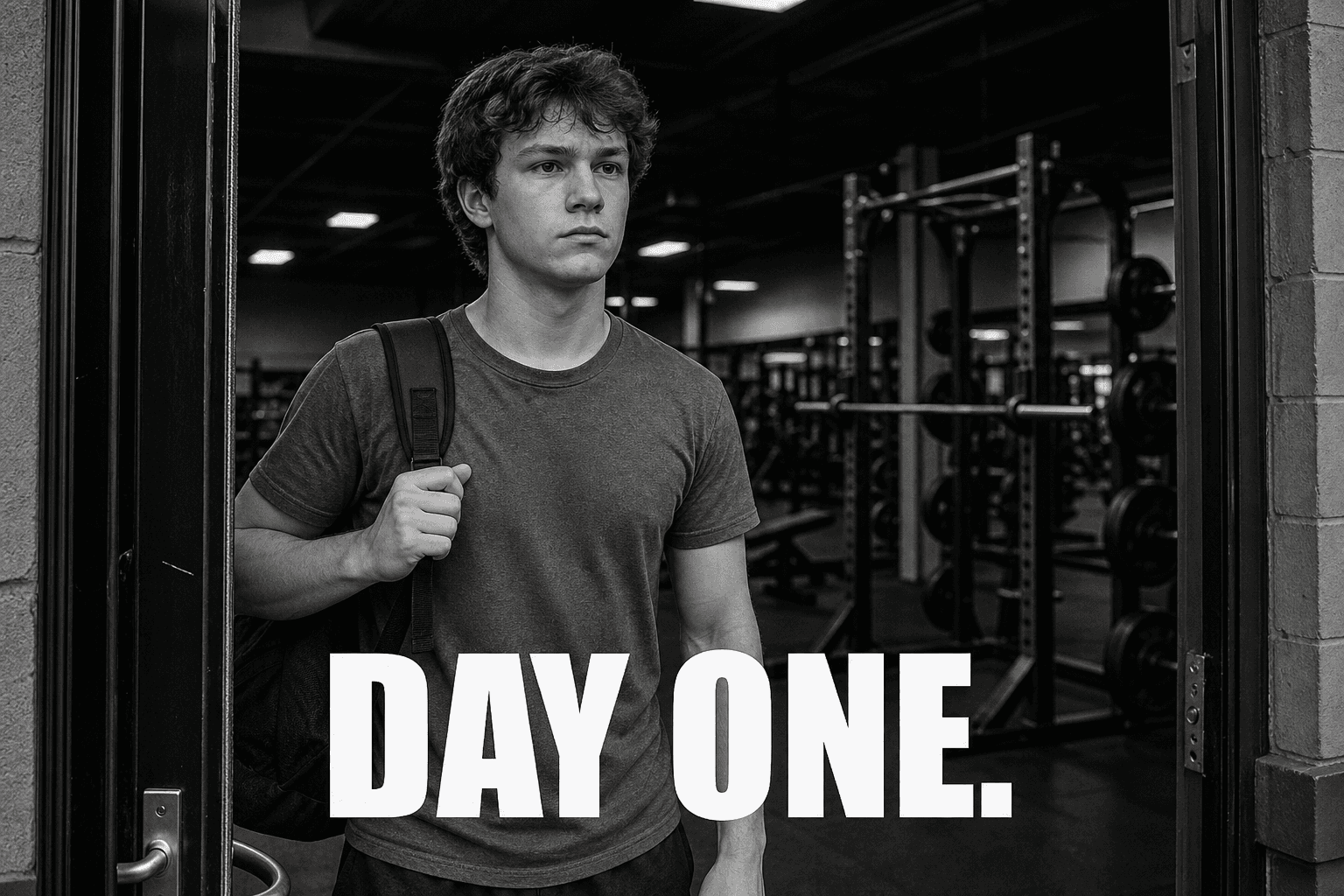
Most beginners quit before week 2 — and it's not because they're lazy
Going to the gym for the first time doesn't usually fail because someone lacks motivation. It fails because nobody tells them what to actually do when they walk in.
They load too much weight. They skip rest. They do eight different exercises and feel destroyed for four days. Then they decide the gym "isn't for them."
None of that is inevitable. Walk in knowing these six things and you will come back.
The first session isn't about training hard. It's about training so you can come back tomorrow.
Mistake 1: Walking in without a plan
Wandering around the gym floor and picking machines that are free is not a workout. It's anxiety with barbells nearby.
A plan doesn't have to be complicated. On day one, pick 3–4 movements that cover your whole body: a squat pattern (goblet squat or leg press), a push (dumbbell chest press or machine press), a pull (lat pulldown or cable row), and a carry or core drill. That's a full session.
Decide the exercises before you walk in. Write them on your phone. When you're new and the gym is loud and people are watching (they're not, but it feels that way), a list is the difference between a productive session and a wasted one.
Mistake 2: Starting too heavy
This is the most universal beginner mistake there is. You will always be able to lift more than you should lift on day one.
Here's why this matters: your muscles will adapt to a new stimulus faster than your tendons, ligaments, and connective tissue do. Muscles feel fine two days later. The joint aches for a week.
Start at a weight where the last rep of your set feels like a 5 or 6 out of 10 effort — not a grind, not a struggle. Embarrassingly light if you have to. You will add weight next session. That's the whole point of progressive overload training.
The beginner's job isn't to lift heavy. It's to learn what the movement feels like under load.
Mistake 3: Doing too many exercises
More is not better when you're starting out. More is just more soreness.
Your body is not used to resistance training at all. Every movement is a new signal. Three to four exercises, 2–3 sets each, is genuinely enough for a first session — and for the first several weeks.
Exercise science is clear on this: total sets per muscle group per week is what drives growth, and beginners respond to very low volumes that would barely touch a trained lifter. You don't need eight exercises. You need consistency across weeks. See how many sets per muscle group per week for the numbers once you're past the first month.
Leaving the gym feeling like you could have done more is the right feeling on day one.
Mistake 4: Skipping rest between sets
Beginners often treat rest as laziness. They superset everything, bounce between machines, keep the heart rate up. It feels productive.
It isn't. Rest between sets exists so your muscles can produce enough force on the next set to actually create an adaptation — a change in the muscle. If you shortcut rest, the next set is weaker, the stimulus is weaker, and the session is less effective.
For strength and muscle, 90 seconds to 3 minutes between sets is the right range. On your first day, 2 minutes is fine. Sit down. Breathe. Check your notes for the next set. That's not wasted time — that's the session working.
For a deeper look at why rest duration matters, see how long should you rest between sets.
Rest between sets isn't laziness. It's how the next set gets hard enough to matter.
Mistake 5: Ignoring the warm-up
You do not walk in cold and go straight to your working weight. That's how you strain something on a movement your body has never done under load before.
A warm-up for a beginner doesn't need to be complicated. 5 minutes of light cardio (walking, cycling) to raise your core temperature, then one or two lighter sets of your first exercise before your working sets. That's it.
If you're doing a goblet squat with 20 kg, do a set of 8 with 8 kg first. If you're doing a dumbbell press with 12 kg, do a set with 6 kg. The lighter set teaches your nervous system — the communication network between your brain and muscles — what's coming. It also tells you if something feels off before you're under real load.
For a full breakdown of what an effective warm-up looks like, how to warm up before lifting covers the evidence.
Mistake 6: Expecting soreness to mean it worked
You will be sore after your first session. Possibly very sore. Your legs might ache going down stairs. This is called DOMS — delayed onset muscle soreness — and it peaks 24–48 hours after a new training stimulus.
Soreness is not a measure of how effective a session was. It's a measure of how unfamiliar the movement was. As you get more experienced, the same training stimulus produces far less soreness — not because you're training worse, but because your body has adapted.
Don't chase soreness. Don't judge sessions by how wrecked you feel the next day. Judge them by whether you added a rep or a small amount of weight compared to last time. That's the real signal. See does soreness mean muscle growth for why this matters.
Also: if you're very sore, you can still train. Just train a different muscle group, or keep the load light.
What your first session should actually look like
Here's a simple template. It takes 35–45 minutes and covers your whole body.
Warm-up (5 min): brisk walk or light cycle.
Movement 1 — Squat pattern: goblet squat (a squat where you hold a single dumbbell or kettlebell at your chest, which keeps your torso upright and your knees tracking forward). 3 sets × 10 reps. Light weight. Focus on sitting your hips back and down, chest up. See goblet squat benefits for why this is the best first squat for most people.
Movement 2 — Push: Dumbbell chest press on a flat bench, or a chest press machine. 3 sets × 10 reps.
Movement 3 — Pull: lat pulldown (a cable machine where you pull a bar down to your upper chest). 3 sets × 10 reps.
Movement 4 — Core: Dead bug or plank. 2–3 sets × 20–30 seconds.
Rest 90–120 seconds between sets. Log the weight you used. Next session, add one small increment — 2.5 kg on a barbell movement, or the next dumbbell up. That's progressive overload — adding a slightly harder challenge each session so the body keeps adapting — and it's the only thing that guarantees long-term progress.
Log your protein target for the day using protein calculator — for most beginners, 1.6–2.2 g per kg of bodyweight is the evidence-based target to support the muscle-building process.
How Planfit applies this
Planfit handles the decisions that make day one overwhelming. It picks your exercises based on your training level and goal, sets the working weight and rep range for each set, and runs your rest timer so you're not staring at your phone wondering when to go again.
Every set you log gets tracked. The next session, Planfit nudges the load up when you're ready — so the progressive overload that drives muscle growth happens automatically, not accidentally.
You just show up. The programme is already waiting.