How Many Sets for Chest? 10–20 Per Week, Per 157 Studies
4 studies · Sports Med meta-analysis 2026
6 min read
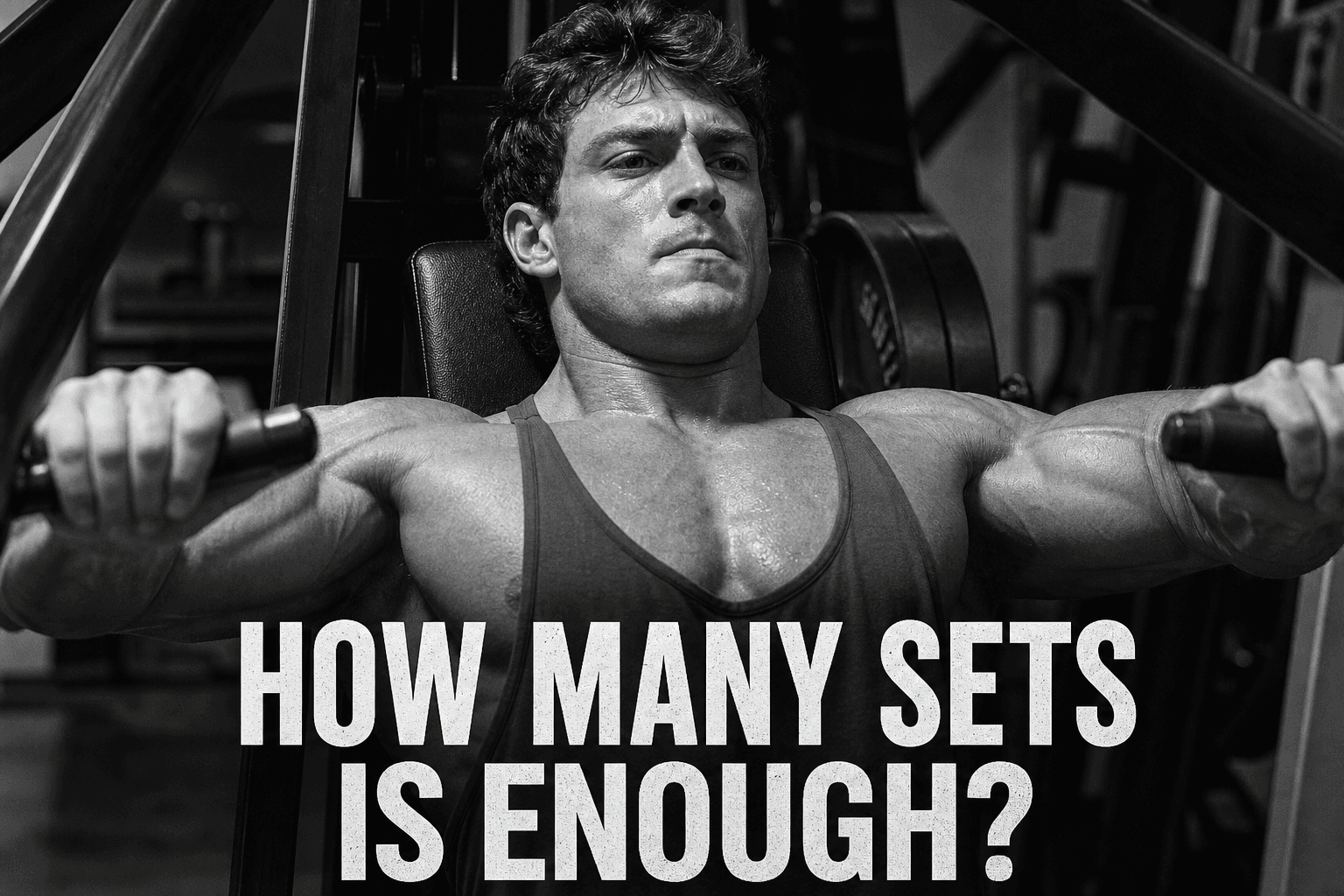
The dose-response answer: more sets do more — up to a point
More chest sets equals more strength and size. That part is simple.
But it's not a straight line. A 2026 meta-analysis — a review that pooled 157 randomised controlled trials (RCTs — people split into groups and compared) — found a clear dose-response for chest strength, but also found that gains plateau once volume climbs past a certain threshold (Lyristakis et al., 2026). Push past it and you're adding fatigue, not muscle.
So the real question isn't just "how many sets" — it's "where does the plateau sit for me?" Let's work through that.
More sets build more chest — but the gains plateau. Piling on volume past that threshold adds fatigue, not muscle.
— Lyristakis et al. (2026). The Influence of Individual Resistance Training Variables on Muscle Strength. Sports Med.
How many sets of chest per week? The working range is 10–20
For most people training for size and strength, 10–20 hard sets of chest per week covers the productive dose-response window identified in the research (Lyristakis et al., 2026).
Below 10 sets, you're leaving gains on the table. Above 20, you're deep into diminishing returns — and likely accumulating joint stress in your shoulders and elbows faster than you're accumulating muscle.
Here's a practical way to think about it:
- Beginner (under 6 months): 10–12 sets/week. Your nervous system is still learning the movement — more volume isn't the limiter yet.
- Intermediate (6 months–2 years): 12–16 sets/week. You're strong enough that mechanical tension — the stretch-and-load the muscle feels — is now the main driver.
- Advanced (2+ years): 16–20 sets/week in a growth phase. You need more total work to keep the stimulus fresh.
If you want to see how your current weekly chest volume stacks up, check out how many sets per muscle group per week for the full breakdown across every muscle group.
How many sets per session? 3–5 working sets is the sweet spot
Weekly volume matters, but so does how you spread it across sessions.
3–5 hard sets of chest per session is the practical ceiling for most people. Simão et al. (2022) had 33 trained men perform 3 sets of chest press at 75% of their one-rep max (1RM — the heaviest weight you can lift once) three times a week. After 8 weeks, both groups — regardless of rest period length — made meaningful strength gains of around 6–7%.
That's 9 working sets per week spread across three sessions. Enough to drive real progress without burning out the muscle or the joint.
The lesson: spreading your weekly volume across 2–3 sessions beats cramming it all into one day. Hit chest on Monday, Wednesday, and Friday with 3–5 sets each, rather than doing 15 sets on Monday and resting it the rest of the week.
3 sets of chest press, three times a week, drove 6–7% strength gains in 8 weeks.
— Simão et al. (2022). Acute and Long-Term Comparison of Fixed vs. Self-Selected Rest Interval Between Sets. J Strength Cond Res.
Does load matter more than sets?
Yes — but they work together. Sets without sufficient load is just cardio for your pecs.
Cavalcante et al. (2023) ran 101 older women through a 12-week chest-press programme (3 sets, 3 days/week) at two different loads: 8–12RM and 10–15RM. Those training at the heavier load (8–12RM) gained 23.2% more chest press strength vs 10.7% in the lighter group (P < 0.01).
Same number of sets. Very different result. The intensity — how heavy the weight is relative to your max — changed everything for strength.
For hypertrophy (building size), the rep range matters less, as long as you're taking sets close to failure — that is, stopping 1–3 reps before you genuinely couldn't do another. But for strength specifically, heavier loading (6–10 reps per set) wins.
See how many reps for muscle growth for the full rep-range breakdown.
Can you build chest with fewer sets if you go heavy enough?
This one's genuinely surprising.
Mattocks et al. (2017) took 38 untrained people and split them into two groups. One group did 4 sets of chest press to failure (roughly 8–12 reps) every session — full hypertrophy training. The other group just performed the 1RM strength test each visit: no extra volume, just lifting as heavy as possible once.
After 8 weeks, upper-body strength gains were virtually identical between groups (difference: −1.1 kg, 95% CI [−4.8, 2.6] kg — not statistically significant). The high-volume group grew more muscle — no surprise there — but the strength gains were nearly the same.
What does this tell you? For untrained lifters, the neural adaptation — your brain getting better at recruiting muscle fibres — is so powerful early on that even a tiny amount of high-effort practice drives strength. Sets matter more once you've already adapted. If you're a beginner, 2–3 sets of heavy chest work per session will do plenty.
For beginners heading into the gym for the first time, going to the gym for the first time has the full starter framework.
For untrained lifters, upper-body strength gains were the same whether they did 4 full sets or just one max attempt per session.
— Mattocks et al. (2017). Practicing the Test Produces Strength Equivalent to Higher Volume Training. Med Sci Sports Exerc.
What about constant vs. pyramid loading — does the set structure change the count?
Ribeiro et al. (2018) compared two common ways to run 3 sets of chest press in older women:
- Constant load — same weight all 3 sets, 8–12 reps each
- Pyramid — starting lighter and adding weight each set: 12 reps / 10 reps / 8 reps
After 8 weeks, chest press strength improved in both groups — CT (constant): pre 122.8 kg → post 128.9 kg (ES = 0.28); Pyramid: pre 120.5 kg → post 125.8 kg (ES = 0.24). No meaningful difference between structures.
Bottom line: the way you structure your 3–5 sets matters less than actually doing them consistently and progressively. Pick whichever approach keeps you getting stronger from session to session. That's progressive overload — adding a little more weight or doing one more rep over time — and it's the only variable that guarantees growth long term. See progressive overload training for how to apply it.
How to programme your chest sets in practice
Here's a simple framework based on the research:
If you train chest 2× per week:
- 5–8 sets per session → 10–16 sets/week total
- Distribute across a flat press, an incline press, and one isolation move (like a cable fly or dumbbell fly)
If you train chest 3× per week:
- 4–5 sets per session → 12–15 sets/week total
- Rotate movements: heavy barbell bench press one day, dumbbell work the next, cables or machine last
Rest between sets: Simão et al. (2022) showed that both 75-second fixed rest and self-selected rest drove similar strength gains over 8 weeks — but the self-selected group did more total reps per session. If hypertrophy is your goal, resting until you feel ready (usually 2–3 minutes for compound chest work) beats watching a timer strictly. For a deeper look at rest periods, see how long should you rest between sets.
Intensity check: Every set should be taken within 1–3 reps of failure. If you finish your last rep of set 3 and feel like you had 6 more in the tank, the weight is too light.
How Planfit applies this
Planfit programmes your chest work based on your training level and goal — picking exercises, recommending your working weight and rep range, and tracking your weekly volume per muscle group. When you've hit the productive dose for the week, the data is right there. When your current load stops challenging you, the app nudges it up. That's the dose-response principle from the 157-study meta-analysis, applied automatically every session.
References
- Lyristakis PM et al. (2026). The Influence of Individual Resistance Training Variables on Muscle Strength: A Systematic Review and Meta-analysis.. Sports Med. 10.1007/s40279-026-02432-5
- Simão R et al. (2022). Acute and Long-Term Comparison of Fixed vs. Self-Selected Rest Interval Between Sets on Upper-Body Strength.. J Strength Cond Res. 10.1519/JSC.0000000000003606
- Cavalcante EF et al. (2023). Resistance Training for Older Women: Do Adaptive Responses Support the ACSM and NSCA Position Stands?. Med Sci Sports Exerc. 10.1249/MSS.0000000000003179
- Mattocks KT et al. (2017). Practicing the Test Produces Strength Equivalent to Higher Volume Training.. Med Sci Sports Exerc. 10.1249/MSS.0000000000001300
- Ribeiro AS et al. (2018). Effects of Different Resistance Training Systems on Muscular Strength and Hypertrophy in Resistance-Trained Older Women.. J Strength Cond Res. 10.1519/JSC.0000000000002326