How to Build Upper Chest: 3 Exercises and a Weekly Plan
By Planfit Editorial Team · 6 min read
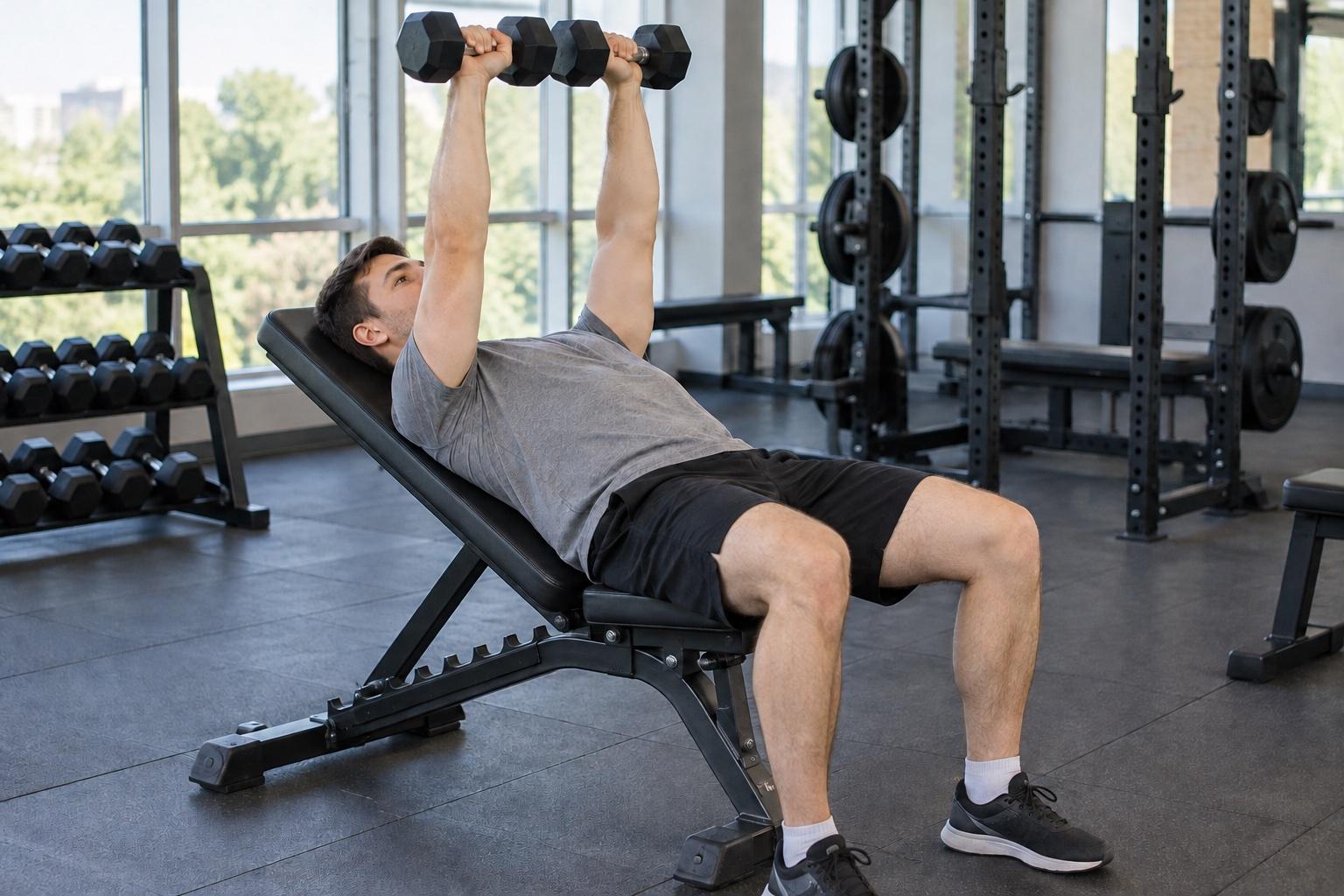
Press on an inclined bench to grow your upper chest
If you bench press regularly but your upper chest still looks flat, it may be because the bench press alone doesn't give that area enough work. Here's how to build it with equipment every gym has: the exercises, the bench angle, and a weekly routine.
Your upper chest is the part of your chest right under your collarbones. It gets more work when you press up at an angle.
A flat Bench Press puts most of the work on the middle and lower chest. Raise the backrest and the upper chest takes a bigger share. In a study where 30 adults with lifting experience bench pressed at five angles (0°, 15°, 30°, 45°, and 60°), the upper chest worked hardest at 30°. Past 45°, the front of the shoulder did more of the work than the chest (Rodríguez-Ridao et al., 2020).
So swap one of your chest exercises for an incline press, and do it first on chest day.
3 upper chest exercises for beginners
These are ordered from easiest to learn. Start with the machine, then mix in the others once the movement feels natural.
- Incline Chest Press Machine: the easiest place to start
- Incline Dumbbell Bench Press: once the machine movement feels familiar
- Incline Smith Machine Bench Press: when you want to go heavier
1. Incline Chest Press Machine
The handles move on a fixed path, so you don't have to balance anything. You can focus on your chest.
- Adjust the seat so the handles line up just below your collarbones.
- Sit with your back against the pad and your feet flat on the floor.
- Pull your shoulders back to press your shoulder blades firmly into the pad, then move your shoulders down away from your ears. Your chest should lift slightly.
- Push the handles up and forward. Stop when your arms are almost straight, without locking your elbows.
- Count "one, two" as you slowly lower the handles back to the front of your chest.
For your starting weight, pick a pin you can lift 12 times but not 15.
2. Incline Dumbbell Bench Press
Try this once the movement feels familiar on the machine. Dumbbells don't move on a fixed path, so you have to keep your arms steady yourself.
- Set the backrest to 30°. On most benches, that's about two notches up from flat.
- Sit on the seat with your hips against the backrest and the dumbbells standing on your thighs.
- As you lean back, use your knees to push the dumbbells up, one at a time, to beside your shoulders.
- Pull your shoulders back to press your shoulder blades firmly into the bench, then move your shoulders down away from your ears. Your chest should lift slightly.
- Holding that position, press the dumbbells up over your upper chest until they almost touch.
- Count "one, two" as you lower them until your hands are beside your upper chest.
Start with 10–15 lb dumbbells in each hand.
3. Incline Smith Machine Bench Press
The bar only moves along its rails, so you can lift more than with dumbbells without worrying about balance.
- Put an incline bench inside the Smith machine. Slide it until the bar would touch just below your collarbones when lowered.
- Set the safety stoppers a little lower than your collarbones. If you can't press the bar back up, you can set it down on them.
- Grip the bar about a hand's width wider than your shoulders.
- Pull your shoulders back to press your shoulder blades firmly into the bench, then move your shoulders down away from your ears. Push the bar up slightly and turn your wrists outward to unhook it.
- Lower the bar slowly to just below your collarbones, then press until your arms are almost straight.
- When you're done, turn your wrists the other way to hook the bar back on.
What bench angle hits the upper chest?
30° works best, and up to 45° is fine. Below 30°, it's close to a flat bench. Above 45°, the front of your shoulders does more of the work than your chest.
Upper chest routine: start chest day with an incline press
This routine is for training chest twice a week (Day A and Day B). Each day has two chest exercises done one after the other, starting with an incline press. The table only lists chest work, so keep doing the rest of that day's workout as usual. Rest 90 seconds to 2 minutes between sets.
That's 5 chest sets a day and 10 a week. The second exercise is only 2 sets, so you can put more effort into the first. For how many weekly sets beginners need, see how many sets for chest.
Add weight by one rule: once you get 12 reps on every set with the same weight, go up one step next time (usually 5 lb on dumbbells, or one pin on a machine). If your reps climb at the same weight, or your weight climbs at the same reps over a few weeks, you're on track.
Upper chest not growing? Check these first
The front of your shoulders is sore the next day before your chest is
The backrest may be too steep, or you're lowering the dumbbells toward your neck. Drop the bench to 30° and lower the dumbbells only to just below your collarbones. Before each set, check that your shoulder blades are pressed into the bench.
You've been stuck at the same weight and reps for 3 sessions in a row
Add reps before you add weight. One more rep per set is enough. If you're still stuck after 3 more sessions, drop the weight one step, work back up to 12 reps, and climb again.
You only do incline work at the end of chest day
After a full set of bench presses, your chest and arms are already tired, so you can't lift your usual weight on the incline. Swap the order and do it first.
If you don't feel your chest at all while pressing, start with why you can't feel your chest when benching.
FAQ
Is the upper chest hard to build?
It isn't uniquely stubborn. Most people train mostly with a flat bench or leave incline work for last, so it looks slower. Move incline work to the start of your workout and check whether your weight and reps climb over 8–12 weeks.
How can I build my upper chest at home?
Try the Decline Push Up with your feet on a chair or bed. With your head lower than your feet, the push-up turns into an upward-angled press. If you can't do 10 regular push-ups yet, practice those first.
How do I train my upper chest without an incline bench?
Two moves don't need a bench: the Incline Chest Press Machine and the Decline Push Up. Start with the machine if your gym has one.
Start with a workout plan that fits you
Tell Planfit your goal, experience, and how many days a week you can train, and it recommends a workout plan to start from. Once you start, it recommends your next weight and reps from your workout log.
References
- Rodríguez-Ridao D, Antequera-Vique JA, Martín-Fuentes I, Muyor JM (2020). Effect of Five Bench Inclinations on the Electromyographic Activity of the Pectoralis Major, Anterior Deltoid, and Triceps Brachii during the Bench Press Exercise.. Int J Environ Res Public Health. 10.3390/ijerph17197339