Can You Build Muscle at Home Without Weights?
By Planfit Editorial Team · 4 min read
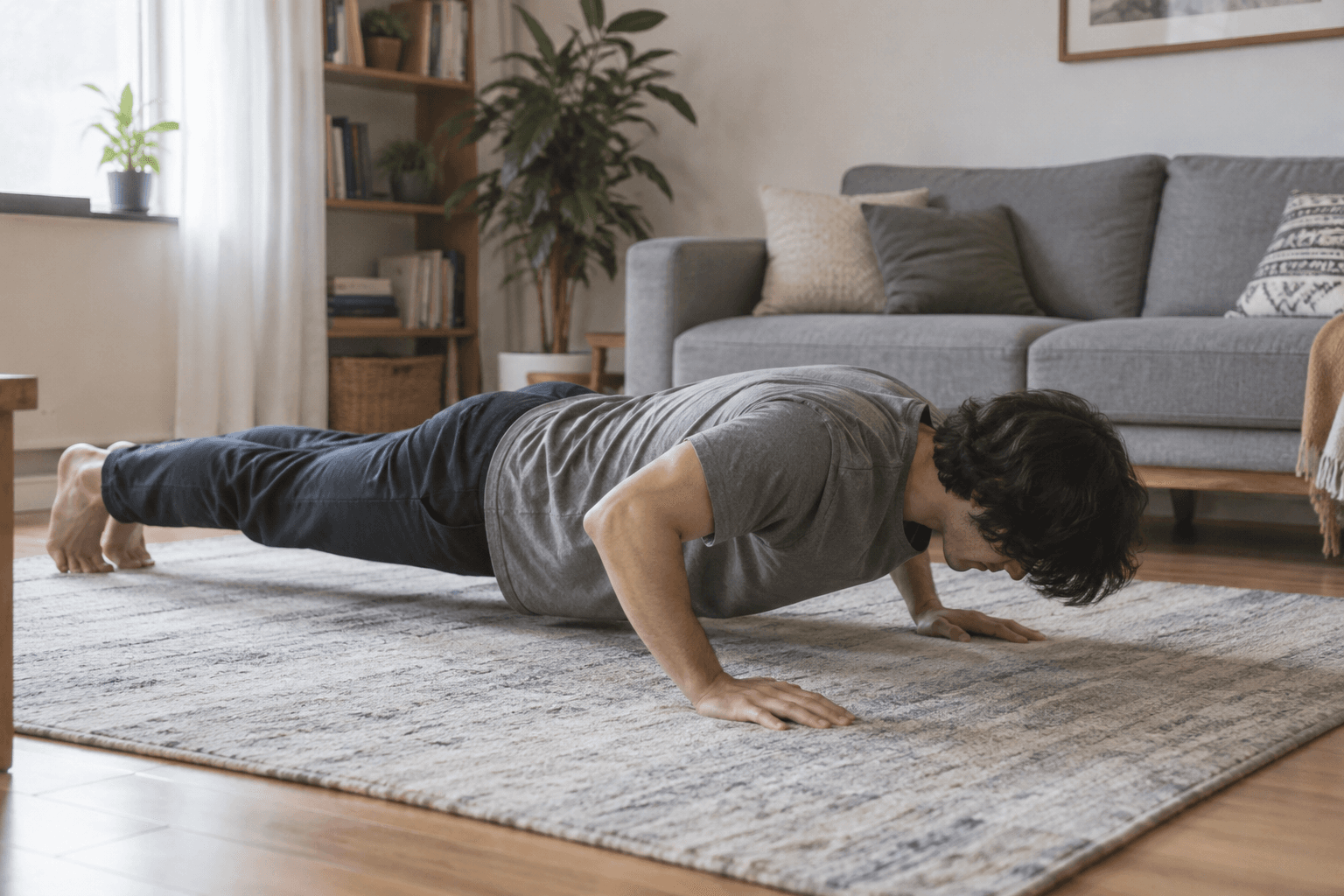
1. Can you build muscle without weights?
Yes, you can build muscle at home without weights. In 2026 the American College of Sports Medicine (ACSM) updated its strength training guidelines after pooling 137 research reviews, and it reached the same conclusion.
What builds muscle is how hard the work is, not how heavy the weight is. In the ACSM review, training with light weights built about as much muscle as training with heavy ones (Currier et al., 2026). Bodyweight training uses your own body as the weight, so if you make it hard enough, it builds muscle too.
2. Are push-ups as good as bench press?
In a study comparing push-ups with bench press at the same load, with every set taken until no more reps were possible, push-ups built chest and triceps muscle about as much as bench pressing (Kikuchi & Nakazato, 2017).
So you don't need a gym to build your chest and arms with push-ups. The catch is switching to harder versions as you get stronger. Start with incline push-ups, hands on a table. Once you can do more than 30 in a row, move to knee push-ups (knees on the floor), then regular push-ups, and finally decline push-ups with your feet on a chair.
3. How many reps should you do to build muscle at home?
Light loads only work when the set is hard. In the push-up study above, every set went until no more reps were possible (Kikuchi & Nakazato, 2017). You don't need to go that far on every set, though: taking every set to failure didn't add more muscle (Currier et al., 2026).
Here's how to set your reps at the start:
- For each exercise, count how many reps you can do before your form breaks. For push-ups, that's right before your hips sag or your butt rises; for squats, right before your knees cave in or your heels lift.
- In your workouts, do 2–3 fewer than that number. If you did 12 push-ups, do sets of 9–10.
- Once you can do more than 30 in a row, move one step harder in the table below. If you don't have dumbbells, add a set once your split squats pass 30; for the plank, add a set once you can hold it for more than 40 seconds.
4. What to do when bodyweight gets too easy
Your body gets used to the same exercise. To keep building muscle, you need to make it a little harder over time (Currier et al., 2026).
In the table, each row runs from easier to harder. Do incline push-ups with your hands on a table and decline push-ups with your feet on a chair. Do hip thrusts with your upper back on a couch. The dumbbell Bulgarian split squat is only for when you have dumbbells, and chin-ups and pull-ups need a doorway pull-up bar.
5. How often should you work out at home?
For muscle size, training once a week and five or more times a week worked about the same when the weekly number of sets was equal (Currier et al., 2026). To build muscle, the ACSM recommends 10 or more sets per muscle per week (Currier et al., 2026). Doing all of those sets in one day makes the workout too long, so at home, split them into full-body workouts 2–3 times a week.
Do the routine below 3 times a week with a rest day in between, such as Monday, Wednesday, and Friday, and you get 12 sets for your chest and 18 for your legs each week. Rest 1–2 minutes between sets, until your breathing settles.
Frequently asked questions
How long until home workouts show results?
Muscle doesn't grow in a few weeks. In a 4-week push-up study, muscle size hadn't changed yet (Kotarsky et al., 2018), while in an 8-week study it had grown (Kikuchi & Nakazato, 2017). Give it about two months of steady training before judging muscle gains.
Do resistance bands build muscle?
Yes. People who trained with bands gained muscle compared with people who didn't train (Currier et al., 2026).
How much protein do you need per day to build muscle?
About 0.7 g per pound of body weight (1.6 g per kg) a day is enough. In people doing strength training, eating more protein than that didn't add more muscle (Morton et al., 2018). If you weigh 150 lb, that's about 110 g a day. Include a protein food such as meat, fish, eggs, or tofu at every meal.
Start with a plan for training at home
Tell Planfit your goal, your training experience, and how many days a week you can work out, and it builds a plan for your level. If you have no equipment at home, it fills the plan with bodyweight exercises only.
References
- Currier BS, D'Souza AC, Singh MAF, et al. (2026). American College of Sports Medicine Position Stand. Resistance Training Prescription for Muscle Function, Hypertrophy, and Physical Performance in Healthy Adults: An Overview of Reviews.. Med Sci Sports Exerc. 10.1249/MSS.0000000000003897
- Kikuchi N, Nakazato K. (2017). Low-load bench press and push-up induce similar muscle hypertrophy and strength gain.. J Exerc Sci Fit
- Kotarsky CJ, Christensen BK, Miller JS, Hackney KJ. (2018). Effect of progressive calisthenic push-up training on muscle strength and thickness.. J Strength Cond Res
- Morton RW, Murphy KT, McKellar SR, et al. (2018). A systematic review, meta-analysis and meta-regression of the effect of protein supplementation on resistance training-induced gains in muscle mass and strength in healthy adults.. Br J Sports Med. 10.1136/bjsports-2017-097608