What Is a Split in the Gym? 4 Workout Splits Explained
Written by Hoseong Kim · 6 min read
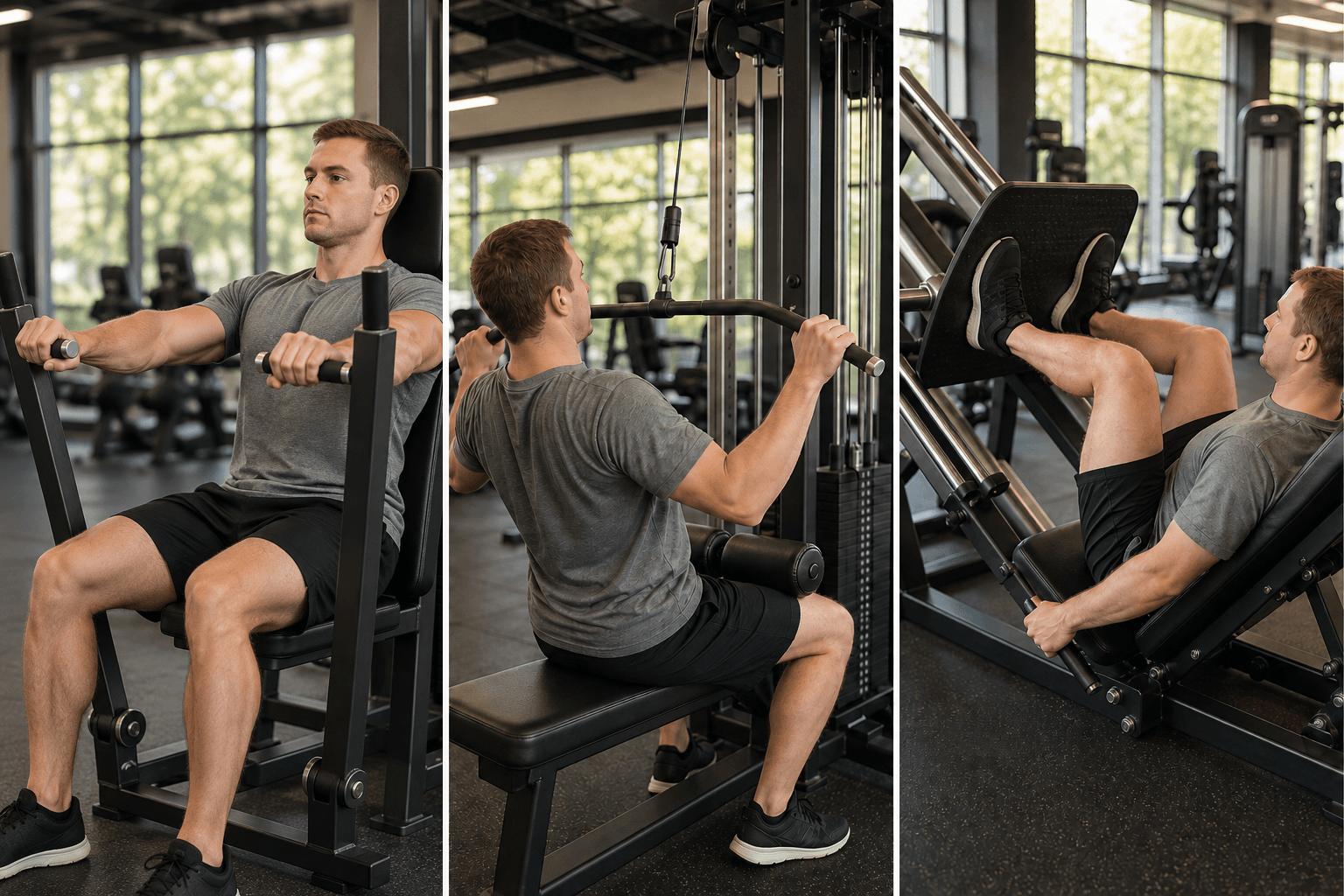
What is a split in the gym?
A split is the way you divide your body across your gym days. Instead of training every muscle every session, you give each day a job: chest and shoulders one day, back the next, legs after that.
The opposite is full body training, where every session works your whole body. This article covers full body as one of the splits too.
For example, if you do upper body on Monday and lower body on Thursday, that is an upper/lower split. If you train Monday, Wednesday, and Friday and do your whole body each time, that is a full body split.
A split tells you 2 things ahead of time:
- What you train each day. You walk into the gym already knowing the plan.
- How often each muscle gets trained. In a full body split, your legs get trained every session. In a split where legs have their own day, they get trained once or twice a week.
When you choose a split, that second point matters most. A muscle that gets trained 2 or more times a week gets more chances to practice the movements and add weight, which is why most beginner programs train each muscle at least twice a week.
The 4 most common gym splits
Almost every program you will find is one of these 4. Some combine two, like 4 upper/lower days plus 1 full body day in a 5-day week.
- Full body (2-3 days): best if you are just starting. You train your whole body every session, so a missed day never leaves a muscle untrained for the week, and you practice each movement several times a week.
- Upper/lower (4 days): for people who can train 4 days a week. Each day focuses on only upper or lower body, and each muscle still gets trained twice a week.
- Push/pull/legs (3 or 6 days): for people who can train almost every day. Each day focuses on one group of muscles, and on 6 days each muscle gets trained twice a week. On 3 days each muscle gets trained only once, so with 3 days a week, full body is the better choice.
- Bro split (5 days): for experienced lifters who know which muscles they want to grow. You can focus on one muscle for a whole session. But you practice each movement only once a week, and a missed day means 2 weeks without training that muscle, so beginners do better starting with full body or upper/lower.
What a week of each split looks like
Here is what a week looks like with each split. Full body, upper/lower, and 3-day push/pull/legs have rest days between training days. Push/pull/legs (6 days) and the bro split leave only 1 or 2 rest days a week.
Full body: train everything, 2-3 days a week
Every session has two leg exercises, one for pushing (chest or shoulders), and one for pulling (back), plus 1-2 arm or shoulder exercises if you have time. The table below is a sample day.
Full body is the easiest split to stick with. If you miss Monday, you train Tuesday and nothing is skipped, because every session covers everything. That is why it is the usual starting point.
Upper/lower: 4 days, upper body and lower body take turns
Upper days train chest, back, shoulders, and arms. Lower days train the front and back of your legs, your glutes, and your calves. Over 4 days, each half of your body gets 2 sessions.
Each session covers only half your body, so you can focus on the muscles you train that day. The catch: if you miss an upper day, your upper body only gets trained once that week unless you shift the order.
The table below shows a sample upper day and lower day.
Push/pull/legs: sorted by the direction you move
Push/pull/legs, often shortened to PPL, groups muscles by the movement they do.
- Push day: chest, shoulders, and the back of your upper arms.
- Pull day: back and the front of your upper arms.
- Leg day: all of your legs.
Run it once through in 3 days and each muscle gets trained once a week. Run it twice in 6 days and each muscle gets trained twice. The 6-day version is the one most programs mean, so PPL fits people who can train almost every day. For a 5-day variation, see push pull legs 5-day split.
Bro split: one body part per day
A bro split gives each body part its own day: chest Monday, back Tuesday, shoulders Wednesday, legs Thursday, arms Friday. It is the classic bodybuilding magazine split.
A bro split still works. When the weekly work is the same, the split makes little difference to results. Beginners are still better off starting elsewhere, for 3 reasons.
- Less practice. When you are new, the more often you repeat a movement, the faster your form settles and the faster the weights go up. A bro split trains chest once a week.
- A missed day costs more. Miss leg day and your legs go 2 weeks without training. Before the habit sticks, missed days happen often.
- Everything for one muscle in one session. After 4-5 exercises in a row for the same muscle, you are too tired to lift well by the third one, and soreness the next day can be heavy.
So try a bro split once you are comfortable in the gym and know which muscles you want to grow.
Which split for how many days you can train
Start from the number of days you can go to the gym every week, even on a bad week. Then pick the split that fits that number.
How to pick your split
Answer these 3 questions in order.
- How many days can you go every week, even a busy one? Use that number, not the number you hope for, and pick the split for it from the table above. If you are not sure how many days to plan for, see how many days a week you should work out.
- How long is each visit? If your sessions are short but you can train more often, upper/lower or push/pull/legs fits. You train fewer muscles each day, so you can finish in less time. If you have few days and only 30-40 minutes each, pick the split by your days and cut each session to 4 exercises: keep the exercises for big muscles like legs, chest, and back, and drop the ones for small muscles like your arms. That works because big-muscle exercises make the small muscles work too. Your shoulders and triceps help during chest exercises, and your biceps help during back exercises.
- What happens when you miss a day? Look at your last month. If you missed 2 or more planned gym days, choose full body, because a missed session never leaves a muscle untrained for the week.
Whatever split you pick, sticking with it is what matters most. Once you have trained for a few months, compare the intermediate 5-day workout plan and 7-day gym workout plan.
Frequently asked questions
What is the Arnold split?
The Arnold split trains chest and back together, then shoulders and arms, then legs, and repeats the cycle so you train 6 days a week. Each muscle gets trained twice a week, like PPL. Training chest and back on the same day means many exercises, which takes a long time and is tiring, so it suits experienced lifters more than beginners.
What split is best for fat loss?
Any split you can stick with. Fat loss depends more on what you eat than on which split you run. That said, in one 8-week study of 23 experienced men doing the same weekly work, the full body group lost 0.78 kg of fat while the split group gained 0.32 kg. See full body vs split for details.
Build your workout plan without the split guesswork
Planfit recommends a workout plan based on your goal, experience level, and how many days a week you can train, so you can start today.