3-Day Full Body vs 4-Day Upper/Lower: Which Split Is Better?
8 min read
Full body 3 days vs upper/lower 4 days: the short answer
Pick 3-day full body if 3 gym days a week is what you can reliably keep. Pick 4-day upper/lower if you have 4 reliable days and want shorter workouts. At the same weekly volume, both build about the same muscle.
- Both splits build muscle. When the weekly work is the same, the split label matters far less than showing up and adding weight over time.
- Pick by the week you can actually repeat. 3 reliable days → full body. 4 reliable days and you want shorter sessions → upper/lower.
- Full body forgives missed days. Every session trains everything, so a skipped Monday costs you nothing if you train Tuesday instead.
- Upper/lower gives shorter, more focused sessions. About 30-35 minutes instead of 40-45, but missing a day leaves half your body untrained that week unless you shift the order.
- Below are two plans built from the same 15 exercises and the same 45 weekly sets, so you can compare the splits themselves, not two different programs.
What a week of each split looks like
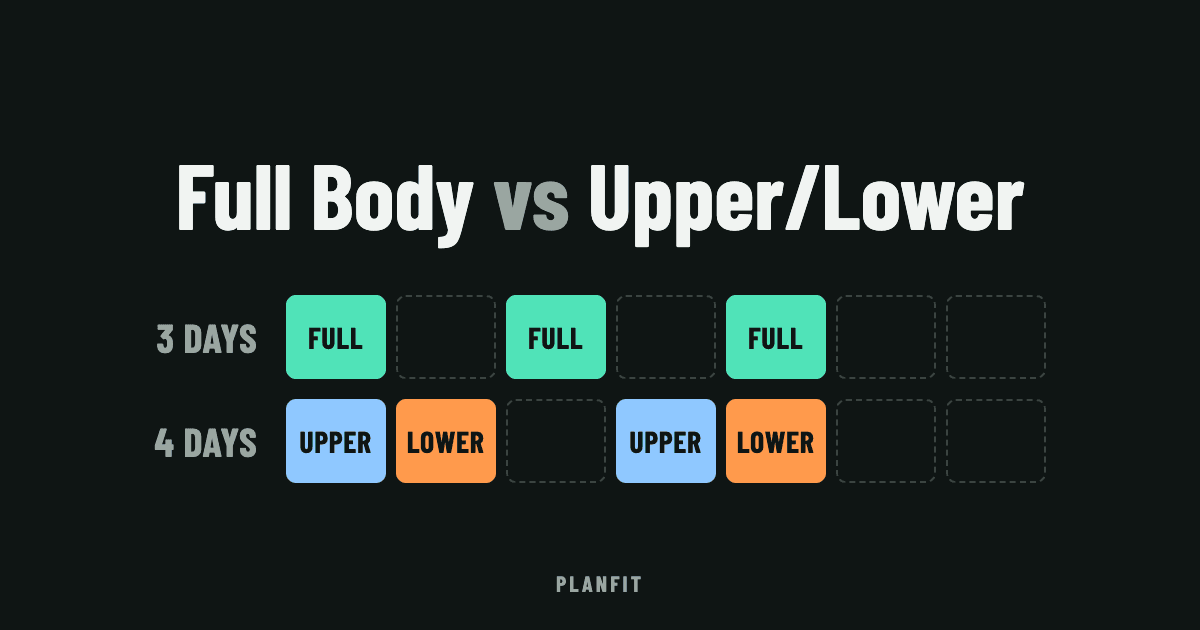
It is easier to decide when you see where the gym days land on a calendar. Here is the same amount of training laid out both ways.
Full body puts a rest day between every session, so you never train the same muscle 2 days in a row. Upper/lower trains 2 days back to back, then rests, which works because Monday's upper muscles are resting while Tuesday's legs work.
Does 3-day full body or 4-day upper/lower build more muscle?
Neither, as long as the weekly work matches. A muscle grows from the total hard sets it gets in a week and from the weight on those sets creeping up. How you slice those sets across days is a scheduling choice. Studies comparing split and full-body training at equal volume land in the same place (full body vs split).
That is why the two plans in this article use the exact same 15 exercises and the same 45 sets per week. The only difference is how they are spread out. Full body hits chest, back, and legs 3 times a week with 3 sets each time. Upper/lower hits them twice a week, so each session can give a muscle more attention.
A common worry with full body is that you cannot reach enough weekly sets per muscle. At a beginner level you do not need to chase big numbers. 6-9 hard sets per muscle per week, done close to failure, is enough to grow while you learn the lifts. You can count your own weekly sets with the weekly volume calculator, and read more on how many sets you need in how many sets per muscle group per week.
The 2 beginner plans, day by day
Both plans use gym machines, cables, and dumbbells that most commercial gyms have. Every exercise is 3 sets of 8-12 reps with 60-90 seconds of rest. Pick a weight you can lift for 8 clean reps. When you can do 12 reps on all 3 sets, add the smallest weight jump your gym has and start back at 8. This is progressive overload, and it is what makes either plan work (progressive overload training).
The first 3 tables are the full body plan. The next 4 are the upper/lower plan. Notice they share every exercise. Only the grouping changes.
Day 1 · Full body
Day 1 starts with the goblet squat while your legs are fresh, then mixes upper and lower body so one area rests while the other works. Holding the dumbbell at your chest keeps your torso upright, which makes it the easiest squat to learn. The stiff-leg deadlift covers your hamstrings, and lateral raises finish the shoulders.
Day 2 · Full body
Day 2 swaps every exercise for a machine or cable version of the same job: leg press for squats, chest press machine for the bench press, seated cable row for the pulldown. Machines let you push close to failure safely on a day when your form is still settling in. Hammer curls are the only direct arm work today.
Day 3 · Full body
Day 3 works your upper chest with an incline dumbbell press and adds the assisted pull-up. For the pull-up, set the assist weight so the last 2 reps of each set are hard, and lower the assist as you get stronger. Leg curls hit the hamstrings from a different angle than Monday's deadlift, and tricep pushdowns close the week.
Day 1 · Upper body
Upper A pairs 2 presses with 2 pulls. The bench press and shoulder press work the front of your body, while the lat pulldown and seated cable row balance it out on the back. With only 4 exercises, you can give the first lift your full effort.
Day 2 · Lower body
Lower A is the heavier leg day: goblet squat, stiff-leg deadlift, and leg press. Hammer curls sit here on purpose. They barely tire your legs, and moving arm work off upper day keeps Upper A from running long. This is a common fix lifters use when upper days feel crowded.
Day 3 · Upper body
Upper B repeats the same jobs with different tools: a chest press machine, an incline dumbbell press, assisted pull-ups, and cable pushdowns. The machine press lets you push hard safely, and the incline dumbbell press hits your upper chest from a different angle. The 2 presses and the pushdowns together give your triceps their main work of the week.
Day 4 · Lower body
Lower B is the shortest day at 9 sets. Lunges train one leg at a time, leg curls cover the hamstrings, and lateral raises are moved here for the same reason as Lower A's hammer curls. If you have extra time, this is the day to add a set to the lunge.
What if your gym doesn't have these machines?
Both plans lean on common gym machines. If yours is missing one, or you train at home with dumbbells, swap in the exercise below. It trains the same muscles, so keep the same sets, reps, and rest. Exercises that already use only dumbbells stay as they are.
If you cannot do 8 push-ups yet, start with incline push-ups, hands on a bench or wall, and lower the incline as you get stronger.
No pull-up bar either? Do dumbbell rows in place of both pull-up and pulldown, and keep the one-arm dumbbell row for the seated cable row.
How long does each workout take?
A set takes about 45 seconds, and you rest 60-90 seconds after it. Add about 10 minutes for warm-up sets and moving between stations.
- Full body: 15 sets → about 40-45 minutes.
- Upper/lower: 12 sets → about 30-35 minutes. Lower B, at 9 sets, takes about 25 minutes.
So the trade is simple. Full body asks for 3 longer visits. Upper/lower asks for 4 shorter ones. Over a week, the total time is almost the same.
If your sessions run well past an hour, the cause is usually long rests or your phone, not the split. Session length on its own does not decide how much muscle you build (how long should your workout be).
Which split is better for beginners?
Full body is the easier start for most people, for 3 reasons.
1. You practice each movement more often. Squatting, pressing, and pulling 3 times a week means you learn the lifts faster.
2. 3 days is easier to keep. Consistency is the hardest part of the first few months, and a 3-day habit survives busy weeks better than a 4-day one (how many days a week should i workout).
3. Soreness is spread out. You do fewer sets for each muscle per session, so the first weeks are less punishing.
That said, "beginners must do full body for a year" is not a rule. If you already have 4 free days a week and you like shorter sessions, upper/lower is a perfectly good first split. A beginner who sticks with upper/lower will beat a beginner who drops out of full body.
Which split is better for strength?
Getting stronger at a lift comes from practicing it often and adding weight when you can. Both plans let you do that.
Full body has the edge in practice: you squat, press, and pull 3 times a week. Upper/lower has the edge in focus: each session trains half your body, so you can put more effort into fewer muscle groups.
For a beginner, this difference is small. Your strength will climb for months on either plan as long as you keep a log and try to beat last week's weight or reps.
What happens when you miss a workout?
This is where the 2 splits differ most in real life.
Full body. Every session trains every muscle, so a missed day just moves. Skip Monday, train Tuesday, Thursday, and Saturday. Busy until Thursday? Training 2 days in a row now and then is fine. What matters is getting 3 sessions in the week.
Upper/lower. Skipping a day means one half of your body loses half its weekly work. Do not skip ahead to keep the calendar. Keep the order instead: Upper A, Lower A, Upper B, Lower B. If you miss Tuesday's Lower A, do it Wednesday and push the rest back. If you only get 3 sessions in that week, pick up where you left off next week.
If your schedule changes every week, full body is the safer choice.
Which is better for you: full body 3x or upper/lower 4x?
Find your situation below. Most people only need the first 2 rows.
So which split should you pick?
If you are not sure, start with the 3-day full body plan. It is easier to keep, it forgives missed days, and it teaches you the lifts faster. Run it for 8-12 weeks and keep a log.
Move to the 4-day upper/lower plan when you have a reliable fourth day or want shorter sessions. Because both plans use the same exercises and the same weekly sets, the switch costs you nothing.
Frequently asked questions
Is 4 days on, 3 days off a good workout schedule?
Yes. The upper/lower week above is exactly that: Monday, Tuesday, Thursday, and Friday on, with Wednesday and the weekend off. Each muscle still gets 2-3 days of rest before it is trained again. If you mean 4 days in a row, that works too: run Upper A, Lower A, Upper B, Lower B from Monday to Thursday. Each half of your body still gets a full day of rest between sessions.
Is it better to do a full body workout 3 or 4 times a week?
For most beginners, 3. You can do 4, but each session then needs fewer sets, or you will not recover between back-to-back days. If you train 4 days, upper/lower is easier to run.
Is 3 days a week really enough to build muscle?
Yes. 3 sessions that each train your whole body give every major muscle 2-3 workouts a week, which is enough to grow as long as you keep adding weight or reps.
Get a routine built around your goal and equipment
The 2 plans above are solid general templates. Planfit generates a routine around your own goal, experience level, and the equipment you have, and adds warm-up sets for you.