Too Weak to Lift Weights? Where Beginners Should Start
6 min read
Too weak to lift weights? The short answer
Being too weak to lift weights is not a reason to wait. Build strength with bodyweight exercises first, then move up to dumbbells and machines. The plan below follows that order.
- Start where you can do about 8 clean reps. That might be a wall push-up, a chair squat, or a 5 lb dumbbell. All of them count.
- Build reps before you add weight. Add reps with the same weight first. When your target reps feel easy, move to a heavier weight or a harder exercise. The section below explains exactly when to add weight.
- Compare yourself only with last week. If your reps or weight went up from last week, you are doing well.
Find your starting point
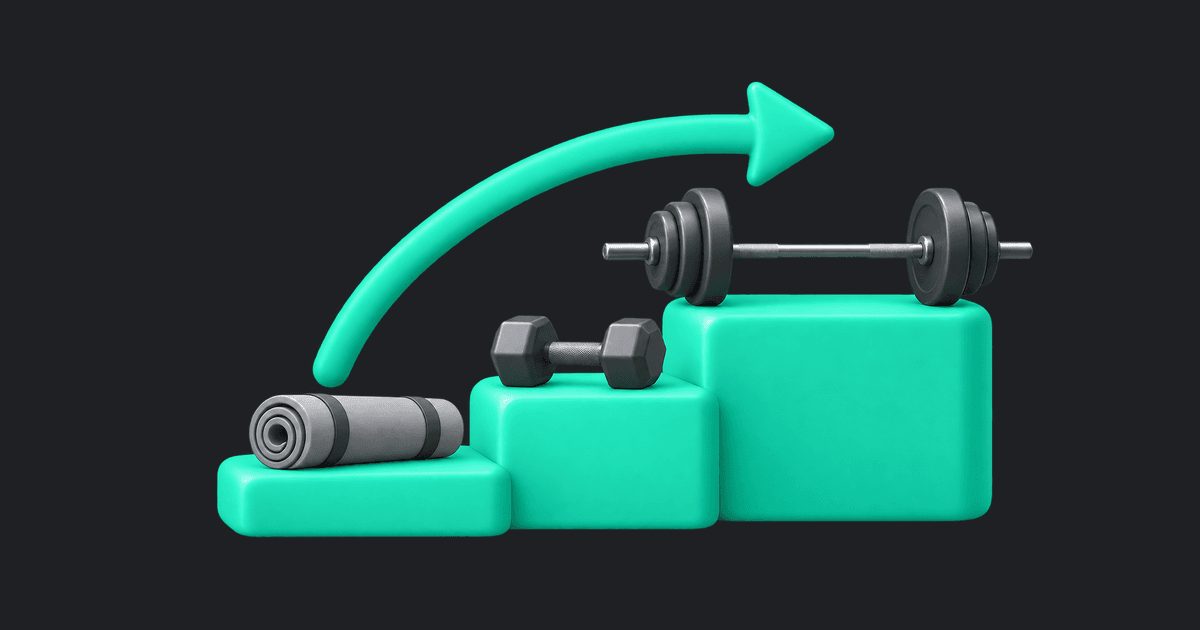
The table splits exercises into 3 stages by what provides the weight.
- Stage 1 · Bodyweight: your own body is the weight. You can start with easy moves that put less of your weight on your muscles, like push-ups against a wall.
- Stage 2 · Dumbbells, kettlebells, machines: you work against a weight you hold or a machine's weight stack instead of your body. You can start with dumbbells as light as 2-5 lb.
- Stage 3 · Barbell: the empty bar alone weighs 45 lb, so you move up after building strength in stage 2.
For each movement, find the stage where you can do about 8 clean reps, and start there. You can start each movement at a different stage. For example, you might start squats at stage 2 and push-ups at stage 1. The exercises in the table are one example per stage.
On machines, start with the pin at the lightest plate. If you can't do 8 reps even at the lightest weight, start that movement with the stage 1 bodyweight version.
When to make it harder
Whatever stage you start at, add reps and weight in this order:
- Pick an exercise or weight you can lift 8-12 times with good form, and set a target of 10 reps.
- Next session, try one more rep in each set with the same weight. If you couldn't add a rep to a set, aim for the same number again next session. A rep only counts if you lower the weight slowly instead of letting it drop.
- When every set goes 1-2 reps past your target in two sessions in a row, add 2-10% to the weight or move to the next stage in the table above. Your reps will drop after you move up. That is normal, so build back up to your target.
Source: American College of Sports Medicine (ACSM)
If you can't do 8 reps even at stage 1, start with as many as you can, build up to 8, and then follow the steps above. Dumbbells only come in fixed weights, so even the next pair up can be a big jump (for example, going from 20 to 25 lb is 25% heavier at once). If it is too heavy, you can use mixed sets, doing only some of your sets with the heavier pair. For how, see How to Progress When You Can't Add Weight on Dumbbells.
A beginner plan from bodyweight to weights
This plan starts with the stage 1 bodyweight exercises in the table above and moves up to the stage 2 dumbbell, kettlebell, and machine exercises. Train 3 days a week with a rest day between sessions, such as Monday, Wednesday, and Friday.
- Start with the bodyweight routine.
- When a movement meets the rule in When to make it harder, switch only that movement to the exercise in the same row of the dumbbell and kettlebell routine. For example, wall push-ups become the dumbbell bench press. Keep doing the bodyweight version of the rest.
It doesn't matter how many weeks it takes before you switch a bodyweight exercise to a dumbbell or kettlebell one. For step-by-step instructions, tap an exercise name under the videos below each routine table to open its exercise guide.
Bodyweight routine
Apart from the inverted row, this routine needs no equipment. For the inverted row, use a bar such as a Smith machine bar or a low pull-up bar. Start with the bar high, around chest height. The higher the bar, the less you lean back, so it's easier. As you get used to it, lower the bar little by little. For the hip bridge, lift your hips and hold for 20-30 seconds. The dead bug trains your core lying on your back, so you can focus on the movement without balancing.
Dumbbell and kettlebell routine
Each movement here is one stage up from the bodyweight routine. Because you hold the dumbbell at your chest in the goblet squat, your torso stays upright, which makes it the easiest squat to learn. The kettlebell deadlift lets you learn the deadlift movement, pushing your hips back, bending forward, and standing up, with less weight than a barbell.
Frequently asked questions
Can light weights build muscle?
Yes. If the last few reps of each set get slow and hard, light weights build muscle about as well as heavy ones. So it's fine to start with bodyweight exercises.
Can I just do bodyweight exercises at home?
Yes, you can build muscle with bodyweight exercises. Your body is the weight, so push-ups and squats are strength exercises too. The bodyweight routine above needs no equipment except for the inverted row, so you can follow it at home. When an exercise gets easy, switch to a version that puts more of your weight on the muscle, such as going from wall push-ups to knee push-ups.
My lower back hurts after I added weight. Did I go up too fast?
Possibly. Go back to the weight you used before it hurt. Once that feels easy again, move up, but by less than last time. If it hurt during a move where you push your hips back and bend forward, like the kettlebell deadlift, check your form in the Kettlebell Deadlift exercise guide. If the pain is sharp or lasts more than a few days, get it checked before you train that movement again. To tell whether the pain needs a doctor, see Lower Back Pain After Deadlifts: Normal or Emergency?
How many times a week should I train?
To build strength, train at least 2 times a week. The plan here uses 3 days, but if you're short on time, 2 days a week works too.
I can't feel the muscle working. Am I doing it wrong?
Not necessarily. Many beginners can't feel a specific muscle working at first. To find that feeling, try these:
- Use a little less weight, and lower it slowly.
- Put your hand on the muscle you're trying to work. You can feel it tighten under your hand.
- If you're not sure your form is right, compare yourself with the videos in the exercise guides.
Even without the feeling, if your reps or weights are going up, your muscles are getting stronger.
Start from your level with Planfit
Planfit generates a routine around your goal, experience level, and equipment, suggests warm-up sets, and recommends the weight and reps for your next workout based on your training log.
References
- Currier BS, D'Souza AC, Singh MAF, et al. (2026). American College of Sports Medicine Position Stand. Resistance Training Prescription for Muscle Function, Hypertrophy, and Physical Performance in Healthy Adults: An Overview of Reviews.. Med Sci Sports Exerc. 10.1249/MSS.0000000000003897